Editor’s Note: This is an excerpt from WBUR’s Saturday morning newsletter, The Weekender. If you like what you read and want it in your inbox, sign up here.
Take a walk through the Upham’s Corner Food Forest, and you’ll notice apples, blueberries, grapes and beach plums growing throughout the park. The fruits ripen as autumn nears, but they aren’t the focus of this morning’s harvest.
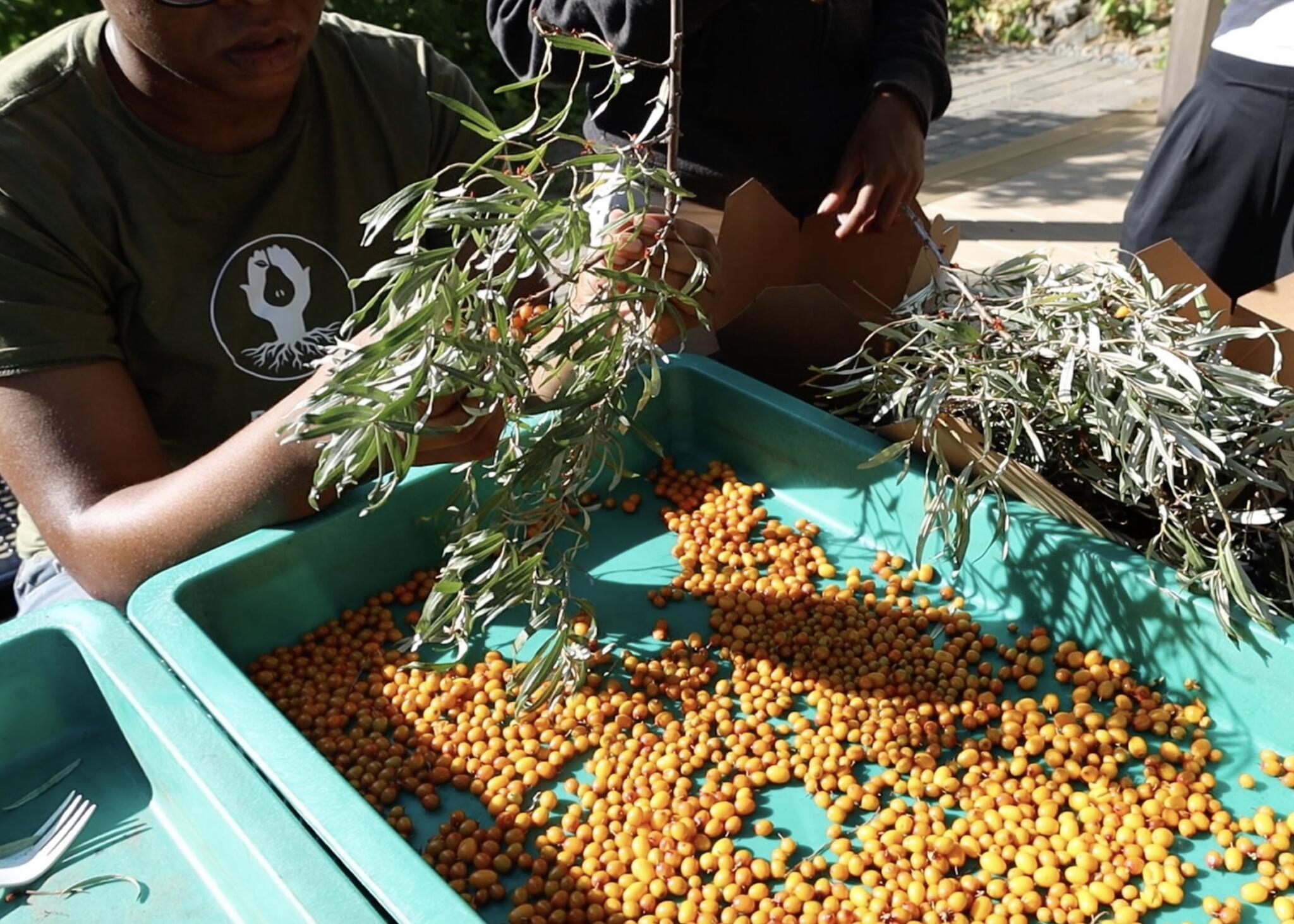
Seaberries — or sea buckthorn berries — are the star of the show today.
If you haven’t heard of seaberries before, you’re not alone. Alex Alvanos, associate director of the Boston Food Forest Coalition, says the fruit is often unfamiliar to locals, even some of those who have been to the food forest before.
“People are like, seaberries? Oh, what is this?” Alvanos said.
That’s where he and his colleagues come in: to show folks that certain plants, even those they’ve never heard of, can be tasty to eat — and a great addition to the urban forest ecosystem.
Seaberries are among those plants. The fruits — which are small and oval-shaped like a grape — come from the sea buckthorn shrub. They’re tart, orange in color and packed with vitamin C. And you’re not likely to find them growing around cities in Massachusetts, said Alice Tilton, senior program manager at the coalition.
Local food forests, however, are an exception.
What’s a food forest, and who gets one?
Massachusetts currently has 13 food forests, with a 14th opening on Radcliffe Street in Dorchester later this fall, according to Tilton. Not to be confused with community gardens, these plots of land focus on replicating a natural ecosystem in the heart of a city, with food-bearing plants, habitats for birds and insects, and places for humans to relax, too.
Field Guide to Boston: Discover — and rediscover — your Boston.
“A lot of neighbors tell me that the food forests are great places of respite for them,” Tilton said. “They are public parks. We have benches. We have gazebos in some of them, places to sit. So they provide that green space for the neighborhood year-round, regardless of whether folks are harvesting.”
The Boston Food Forest Coalition wants 30 food forests across Massachusetts by 2030. But several factors go into selecting an area that might be a good fit for a forest.
Alvanos said the team prioritizes neighborhoods that have less parkland, tree cover and access to fresh food. Then, they “work with neighbors for multiple years, design and build the food forest park of their dreams,” he added.
Collaborating with the local community’s stewardship team — that is, a group of neighbors who have chosen to help see the project through — the Boston Food Forest Coalition helps implement landscape elements like pavilions, benches and shade trees. But what gets planted is up to the people.
“Every food forest project is a project of the neighbors and the neighborhood,” Tilton said.
Native perennials like apples, pears, and berries are mainstays in most Massachusetts food forests, Tilton said, with some variations depending on group desires.
“We do community design meetings before building a food forest where the neighbors will share what plants they want to put in,” Tilton said. “And so that’s where you’ll see some differences between food forests, because one group of neighbors might be enthusiastic about peaches, another might be enthusiastic about cherries.”
Like a community garden, food forests rely on group engagement to bring plants from soil to harvest. Workdays can be monthly or weekly, Tilton said. But chipping in is a key part of the operation.
Seaberries in a harvesting bin. (Courtesy Boston Food Forest Coalition)
Getting your hands dirty
Anyone can volunteer to work at any of the food forests open in Boston. The easiest way to get started is to come to an event, Tilton said.
“I find people will usually find the way they want to plug in,” she said. “They might be really excited about the plants. They might be more excited about the social side of things, engaging with neighbors. But the best way to discover that is to talk to people who are already involved in the site.”
Today’s seaberry harvest is a good example. The collection begins at 10 a.m., and there will be different seaberry preparations to try, plus recipe ideas to take home with your harvest.
“If you don’t like how tart they are when you just eat them off the plant — some people love that flavor, some people don’t — you can make seaberry salsa out of it.” Alvanos said.
Tilton prefers seaberries in a drink. “Like a lemonade with a little bit of sweetener, ideally some seltzer or something kind of fizzy in them. They make a really refreshing beverage,” she said.
The event is free to join and does not require registration. But if you do choose to show up, be sure to bring-your-own gardening gloves. (The plants can get a little prickly.)
“Educating and bringing more and more neighbors into it is the name of the game for us. We’re trying to increase access to healthy foods and connection to nature, and each other,” Alvanos said. “And, you know, the food is just a joyful thing.”
P.S. — If you’d like to see a food forest built in your neighborhood, the Boston Food Forest Coalition has a form on its website where people can report vacant lots that might be good candidates for renovation. You can get a glimpse of the process here.