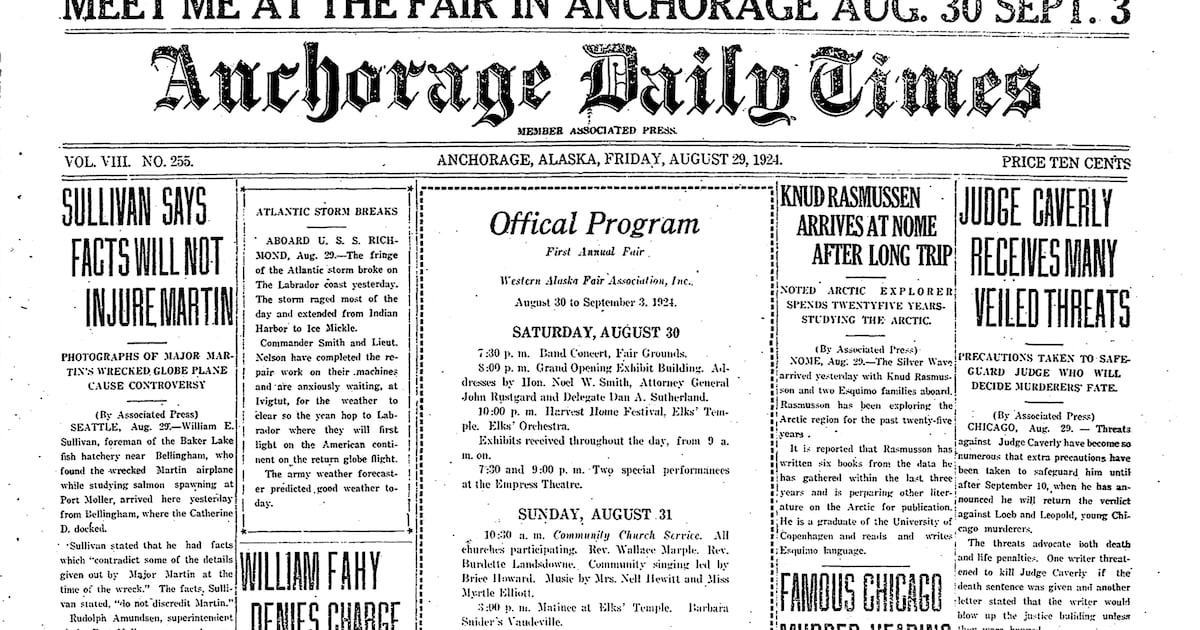
The official program from the Western Alaska Fair, published in the Aug. 29, 1924 edition of the Anchorage Daily Times.
Part of a continuing weekly series on Alaska history by local historian David Reamer. Have a question about Anchorage or Alaska history or an idea for a future article? Go to the form at the bottom of this story.
More than a decade before the first Alaska State Fair, back when it was the Matanuska Valley Fair, there was a similarly ambitious festival established in Anchorage, partially organized by the same man who later founded the fair in Palmer. A fading economy prompted its demise; otherwise, people might be eating fry bread while watching Modest Mouse perform in Anchorage rather than Palmer. This was the Western Alaska Fair.
Harvest festivals have been around longer than written history. The idea is too obvious, too clearly beneficial to communities, especially in more agrarian eras and regions. Through to more modern small towns, the fall harvest marks one of the more natural occasions for celebration within the seasonal rhythm.
Before 1924, there were several fairs about the Territory of Alaska that did not inspire annual repetitions. A non-exhaustive list includes a 1915 Fairbanks harvest fair with $500 in profits, roughly $16,500 in 2026 dollars. There was a one-day strawberry festival in 1917 Haines, a precursor to the Haines Strawberry Festival, which ran from 1952 to 1969 before it was rebranded as the ongoing Southeast Alaska State Fair. The First Alaska Agricultural and Industrial Fair held in 1917 Anchorage failed to produce successors as the town declined from its founding boom. So on and so forth.
In 1923, the Territorial Legislature passed a bill introduced by Sen. Milton Snodgrass (1897-1967), annually granting each territorial division $1,000 for fairs. The territory was then divided into four judicial divisions with headquarters in Juneau, Nome, Valdez and Fairbanks. The next year, the Anchorage Chamber of Commerce and Anchorage Women’s Club used that funding to organize a Western Alaska Fair.
From the fair’s program, it would demonstrate “the varied range of farm products which are being successfully propagated in the Territory, and to bring the residents of the district into closer touch with the vast industrial possibilities lying along and adjacent to the Alaska Railroad and in those portions of Southwestern and Western Alaska accessible by transportation and which have felt the first touch of commercial enterprise. Thus the fair will prove a double purpose — instructive and entertaining.”
The fair announcements are also a window into how people talked back then. From the Anchorage Daily Times discussion of the dog show, “The mutt is to come into his own … the ‘Kiddos’ of Anchorage will have the opportunity of showing to the world yoke-fellow of his joy and woes, be he blue-ribbon bred or just common dog. And while the ‘Kiddo’ is breaking in the effulgence of the spotlight, his gentler prototype will not be obscured.”
And yes, the name deserves some small comment. The explicit local hope was that the fair would become the primary fall event for the entire Territory. And yet, the “Western” part of the name does not speak well of unity given the significant amount of land west of Anchorage.
Publicity was minimal. Posters were placed at the other towns along the Railbelt, and a sign was hung across G Street between Third and Fourth avenues. But entertainment was in short supply, and within the small settler towns, news spread quickly. Anchorage residents were incentivized to participate for either general civic gains and pride or more specific rewards. The woman who sold the most tickets to the dance received a $10 prize, about $200 in 2026 money.
The Western Alaska Fair ran from Aug. 30 to Sept. 3, 1924. Though well attended, the opening ceremony that first evening was maybe the least exciting day of the festival. A band of locals played, followed by multiple speeches by politicians and fair organizers, then a violin solo followed by more speeches.
Most of the fair was housed in the studio building built by Austin “Cap” Lathrop. The structure was used during the filming of the 1923 movie “The Chechahcos” and meant as the headquarters for a movie industry that never developed. Two years later, the fair association acquired its own building.
Exhibits included the full range of Alaska’s bounties: fauna, flora, mineral and cultural. Produce and livestock were, of course, exhibited. It could hardly be a fair without them. A flower booth overflowed with roses, lilacs, peonies and other floral delights. Ore samples from what is now the University of Alaska Fairbanks were also shown. Horace Nagley, the Talkeetna merchant, displayed thousands of dollars’ worth of gold from the Cache Creek region. Live foxes and fox furs were also exhibited. The years between World War I and the Great Depression saw a boom in fur farms in Alaska. Locals also competed in sewing, embroidery and baking contests.
Sept. 1 was “baby day.” Babies were lined up on both sides of a Fourth Avenue block, then led in a parade. At the end, judges picked the “best baby, awarding the first-place prize to 12-month-old Richard Landers Jr. His father was one of the first Anchorage men to volunteer during World War I and, in that time, was described as the first Anchorage resident to see active service in France.
Other events were a bit livelier. The men of Company G, the 7th Infantry Regiment troops stationed here, staged a mock “Battle of Anchorage” on the Park Strip. Under the command of Capt. George Lockhart, they successfully defeated an imaginary opponent, firing a barrage before rushing the enemy position with bayonets drawn. The soldiers then performed some drill exercises. Children chased them around the field, recovering spent shells and mimicking the marching.
And there were races and boxing matches. The Empress Theatre, the first proper movie theater in town, played multiple films, including showings of the 1924 romantic comedy “Daddies.” There were multiple dances. Many people showed up in Klondike Gold Rush-era costumes left over from filming “The Chechahcos.”
Then there were the features that are more likely to surprise Alaskans today. There were at least two fortune tellers. One used a traditional deck of cards, but the other was a “horticultural prophet.” Mrs. Jerry Perry read fortunes via flowers. While contemporary accounts lack further details, flower fortune-telling was a longtime popular parlor game for younger women.
Excerpts from the 1847 book, “The Floral Fortune-Teller.”
An 1847 book, “The Floral Fortune-Teller,” explains one approach. A lady seeking answers about her future would “select a bouquet of five different colored flowers, of whatever kind he chooses.” The “he” was the target of her affections. The rest of the book explained the deeper meanings of specific color and breed combinations. This coded flower language worked both ways. A gentleman could impress a lady with the choices of his flowers, conveying a secret love message of sorts, which meant a return to the book.
For example, if the bouquet included a white lily, then the fortune teller turned to that entry on page 33 for the description of the future mate. In this case, there is a passage from William Shakespeare’s “Othello”: “Of a free and open nature, That thinks men honest that but seem to be so, And will as tenderly be led by the nose As asses are.” In other words, he will be trusting and easily dominated. Subsequent time is reserved for the requisite giggling and blushing.
From the Daily Times coverage, “One of the most interesting attractions was ‘Spidora,’ the living head without a body. This attraction kept the onlookers mystified in an effort to solve the illusion.” By 1924, this was a decades-old carnival sideshow illusion. Careful mirror use made it appear as if a box contained only a spider with a woman’s head atop a web. More complicated versions included ways to make the legs move. The same trick is performed in “The Show,” a 1927 Tod Browning film about carnival performers.
A still image of Arachnida from the 1927 film “The Show,” directed by Tod Browning.
Finally, there was the more exotic entertainment. Per the Daily Times, a belly dancer from New York happened to be passing through Anchorage. “This clever dancer was persuaded at length to appear. It is understood that some of the dances she has presented in moving pictures have been cut out by the censors. However, there are no censors in Anchorage.” A wink is heavily implied. Another article said she “put the wig in wiggle,” not that anyone would or should pay for a wig-less gle.
The dancer was billed as “Little Fatima,” but that was a common stage name, and her real one was never mentioned. The entire backstory was somewhere between possibly and certainly fictional; “Fatima” was also able to perform in town seven months later.
Ashea Wabe is seen here as Little Egypt, in one of a series of photos by Benjamin Falk from the 1890s. (Benjamin Falk / Public Domain via Wikimedia Commons)
Belly dancing boomed in popularity in the United States after a salacious for the time performance at the 1893 Chicago World’s Fair. The gyrating hips, uncorseted bodies and exposed skin were widely deemed scandalous even as massive crowds surged to every show. No one fainted, but in the years after, several belly dancers were indeed arrested for their acts.
Outside noble Alaska, there is a long tradition of more artless nudity at fairs, from the county to world level. For decades, risque films, girlie shows and outright strippers were a festival fixture, if often tucked into the corners of the fairgrounds. At the 1939 New York World’s Fair, ticket sales skyrocketed when the striptease performers were working. Come to think of it, even the Alaska State Fair has hosted lingerie shows.
With that, the first Western Alaska Fair came to a close. The first Tanana Valley Fair purposefully ran directly after, from Sept. 11-13. As deprived of entertainment as Alaskans were in 1924, an overlap would have been a criminal waste of resources.
After several successful years, the Western Alaska Fair sputtered to a close in the early 1930s, hampered by the new economic reality of the Great Depression. The 1932 iteration notably offered far fewer attractions than previous fairs. In 1933, the fair association could only stage a two-night jamboree. Then it faded away, replaced in the city consciousness by what would become the Fur Rendezvous.
[When was the first Fur Rondy?]
In 1947, the fair was revived as a two-day event. Races, pet contests, bingo games, a concert, a softball game, a horseshoe tournament and a fireworks display joined the required agricultural exhibits. Though there was a clear desire to honor the past, the memories of the original Western Alaska Fair had faded. Apparently, they did not know when it ended, as seen in a headline: “Western Alaska Fair Back After 17 Years.” The fair returned once more in 1948, but that was it. Despite — or perhaps because of — limited schedules, both events lost money.
Milton Snodgrass, author of the 1923 bill that partially funded the Western Alaska Fair, was listed as a committee member for the inaugural edition, though that might have been a ceremonial honor. Certainly, he remained a booster for the entirety of its existence. When he died, his papers included the receipt for the $1,000 appropriation and the organizer’s formal funding request, perhaps a sign of pride in his role in its creation.
In 1936, he was a lead organizer for the Matanuska Valley Fair. He was a director and the fair association’s first president. He wrote the 12-page fair guide, and the association pulled funding from his 1923 bill. Mostly hosted in a new school building, the festival was timed to coincide with the opening of the Knik River Bridge and the completion of a road connection to Anchorage. That fair had its own, more successful evolution. The familiar cabbage contest began in 1941, and carnival rides were a 1950 addition. And in 1959, it became the Alaska State Fair.
• • •
Key sources:
“Carnival Will Captivate All.” Anchorage Daily Times. September 4, 1924, 4.
Colberg, Talis James. “M.D. Snodgrass: The Founder of the Alaska State Fair.” Doctoral dissertation, University of Alaska Fairbanks, 2008.
Edgarton, Sarah Carter. The Floral Fortune Teller; A Game for the Season of Flowers. Boston: A. Tompkins, 1847.
“Fair Assured Fine Exhibits of Products.” Anchorage Daily Times. September 1, 1932, 2.
“Fair Jamboree Successful for Finance and Fun.” Anchorage Daily Times. September 8, 1924, 3.
“Fair Makes Money.” Seward Gateway. September 10, 1915, 6.
“First Annual Fair Opens with Due Ceremony.” Anchorage Daily Times. September 2, 1924, 1, 8.
“Haines Notes.” [Skagway] Daily Alaskan. July 26, 1917, 4.
“H.W. Nagley and Family Here to Attend the Fair.” Anchorage Daily Times. August 29, 1924, 6.
“Live Foxes May Be Shown in Anchorage.” Anchorage Daily Times. August 4, 1924, 5.
“Maneuvers Are Given by Troops.” Anchorage Daily Times. September 2, 1924, 5.
“Mining Board to Co-Operate in Conjunction with Alaska College and Bureau of Mines.” Anchorage Daily Times. April 26, 1923, 1.
“Mutt Exhibit Arranged for Fair Program.” Anchorage Daily Times. July 30, 1924, 1.
“Varied Features Plan for Rally.” Anchorage Daily Times. September 5, 1924, 8.
“Western Alaska Fair Back After 17 Years.” Anchorage Daily Times. August 22, 1947, 1.
“Wins Dance Prize.” Anchorage Daily Times. September 11, 1924, 4.