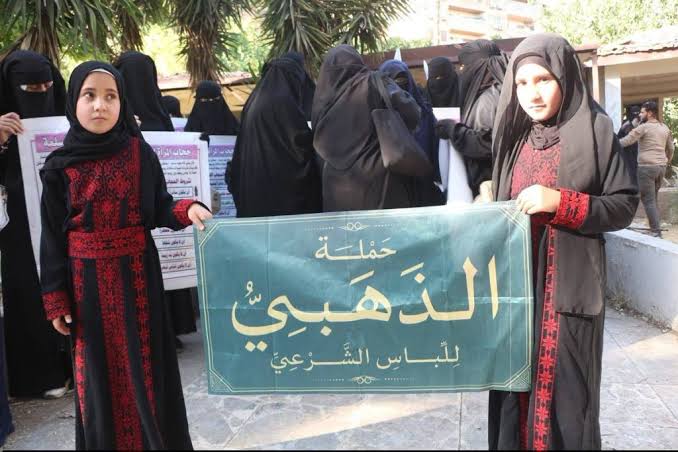
A campaign promoting what it calls “Islamic dress” has reopened a sensitive debate in Syria over religion, women’s clothing and the boundaries of public authority. The controversy intensified after the Ministry of Religious Endowments refused to approve an event organised by the “Al-Dhahabi Campaign for Islamic Hijab” at Damascus’s Cham City Center.
The ministry said organisers had been asked to submit a formal religious outreach plan but declined to do so. Deputy Minister Samer Bayraqdar said the ministry supported religious activities, provided that they were supervised by clerics and preachers accredited by the Supreme Fatwa Council and the ministry itself.
The dispute, however, extends well beyond administrative procedure. At its core lies a broader question: whether a contested interpretation of Islamic dress can be presented as the sole religious standard in a society marked by considerable social and doctrinal diversity.
The campaign, led by the figure known as Sheikh al-Dhahabi, says it began on 8 December 2024, hours after the fall of the Assad government and the entry of opposition forces into Damascus. It describes itself as an independent, non-profit religious and social initiative intended to restore what it regards as Syria’s authentic religious and cultural identity after decades of repression and enforced secularisation.
In a recent statement, the campaign sought to cast its mission in strategic terms, arguing that its timing reflected the beginning of a new national era. It says its aim is to promote a moderate Islamic outlook, encourage religious observance and distribute what it defines as proper Islamic dress to women who request it.
The campaign also claims an economic role, saying that the production of such clothing supports Syrian workshops, textile factories and local employment. That argument has drawn ridicule from critics, who see it as an attempt to inflate a religious initiative into a broader social and economic project.
More substantive criticism, however, focuses on the campaign’s underlying assumptions.
Ammar al-Hariri, an academic and researcher in Islamic studies, argues that the issue should not be reduced to the niqab itself. A woman who chooses to wear it, he says, is exercising a legitimate personal choice, just as another woman may choose the hijab or a different form of modest dress.
The problem begins, he argues, when one jurisprudential interpretation is elevated into the definitive standard of Islam and used to judge the religious commitment of others.
The niqab has long been the subject of disagreement among Muslim jurists. Yet some contemporary religious currents, Hariri says, increasingly treat it as a measure of piety, placing women who wear the hijab or other forms of modest clothing on a lower moral or religious plane.
At that point, the issue ceases to be a matter of jurisprudential interpretation and becomes an attempt to reshape public space around a particular ideological vision of religion.
Hariri argues that this tendency risks turning women’s bodies into a permanent arena of religious scrutiny. Questions over the face, hands, veil and length or looseness of clothing become markers through which faith and morality are assessed, despite the absence of consensus on many of these matters.
For a society such as Syria, with its long history of religious, social and cultural diversity, imposing a single model of outward religiosity would amount to a form of social engineering.
There is also a question of priorities. Syria faces poverty, corruption, social fragmentation, violence, weak institutions and the erosion of civic trust. Critics of such campaigns argue that religious discourse would have greater public value if it concentrated on justice, honesty, compassion, education and social responsibility rather than on policing women’s appearance.
None of this requires hostility towards the niqab or towards women who choose to wear it. The central issue is coercion, whether formal or informal, and the attempt to transform a legitimate area of religious disagreement into a test of faith and social respectability.
That distinction is particularly important in today’s Syria. The collapse of authoritarian rule has opened a wider contest over the country’s future identity and over who has the authority to define it. Religious actors, state institutions and social movements are all seeking to influence the norms of the emerging public order.
Seen in that light, the Al-Dhahabi campaign is about more than clothing. It is part of a larger struggle over who gets to define the boundaries of acceptable religious life in post-Assad Syria, and whether the country’s new public sphere will accommodate competing interpretations or replace one form of imposed conformity with another.
According to publicly circulated accounts, Sheikh al-Dhahabi is an Egyptian national whose real name is Hani Dahab. He reportedly joined Jabhat al-Nusra after arriving in Syria and worked in religious affairs in the coastal region before leaving the country in 2015. In February 2024, a group of former Egyptian fighters issued a statement distancing themselves from him and questioning his credibility, including allegations concerning fundraising in the name of fighters and displaced civilians.
This article was translated and edited by The Syrian Observer. The Syrian Observer has not verified the content of this story. Responsibility for the information and views set out in this article lies entirely with the author.