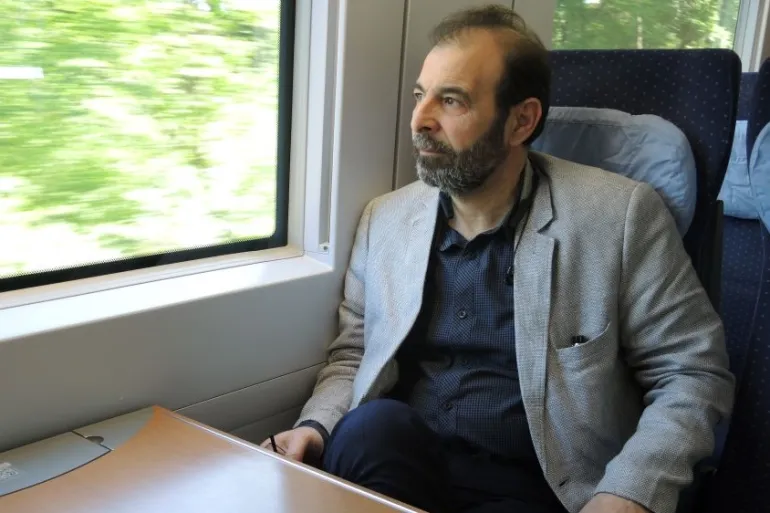
For Anwar al-Bunni, the fall of Bashar al-Assad was neither unimaginable nor unexpected. After decades spent defending political prisoners, documenting torture, and pursuing Syrian officials through European courts, the veteran human-rights lawyer had long believed the regime would eventually collapse.
“I was expecting this moment,” Al-Bunni, who was talking to Catharina Lovreglio, an RSF member, says. “So it did not surprise me, because I knew it was coming.”
What changed was the direction of his work. Within a day of Assad’s fall in December 2024, members of al-Bunni’s team had already entered Syria. By 26 December, they were holding their first workshop. Since then, their efforts have increasingly shifted toward the country itself—training lawyers, helping victims prepare cases, and trying to lay the foundations of an independent justice system.
Al-Bunni, who heads the Syrian Center for Legal Studies and Research, remains in Berlin. His daughter and son have returned to Syria, but he says his own situation is more complicated.
Security remains fragile, he argues, and he has accumulated enemies over decades of activism—among them ISIS members, former regime networks, Iranian-backed actors, and extremist groups. There is another reason for caution: he refuses to build personal relationships with members of the new authorities whose conduct, he believes, may one day come under legal scrutiny.
“I do not want to shake hands with anyone in the authorities at the moment,” he says. “They may be prosecuted as criminals in the future.”
Optimism, Without Illusions
Despite his reservations, al-Bunni describes himself as broadly optimistic about Syria’s transition.
Transitions elsewhere, he notes, have often been costly, chaotic, and violent. Syria faces the added challenge of navigating this period with limited international assistance, alongside severe economic pressures, corruption, and the consequences of violence in the coastal region and Suwayda.
Even so, he believes the overall trajectory is improving.
The gravest danger, in his view, lies in fragmentation among the forces that toppled Assad. The armed groups that emerged from Idlib, he says, consisted of dozens of factions that had previously fought one another. Their ability to remain within a unified political and military framework is therefore essential.
“If they start fighting each other again,” he warns, “Syria will descend into chaos and there will be blood in the streets everywhere.”
His optimism is therefore conditional. He acknowledges that serious mistakes are being made and says some members of the current authorities have themselves been implicated in past war crimes. Transitional periods, he argues, are difficult precisely because the institutions overseeing them are part of the unresolved legacy of war.
A Justice Process He Refuses to Join
Al-Bunni has not been invited to work formally with the new government on transitional justice. Even if such an invitation came, he says, he would decline.
Germany’s ambassador contacted him to ask about his proposals for Syria’s transition. Al-Bunni shared his ideas, which were then passed to the Syrian authorities. They showed little interest.
“Some of them are afraid of me because they know very well that they committed crimes themselves,” he says. “I will always stand with the victims.”
His criticism of the emerging justice system is blunt.
He dismisses what Syria currently calls transitional justice as political theatre.
“So far, the transitional justice process in Syria is everything except transitional justice,” he says.
He argues that the Justice Ministry has taken control of accountability at the expense of an independent transitional justice commission, turning the process into what he calls “retributive justice.” He also accuses the authorities of selective prosecution, choosing certain defendants while allowing others to escape accountability.
For al-Bunni, a genuine process must be universal. It cannot restrict itself to Assad or a handful of former officials. Thousands of alleged perpetrators are now outside Syria, including in Europe, and he insists that Syrian law alone is insufficient. International law must also form part of the accountability framework.
He is particularly wary of recent moves to issue judgments against Assad and other former regime figures if those rulings are designed primarily to demonstrate that Syria can handle accountability without outside involvement.
The authorities, he believes, want control over the process.
“They want to hold it as an instrument, rather than make it genuine transitional justice for the victims,” he says.
Justice Cannot Be a Tool of Power
For a lawyer who spent decades confronting the Assad state, the question is larger than which individuals are prosecuted.
Under Assad, he says, the judiciary became an instrument of control. Reproducing that relationship under a new government would betray the revolution’s purpose.
“There is only one way to achieve justice,” he says. “You cannot achieve real justice in the wrong way.”
Victims may feel tempted to take revenge. Assad could be killed in the street, he acknowledges, and many Syrians might celebrate. Yet revenge and justice are not the same.
“If victims kill criminals in the street, that is not justice,” he says.
This distinction also shapes his view of Russia, where Assad fled after the collapse of his government. Al-Bunni says he is not particularly concerned about Moscow’s refusal to surrender him. Russia, he argues, protected Assad for its own interests and will ultimately bargain with him if circumstances change.
France and Germany have already issued arrest warrants for Assad, he notes, and he believes Moscow’s position could eventually become transactional.
His larger concern remains the integrity of the process itself. Justice, in his view, cannot belong to a minister, a government, or a victorious faction. It must belong to victims and to institutions capable of acting independently of political power.
Building Justice from Below
While criticising the official process, al-Bunni and his colleagues are working to build an alternative infrastructure from the ground up.
Around 200 lawyers are currently being trained across Syria, he says, and his organisation has conducted more than 23 workshops in different parts of the country. Those lawyers are meeting victims, preparing case files, filing complaints, and following proceedings against alleged perpetrators.
Yet international support remains limited.
Al-Bunni says his organisation has received no meaningful assistance from the European Union for its work inside Syria. European organisations may support accountability efforts on the continent, but few are equipped—or willing—to help build legal capacity inside Syria.
He says he has offered to train Syrian judges and police. The authorities rejected the offer.
“They do not want anyone on their territory whom they cannot use as they please,” he says.
His relationship with interim President Ahmed al-Sharaa is equally cautious.
Al-Bunni says people have encouraged him to return to Syria and meet al-Sharaa. He has refused, partly because he believes the president himself could one day face claims from victims over actions committed in the past.
“I will give him a chance,” al-Bunni says, “but that does not mean I will not stand with the victims if they demand justice.”
At the same time, he acknowledges al-Sharaa’s current importance. Without his role in holding the country together, al-Bunni argues, Syria could face far greater danger.
That tension captures much of his view of the transition: the present authorities may be necessary to prevent collapse, yet necessity cannot place them beyond future scrutiny.
The Revolution’s Second Battle
The fall of Assad, in al-Bunni’s telling, did not complete the Syrian revolution.
He estimates that only a minority of those who opposed Assad genuinely wanted a Syria built for everyone on the basis of peace and freedom. Others, he fears, may simply seek a different version of authoritarian rule built around another ideology.
“The Syrian revolution was the first step,” he says. “Now we are fighting a major battle with those who do not want Syria to belong to everyone.”
That struggle, he insists, is being waged peacefully—through civil society, public protest, legal awareness, and organisation.
Syria today enjoys a level of freedom unimaginable under Assad, he says. People openly discuss politics and public affairs, while more than 1,500 new organisations have been established. His own team has helped around 60 organisations form, register, and build their internal structures.
“The main result of the Syrian revolution is that the people will not allow the country to go backwards,” he says. “Fifty years under Assad was far too long. Syria now needs a rest.”
The Greater Danger Comes from Abroad
Al-Bunni does not currently see Syria’s greatest threat as coming from domestic groups.
External actors worry him more.
He names Türkiye, the United Arab Emirates, Russia, Iran, Hezbollah and, above all, Israel as forces capable of destabilising Syria.
“The danger from outside is much greater than the danger from within,” he says.
That does not mean he regards the authorities as secure indefinitely. Their performance has so far been relatively effective, in his assessment, but there is no guarantee that the present equilibrium will last.
He also rejects the idea that Syria’s Druze or Kurdish communities are inherently opposed to the Syrian state, although he distinguishes between communities themselves and actors such as Sheikh Hikmat al-Hijri or the Kurdistan Workers’ Party.
Civil society, he argues, remains one of Syria’s strongest assets. He believes some figures in the current leadership, including al-Sharaa and Foreign Minister Asaad al-Shaibani, genuinely aspire to build a civil state. Yet the transition remains vulnerable, with ISIS and other armed groups still present.
Why He Still Has Hope
Al-Bunni measures Syria’s future less by speeches from Damascus than by the people he encounters in workshops across the country.
Mistakes by the authorities, he says, will increase the cost of transition and prolong it. Those mistakes already exist. Yet his optimism has survived them.
Part of that confidence comes from younger Syrians.
Across 23 workshops, al-Bunni says he has met young men and women who have renewed his faith in the country’s future. Their willingness to discuss rights, institutions, and accountability gives him reason to believe Syria can still emerge from decades of dictatorship and war with something better.
The transition will take time. Syrians, he notes, spent decades under a state that gave them little sense of security or national belonging, encouraging many to retreat into religious, ethnic, or communal identities. Rebuilding trust in a common state cannot happen quickly.
Yet when asked how, after prison, torture cases, mass atrocities and decades spent confronting perpetrators, he can still believe in humanity, his answer returns to the same place: Syria’s young people.
“I met young people there and I felt hope,” he says. “I believe in their abilities. I believe the future will be better.”