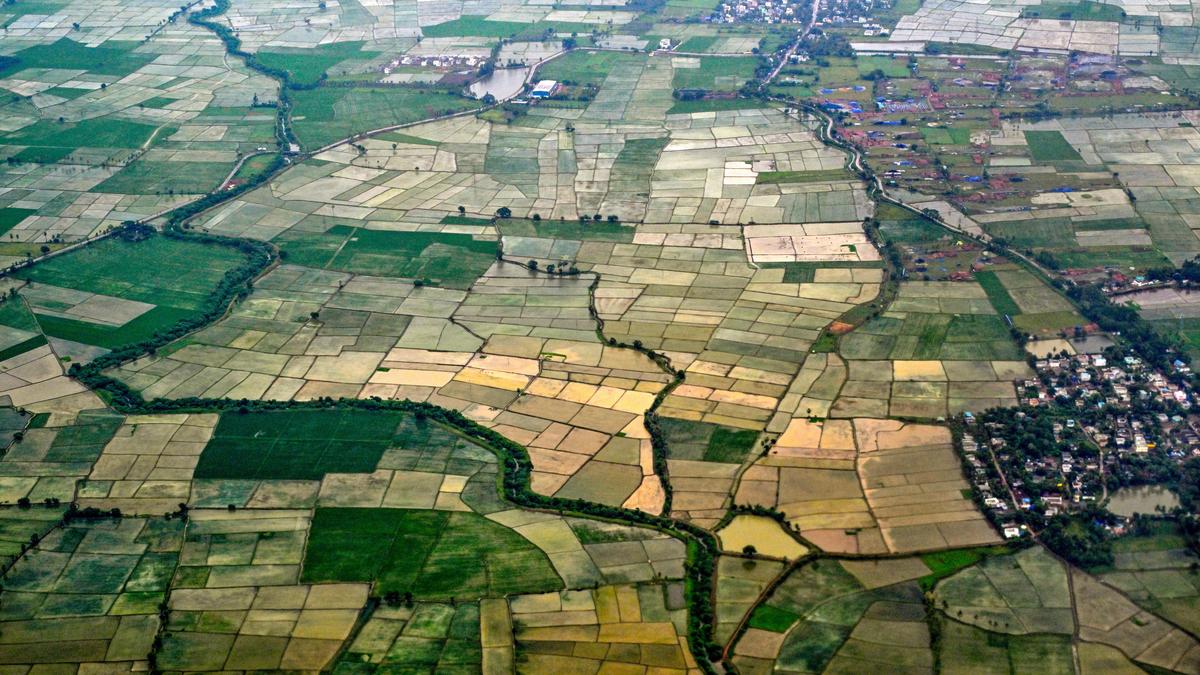
An aerial view of farm fields inundated with rainwater on the outskirts of Vijayawada on Monday. File Photo
| Photo Credit: File Photo
Andhra Pradesh has mounted a comprehensive response to one of its most challenging monsoon seasons in recent years, with the State registering a 51% deficit rainfall during the Kharif-2026 season, according to Agriculture Director Manazir Jeelani Samoon.
In a statement on Wednesday, Dr. Samoon said, while India recorded a 13% monsoon deficit between June 1 and August 25, all the 28 districts in Andhra Pradesh reported deficient rainfall, including three districts classified as large-deficit. With agriculture supporting nearly 62% of the State’s population, protecting farmers and rural livelihoods had become a key priority, Dr. Samoon said.
The Agriculture Department began preparations in February, in consultation with IMD and CRIDA, and risk-graded all the 8,489 Rythu Seva Kendrams. Of these, 1,357 were identified as high-risk and 2,077 as moderate-risk areas.
A four-pronged strategy was implemented based on local water availability. In irrigated areas, crop calendars were advanced and water use optimised, while farmers in water-scarce regions were encouraged to shift from paddy to drought-resilient crops. Natural farming, pre-monsoon dry sowing, and seed pelleting were expanded, covering 18.20 lakh acres so far, he said.
The government also promoted farm ponds, moisture conservation, crop diversification and fodder security, while expanding crop insurance coverage. Insured acreage increased from 7.83 lakh hectares in Kharif-2025 to 16.39 lakh hectares this season.
Under the ‘Rythanna Meekosam’ campaign, multidisciplinary teams were conducting parcel-level crop surveys across 18,513 villages. Of the 2.74 crore targeted plots, 96.91% were surveyed. “Most crops remain in normal condition, though stress has been reported mainly in Kurnool and Nandyal districts,” he added.
The State had sown 20.35 lakh hectares so far, compared to 25.63 lakh hectares the previous year, reflecting a planned, water-budgeted shift towards pulses and other drought-resilient crops, rather than a decline in agricultural activity, Dr. Samoon said.
Published – August 26, 2026 07:51 pm IST