(Aug. 25, 2026 / JNS)
Yechiel Leiter, the Israel ambassador to the United States, plans to have the same sort of unusual High Holidays that he did last year, back when he was about six months into the post in Washington.
“I don’t remember the last time I had a normal Shabbat,” Leiter, who is Orthodox, told JNS during an interview in his office in the embassy on Aug. 23. “I have not had a normal Shabbat pretty much without exception since I’m here.”
“There’s always some sort of crisis. People have to remember we’re in a multi-front war,” he said. “The war is not over.”
People get confused when they “look at things piecemeal,” according to the Israeli envoy.
“There’s a strike in Gaza. There’s a strike on the runway in Syria, or there’s a strike in the tunnels in the yellow zone in Lebanon. That’s a wrong approach,” he told JNS. “We’re at war with Iran and its proxies. It’s an ongoing war. It’s not over yet.”
The Jewish state had degraded the Islamic Republic and its proxies over the past three years, but there needs to be “constant finessing” between Israel and “our senior partner, the United States,” Leiter said.
“We’re full partners when it comes to Iran. We’re lesser partners when it comes to the other enemies we have around us,” he told JNS. “We’re managing that ourselves. When you have something like an issue with Turkey, obviously that needs to be finessed properly. So it’s ongoing. It’s 24/7. There’s no respite whatsoever.”
“So will I have the opportunity on Rosh Hashanah to have a quiet Rosh Hashanah?” he said. “Our enemies don’t rest.”
Leiter is able to get to synagogue “very rarely,” and only when he has speaking engagements or when he visits his 92-year-old mother in Scranton, Pa. “Whenever I can get away, I go to visit her for Shabbat,” he told JNS.
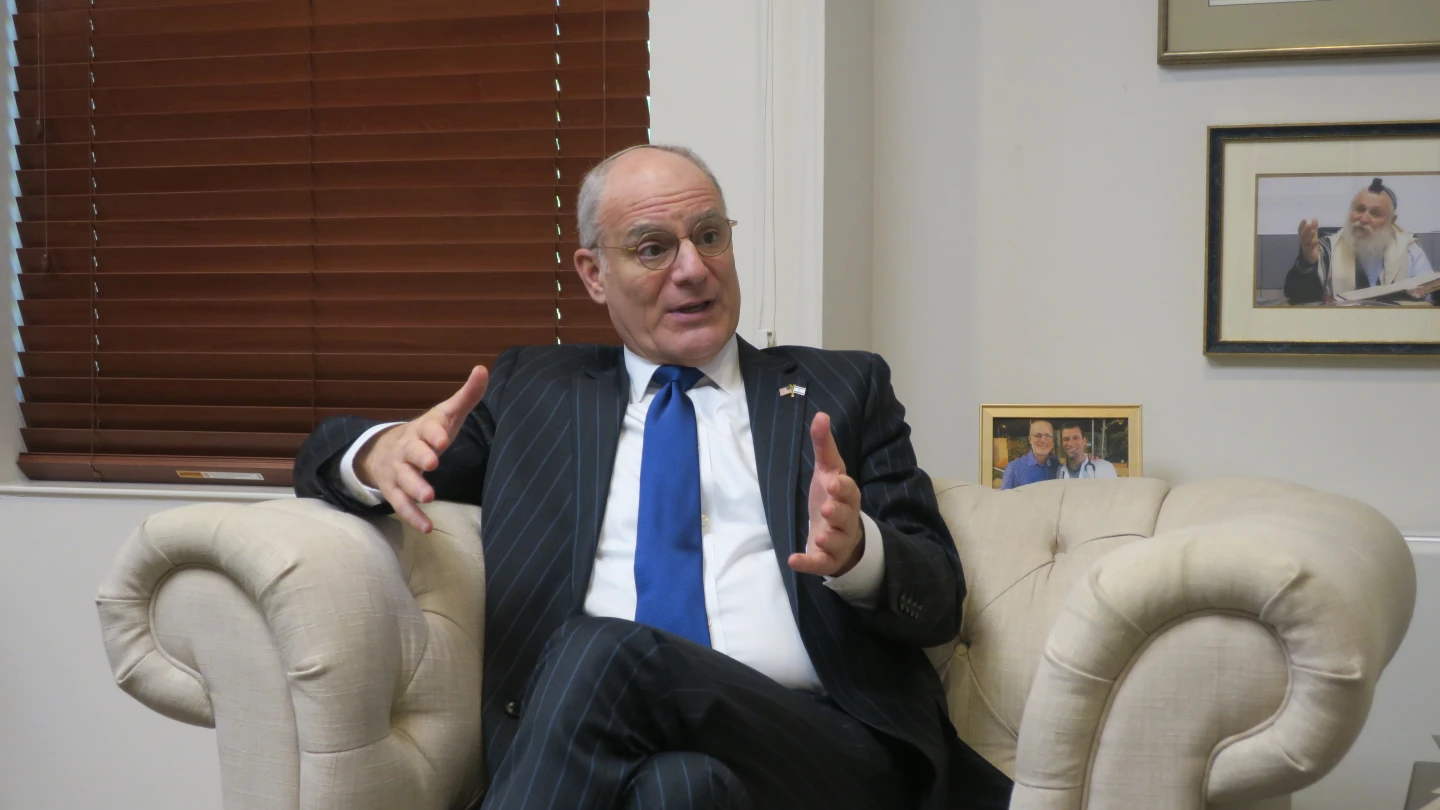
Yechiel Leiter, Israeli ambassador to the United States, talks to JNS in his office at the embassy in Washington, D.C., in August 2026. Photo by Menachem Wecker.
He is scheduled to travel to Los Angeles for an Israel Bonds event, and he plans to speak at four synagogues over Shabbat. “I’ll be in Reform, Conservative and Orthodox temples,” he said.
“If I do get to shul, it’s because I’m working,” he told JNS. “People are wondering why the ambassador is out there talking on his phone in the ballroom outside the shul, because I’m getting called. Invariably, on Shabbat morning there are crises. I don’t know why there are more crises on Shabbat morning than any other day of the week.”
‘We need calm’
Leiter turned to those crises repeatedly, even when asked about other topics, like his thoughts on Rosh Hashanah.
“Last year we went into Rosh Hashanah with hostages. This year we’re going into Rosh Hashanah with our hostages home,” he said. “What does that mean with regard to Gaza? Last year we weren’t in negotiations with Lebanon. Now we are.”
“Israel’s standing in the world has changed over the past year,” he told JNS. “We have a deteriorating situation, both on the woke left and the woke right here in the United States. So, it’s time for an assessment.”
“Where do we stand? What are we going to do? And what are we going to double down on?” he asked, echoing themes of introspection, in which many Jews engage in the High Holiday season. “What are the things that are most pressing and important?”
Israeli Prime Minister Benjamin Netanyahu has frequently described the Jewish state as being engaged in a “seven-front war,” but some of those fronts are now more complex and involve more potential combatants and negotiating parties than they did a year ago.
Success in Israel’s campaign against Hezbollah in Lebanon now depends in part on the first direct talks between the Israeli and Lebanese government in decades.
Yechiel Leiter, Israeli ambassador to the United States, talks to JNS in his office at the embassy in Washington, D.C., in August 2026. Photo by Menachem Wecker.
Syria has perhaps undergone the most dramatic changes of any of Israel’s neighbors since Oct. 7, with the pro-Iranian and pro-Hezbollah dictatorship of Bashar al-Assad replaced with the new government of Syrian President Ahmed al-Sharaa. The latter is a former member of al-Qaeda whose rise to power at the head of an Islamist rebel army was fostered by Turkey.
The threat of Turkish military deployments deeper inside Syria prompted Israeli airstrikes at a Syrian air base near Idlib on Aug. 18. The Trump administration expressed “concern” about those strikes, describing them as “unnecessary escalation,” and Rep. Joe Wilson (R-S.C.), one of Israel’s staunchest supporters in Congress, called the strikes “one-sided aggression.”
Turkey, a NATO ally of the United States, is not yet a belligerent in Israel’s multifront wars, but Israel’s place in Syria, its views on Syria’s new government and its increasing wariness of Turkey are new areas where the United States and Israel may not see eye-to-eye.
“I represent what my prime minister and the government think, and that’s that we should be more cautious,” Leiter said, of al-Sharaa and the new Syrian administration. “The situation is far better than it was with Hafez al-Assad or Bashar al-Assad, but there isn’t a long history of jihadis becoming Jeffersonians.”
“Congressman Wilson is a great friend of Israel, but we think that he’s embraced al-Julani a little bit too quickly,” the ambassador told JNS, using al-Sharaa’s former nom de guerre.
“Rushing towards Abraham Accords normalization is a little bit too soon, but we are working on the background for ultimately reaching a security agreement with Syria,” he said. “We’d like to see less of the harsh jihadi antisemitism that’s being taught in schools. The chants of the soldiers, which are, ‘blood will run through the streets of Jerusalem when we slaughter the Jews’ and all that kind of stuff. We need to see less of that.”
Yechiel Leiter, Israeli ambassador to the United States, talks to JNS in his office at the embassy in Washington, D.C., in August 2026. Photo by Menachem Wecker.
Leiter pointed to the “menacing manner” in which Turkey threatened to extend its presence in Syria with al-Sharaa’s permission and the open question of his intentions in Lebanon and how he will contend with Iranian-backed militias in Iraq.
“There are too many things moving,” Leiter told JNS. “We need calm.”
‘Spitting back’
Israeli diplomats are sometimes placed in the bind of officially desiring calm while some of the country’s politicians and political appointees in the diplomatic corps prefer a smash-mouth, no-apologies approach to representing the world’s only Jewish state.
Itamar Ben-Gvir, Israel’s minister of national security, is perhaps the most prominent proponent of the latter approach and has prompted repeated statements over the course of the war from the Prime Minister’s Office to the effect that his views do not represent the policy of the Israeli government, despite his membership in the cabinet.
What might be called the “trolling” mode of some Israeli diplomacy has been perhaps most tempting in Israel’s engagements with European countries, given their histories in the Middle East.
“I have two issues on my desk right now that I’m supposed to weigh in on where that is the exact dilemma,” Leiter told JNS. “The Brits just threatened sanctions over E1,” a Jerusalem-area settlement corridor called “East 1.”
“Forget diplomacy for a moment. Just think about the absurdity, the sheer, pure, unadulterated chutzpah of the Brits criticizing us over E1,” the Israeli envoy said. “They’re still occupying some 14 colonies around the world.”
The United Kingdom retains 14 overseas territories, including Gibraltar and the Falkland Islands. Some of those territories are disputed, and many are on the U.N. Special Committee on Decolonization’s list of non-self-governing territories alongside the U.S. territory of Guam and French Polynesia.
“What the hell gives you the right to critique us on the boundaries of Jerusalem?” Leiter asked of the United Kingdom. “They’re going to sanction us, because when you walk down Edgeware, you think you’re in Baghdad?”
Yechiel Leiter, Israeli ambassador to the United States, talks to JNS in his office at the embassy in Washington, D.C., in August 2026. Photo by Menachem Wecker.
“That having been said, do I have to say that in the next interview I give?” he said. “Do I get sucked into this spitting match? If you spit on me, I’ll spit back at you? Even though what I’m spitting back is true.”
“The whole thing is absurd. It’s obnoxious, and it’s a dilemma, and you have to finesse it,” Leiter told JNS. “I think that the answer in most cases is to present the case with the least bit of sarcasm and facetiousness, to avoid the biting sarcastic response and to be as straightforward as possible.”
‘Kippah-toting people’
Leiter, who wears a kippah, or a Jewish skullcap, is identified as a rabbi on his Wikipedia page. “I’m not a rabbi,” he told JNS. “I taught for a while, and they gave me the epithet of rabbi. I never practiced as a rabbi. I have never worn the cloak of a rabbi.”
“That made its way into Wikipedia,” he said. “Now it’s true.”
Recent photos, which both the White House and the Israeli Prime Minister’s Office published, show Leiter, Shmuel Ben Ezra, head of Israel’s National Security Council, and Ido Norden, Netanyahu’s chief of staff, sitting on a couch in the Oval Office. All three wear kippahs.
Many Jews and supporters of Israel have said that after Oct. 7, they have been more inclined to show Jewish and Zionist pride, including by wearing Jewish religious attire, like kippahs, and jewelry with Stars of David.
JNS asked Leiter if it is meaningful to him that there were so many officials wearing kippahs in the Oval Office, or whether even counting conspicuous displays of Jewish observance like that is akin to the kinds of diversity tallies that have often led to criticism of Israel and Jews.
“There are certain people, obviously, who see that and applaud it, and say, ‘Wow. The people with kippot, Orthodox people, didn’t have a place for a long time in the day-to-day management of public policy or foreign policy, and now it’s predominant,’” he said.
“I think other people see it and say, ‘There are too many of the kippah-toting people involved in policy, because they’re bringing other values into the circle,’” he told JNS. “I think there are some people who probably feel that way.”
For Leiter, the question is “are we dealing with quality people or not?”
He referred JNS to an “old story about a sainted rabbi by the name of Chaim of Brisk, the Brisker Rav,” and here the conversation returned to the High Holidays.
The community told the rabbi that it had two candidates to be chazzan, the cantor who chants the Yom Kippur service. One was very righteous but didn’t have the nicest voice, and the other sang beautifully, but wasn’t the most virtuous person.
“The Rav said, ‘Are you looking for a rabbi or are you looking for a chazzan?’” Leiter told JNS. “The one who’s a tzaddik but is not a great chazzan, he’s not in the running.”
“If somebody is looking at the people around the prime minister and saying, ‘Ah. He has a kippah,’ and that’s the qualifying trait, that’s not a good thing, because we’re not looking for a rabbi,” he said. “We’re looking for people who understand foreign policy, who can do diplomacy and have the right ideas. That should be of paramount importance, in my opinion.”
In his first meetings, he was the only one on the couch with a kippah.
“It was Gil Reich, who was the national security adviser. Doesn’t wear a kippah, and Roman Gofman,” then the Israeli military secretary, “doesn’t wear a kippah. It was the three of us on the couch,” he said. “Before that, it was (Ron) Dermer, myself, and Gil. Two kippahs and one no. Now it’s three kippahs.”
“I don’t think that we should look at all at the presence of the kippah or not,” he said. “I think that’s highly irrelevant.”
Yechiel Leiter, Israeli ambassador to the United States, talks to JNS in his office at the embassy in Washington, D.C., in August 2026. Photo by Menachem Wecker.
AJB additions on Jewish community
Leiter’s attitude might be an asset in navigating the diversity of religious and political opinion both in his native United States and in Israel, the country to which he emigrated in the 1970s and now represents.
He pointed to the comments from May Golan, Israel’s social equality minister, in which she said that Reform Jews are “marrying dogs in your delusional synagogues.” Leiter apologized for those remarks and called them “disgusting and reprehensible.”
“I don’t have to be a Reform Jew to be offended,” he told JNS. “In this period of time when Zionism is being put on the chopping block, is on the witness stand, and American Jews are being encouraged to choose to abandon it, it’s very important that the Zionist consciousness of the Jewish people should be engaged with them.”
“For better or for worse, I’m the ambassador of Israel,” he said. “I’m the Zionist consciousness here, so I want to engage with them.”
American Jewish and pro-Israel groups are contending with rapidly shifting political opinion among the wider American public about Israel, Zionism and what American support for Israel means for American Jews.
Leiter said that those groups frequently ask him about the “alternative” that anti-Israel activists are presenting to American Jews on both the left and right.
“They’re being given an offer. Denounce your Israelism, denounce your Zionism, and we’ll embrace you,” he told JNS.
“There are some Jews—Mamdani-voting Jews, let’s just say, for argument’s sake, we’ll call them that—who basically are giving up on their Zionism, giving up on Israelism, or in a different variation, a J Street variation, will say, ‘We’ll give up on Israel as long as Israel does not comport with our version of Israel,’” he said.
He identified J Street, a liberal group that describes itself as pro-Israel but frequently criticizes the Israeli government, as “the only people that are outside the tent” of those with whom he is willing to engage.
Leiter’s advice to pro-Israel groups is to reject the offer to give up on Zionism or support for Israel.
“The slippery slope is going to get ever-slipperier and steeper, and the crash is going to be the greater,” he told JNS. “You’re going to lose Jews. You’re going to lose Judaism.”