Endangered Asiatic wild dogs in central India almost entirely eat wild prey, even where they overlap with livestock, according to a recent study.
The findings show that maintaining healthy wild prey populations is key to conserving the species, reports contributor Rajeev Tyagi for Mongabay India.
The study, led by the National Centre for Biological Sciences (NCBS) in Bengaluru and the Maharashtra Forest Department, analyzed the feces or scat of dholes or Asiatic wild dogs (Cuon alpinus) inside the Tadoba-Andhari Tiger Reserve in the state of Maharashtra.
Instead of scooping up entire piles of dhole scat, forest staff and researchers collected only small pinches of material during the monsoon and winter of 2022-2023.
Researchers then used a method called DNA metabarcoding to analyze what the dholes had eaten. It’s a technique that extracts genetic material from fecal samples and matches it against a massive reference database containing information from tens of thousands of species.
Traditional methods for analyzing carnivore diets rely on microhistology — examining prey hairs found in animal feces of scat under a microscope. But this method is vulnerable to observer bias, said study co-author and molecular ecologist Abhinav Tyagi.
“Different people can categorise hair differently, and it induces a human or an observer’s bias,” Tyagi said.
Arjun Srivathsa, a wildlife biologist affiliated with the Wildlife Conservation Society – India and not involved in the study, said that traditional methods are also prone to errors like misidentification of species or non-detection of certain species.
However, the DNA barcoding method removes observer bias and makes data comparable across studies, Tyagi said.
The DNA analysis revealed that dholes feed overwhelmingly on wild herbivores like sambar deer (Rusa unicolor), wild pigs (Sus scrofa), and chital (Axis axis). Livestock made up only a marginal, negligible part of their diet, even in buffer zones where grazing by livestock is common.
“Irrespective of season, irrespective of area, [their diet] is mostly wild prey,” Tyagi told Mongabay India.
Srivathsa told Mongabay India that dholes “are hypercarnivores and rely substantially on wild prey even when there is domestic livestock available in the landscape.” Although not directly involved in the study, Srivathsa reviewed its manuscript.
Dholes have lost roughly 80% of their historic range, with only 1,000 to 2,000 adults left globally.
“If we increase wild prey density, then dhole populations might come up in numbers,” Tyagi said.
However, increasing wild herbivore populations is a delicate process, according to Abraham Pious, a researcher who has studied dhole diets in Valparai in southern India and was not involved in the study. Herbivores often raid local crops, which can fuel other forms of human-wildlife conflict, he told Mongabay India.
“Conservation should never be at the cost of people who co-exist with the animals,” said Pious.
Read the full story by Rajeev Tyagi here.
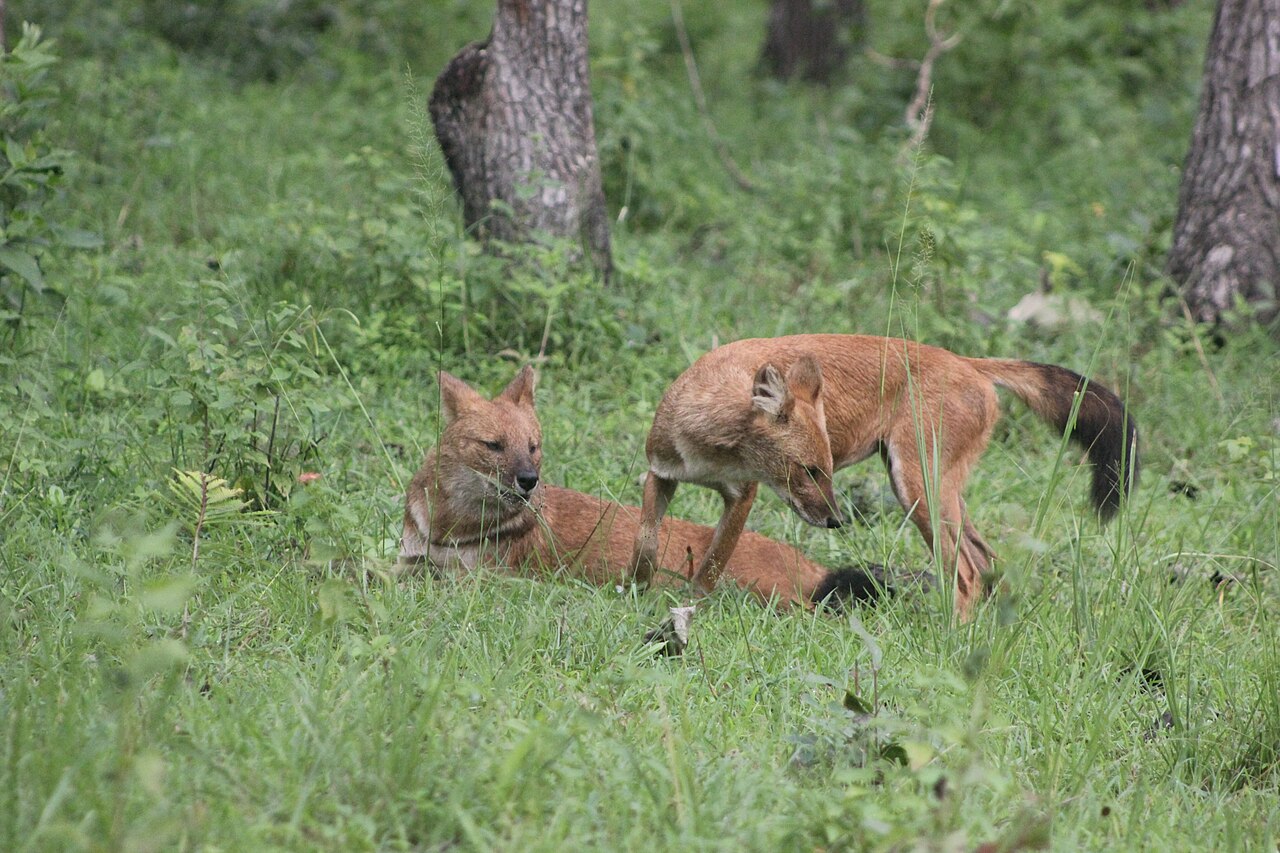
Banner image: Asiatic wild dogs or dholes in Bandipur National Park, India. Image by Dineshkannambadi via Wikimedia Commons (CC BY-SA 3.0).