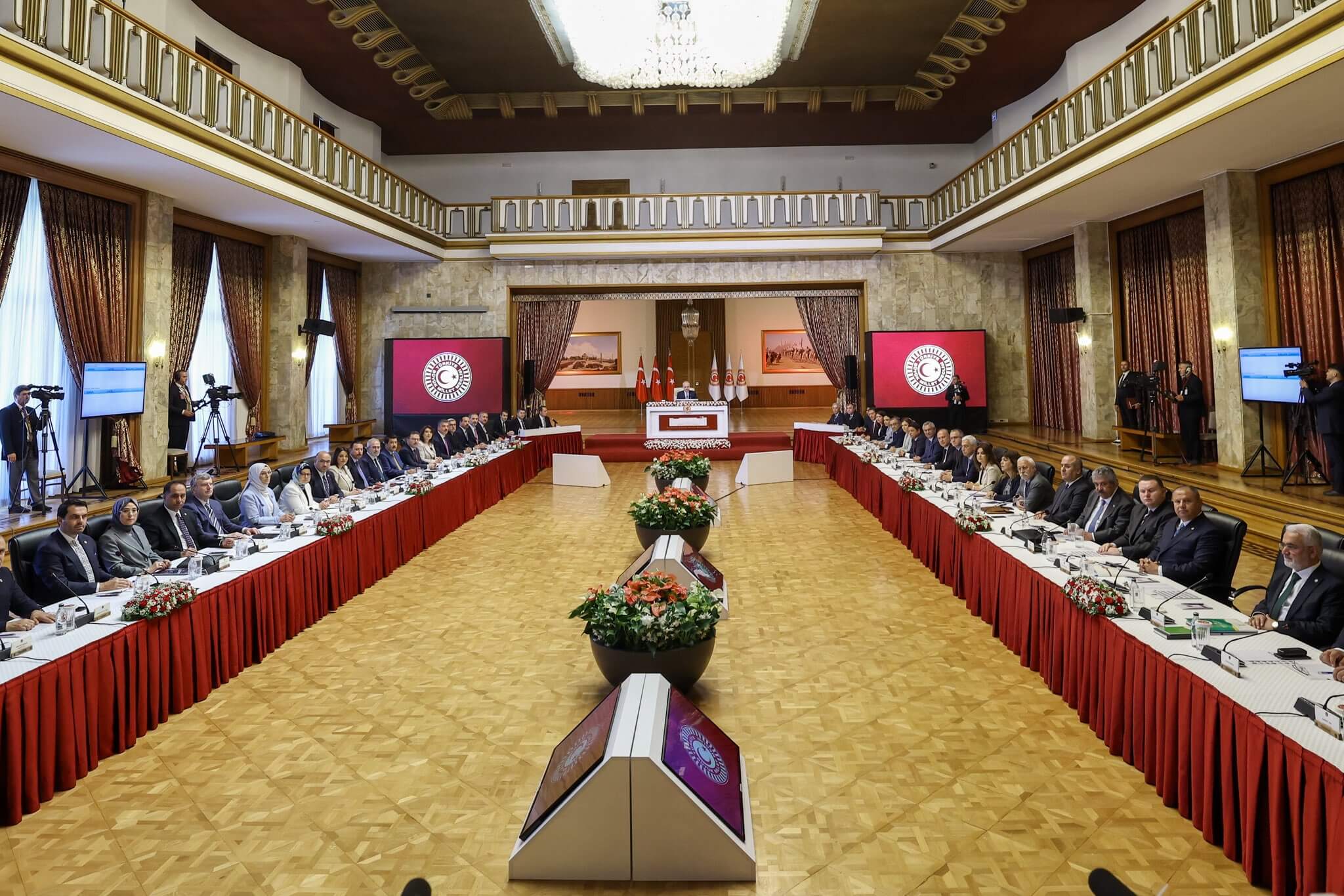
A government board tasked with overseeing the outlawed Kurdistan Workers’ Party’s (PKK) dissolution and laying down of arms held its first meeting in Ankara on Monday under the chairmanship of Vice President Cevdet Yılmaz, the state-run Anadolu news agency reported.
The Monitoring and Evaluation Board was established under the Law on Strengthening National Solidarity and Social Integration, which took effect last week and provides conditional legal relief to some people prosecuted or convicted of PKK-related offenses.
The meeting was held at the presidential complex and was attended by Justice Minister Akın Gürlek, Foreign Minister Hakan Fidan, Interior Minister Mustafa Çiftçi and Defense Minister Yaşar Güler.
Presidency Secretary-General Hakkı Susmaz, National Intelligence Organization (MİT) Director İbrahim Kalın and National Security Council (MGK) Secretary-General Okay Memiş also attended.
The board’s first meeting was expected to focus on its working procedures, coordination among government agencies and the creation of subcommittees to monitor different parts of the process.
Yılmaz said last week that the subcommittees would be established in accordance with the needs arising from the PKK’s dissolution and laying down of arms.
The board is responsible for monitoring whether the PKK, its umbrella organization, the Kurdistan Communities Union (KCK), and affiliated groups have ended their activities and surrendered all weapons and ammunition under their control.
Turkish security and intelligence agencies must first determine that those conditions have been met. The MGK must then confirm the finding, and its decision must be published in the Official Gazette before the law’s provisions can be applied.
Turkey and its Western allies designate the PKK as a terrorist organization.
Possible role for Öcalan
Pervin Buldan, a lawmaker from the pro-Kurdish Peoples’ Equality and Democracy Party (DEM Party), said last week that imprisoned PKK founder Abdullah Öcalan would take part in a panel overseeing the group’s laying down of arms.
Buldan, a member of the DEM Party delegation that holds talks with Öcalan at İmralı Prison, said one of the subcommittees would focus on the process of laying down arms and that Öcalan would help arrange the return to Turkey of PKK members who surrender their weapons.
The law does not name Öcalan or establish a specific subcommittee for him. However, it authorizes the board to create subcommittees and invite people whose participation it considers necessary.
The government had not confirmed Öcalan’s participation or announced the structure and membership of any subcommittee as of Monday.
Buldan’s remarks followed reports that a body dealing with the laying down of arms and the PKK’s transition to political activity could be established after the main board’s first meeting. DEM Party representatives have also called for civilian bodies, including a committee focusing on women, to participate in the broader process.
Öcalan, who has been imprisoned since 1999, called on the PKK in February 2025 to lay down its arms and disband, saying Kurdish demands should instead be pursued through democratic politics.
The PKK accepted his call in May 2025 and subsequently took steps that included a symbolic ceremony in northern Iraq at which militants burned their weapons.
Conditional legal relief
The 12-article law, approved by parliament on August 10, is the most concrete legal step yet in a peace initiative launched in late 2024 to end the PKK’s four-decade conflict with the Turkish state, which has claimed more than 40,000 lives.
It allows investigations, trials and prison sentences for certain PKK-related offenses to be suspended for five or 10 years, depending on the severity of the offense.
The relief can be applied only after the MGK confirms that the PKK and its affiliates have ended their activities and surrendered all weapons and ammunition under their control.
The law does not constitute a formal amnesty and excludes intentional killings committed as part of PKK activity. It also excludes offenses committed before June 1, 2005, that carry life or aggravated life sentences.
That provision prevents Öcalan, who is serving an aggravated life sentence, from benefiting from the measures concerning the suspension of investigations, trials and prison terms.
PKK denies purported İmralı records
Meanwhile, the PKK denied the authenticity of documents circulating on social media that purported to contain records of Öcalan’s July 20 and August 2 meetings with the DEM Party delegation.
In a statement attributed to its leadership, the group described the texts as fabricated and called their circulation before and after parliament’s adoption of the law a “planned provocation” intended to undermine the peace initiative.
The PKK said information about the İmralı meetings should be considered reliable only when released or confirmed by the DEM Party delegation.
The current initiative began after far-right Nationalist Movement Party (MHP) leader Devlet Bahçeli, a key ally of President Recep Tayyip Erdoğan, made a surprise call in October 2024 for Öcalan to urge the PKK to dissolve.
It follows the collapse of an earlier peace process in 2015, after which fighting resumed and the government intensified pressure on Kurdish politicians, elected officials and civil society groups.