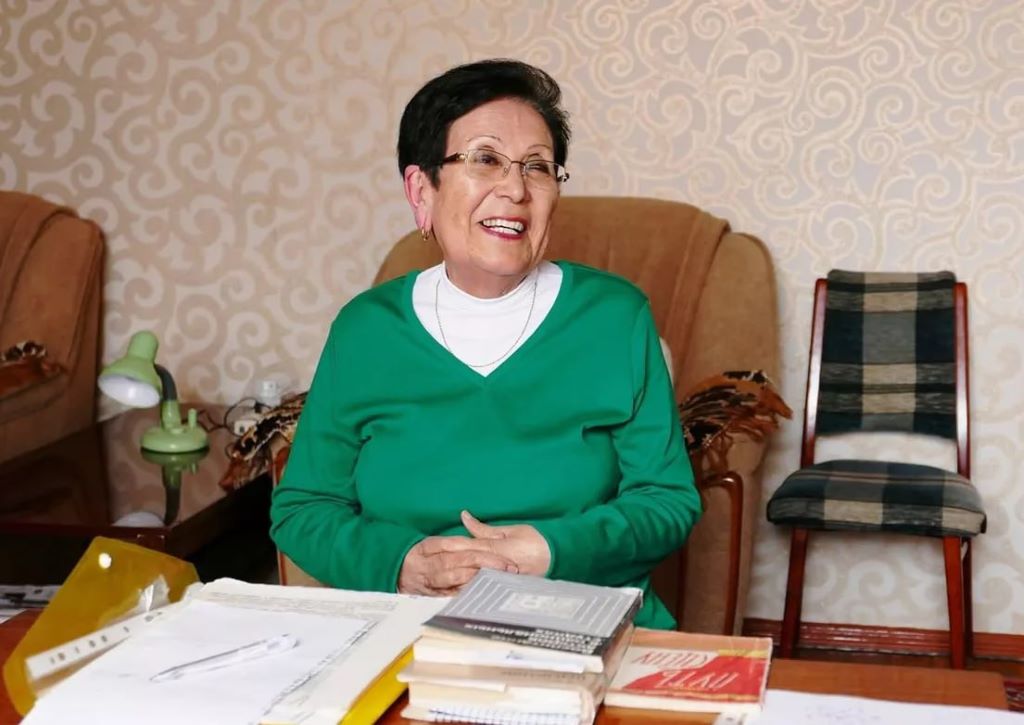
Tamara Abdushukurova — a renowned actress, theater director, and mentor to several generations of artists — would have turned 86 today. She passed away last year in Dushanbe.
Throughout her life, Abdushukurova devoted herself to the development of art and culture in Tajikistan, was an honored artist of the Tajik SSR, a teacher, a leader in the arts, and the country’s minister of culture.
Last year, on the occasion of Tamara Abdushukurova’s anniversary, “Asia-Plus” told the story of her life and creative path. Today, on another anniversary of her birth, we are publishing this material again.
Daughter of a High-Ranking Official
Tamara Abdushukurova was born in 1940 in the village of Shulmak in the Garm district, now Rasht. Her parents were natives of Samarkand. In 1938, her father was appointed first secretary of the Shulmak district of the Garm region of the Tajik SSR, so Tamara was born and raised here.
She showed an interest in art from childhood. She sang well and loved literature very much. The name Tamara was chosen for her by her older brother Rashid.
Later she would say that she was proud of her name: it was borne by the famous Georgian Queen Tamara, who was considered a just ruler and protector of her people. Moreover, it was also the name of a well-known Armenian singer who married an Uzbek, lived in Tashkent, and performed songs and dances of various peoples of the world.
Her father, who held a high position in the region, played an important role in Tamara’s fate, although he did not always approve of her choices. The family had four brothers and three sisters. Her mother was a homemaker.
Fear of Her Father and Her Brother’s Support
At age 16, Tamara participated in a festival at the Summer Theater in Dushanbe. There she was noticed by Mehrubon Nazarov, then deputy minister of culture, who offered her the opportunity to enroll at the State Institute of Theatrical Arts in Moscow — GITIS.
Tamara feared her father’s reaction: in those years, society was far from always favorably disposed toward women who chose an acting career.
Once again, her brother Rashid came to her aid. He convinced their father that Tamara would become not an actress, but a director of actors. In a sense, his words proved prophetic: later she indeed held high leadership positions in the field of culture.
At GITIS, Tamara Abdushukurova was exceptionally admitted directly to the second year, despite being only 16 years old. Her teachers Olga Pyzhova and Boris Bibikov valued the student for her modesty, discipline, and distinctive Tajik charm.
“
“Do not lose your modesty, do not chase Moscow fashion, and preserve the beautiful image of your people,” — such advice Pyzhova once gave to Tamara and her classmates.
She Was Entrusted with Roles of Strong Women
Tamara Abdushukurova occupies a special place in the history of Tajik theater. She established herself both as an independent dramatic actress and as an outstanding mentor to a new generation of artists.
In 1960, after graduating from the institute, she was assigned to the Musical Comedy Theater in Khujand, and just a year later was invited to Dushanbe — to the Tajik State Academic Drama Theater named after Lahuti, where she worked from 1961 to 1972.
According to Tajik theater critic Muhammadulo Tabari, one of Abdushukurova’s main characteristics was that she gave herself completely to each role and literally lived the life of the character on stage.
“
“Strong emotionality and precision in psychological states helped the actress deeply penetrate the inner world of her character. Despite the difference in age and social status of the characters, she always managed to create images of educated women on stage. That is why she was most often offered roles of bold and strong-willed women,” — notes Tabari.
Among her most notable works, he mentions Pelageia Egorovna in Alexander Ostrovsky’s play “Poverty Is No Vice” and Pauline in a production based on Honoré de Balzac’s play “The Stepmother.”
She also performed Antigone in Jean Anouilh’s play of the same name and Mawjuda in the production “The Will of a Woman” by A. Sidki.
During her years in the theater, Abdushukurova collaborated with renowned Tajik directors, including E. I. Mittelman, Kh. Rakhmatulloev, and Kh. Maybaliev. This work helped her further reveal her acting skills and the characters of the heroines she created on stage.
From Teacher to Minister
Tamara Abdushukurova proved herself not only on the theatrical stage. She played a major role in the development of artistic education and culture in the country.
From 1972 to 1986, she worked at the Tajik Institute of Arts — as an associate professor, head of department, and vice-rector. During these years, Abdushukurova passed on her knowledge and experience to the younger generation and educated many future artists.
Her organizational abilities and management experience were one of the reasons why in 1986 she was appointed first deputy minister of culture of Tajikistan. In this position, she was able to influence the development of national culture at the state level.
After three years of work in the ministry, in 1989–1990, Tamara Abdushukurova returned to the Tajik Institute of Arts as rector and continued working to improve the system of training creative personnel.
The pinnacle of her state career was the position of minister of culture of Tajikistan, which she held from 1990 to 1992. This was one of the most difficult periods in the country’s history. Despite the confrontation that had begun and escalated into civil war, Abdushukurova sought to preserve cultural life and support its development.
During her tenure, a number of major cultural events took place, including the “Navruz” theater festival for the Central Asian republics.
In 1991, she headed the organizing committee of the International Ballet Competition named after Maliki Sobirova.
On Life, Art, and Calling
Tamara Abdushukurova believed that talent alone was not enough for a true artist.
“In my opinion, art is not only talent; it also requires enormous work. If you do not work on your craft and do not labor, it will be very difficult to achieve success.”
She believed that art was capable of uniting people: “Art has no boundaries. It can unite people of different nationalities, religions, and beliefs.”
She took particular pride in the success of her students:
“When I see that my students have become masters of their craft, I am very happy. For me, this is the greatest reward.”
And even decades later, she had no doubt about her choice of profession: “I love my profession and still say: if I were given the opportunity to choose again, I would not choose any other profession.”
She formulated her attitude toward fame simply:
“
“I never chased fame and recognition; for me, it was more important to serve art and serve the people.”
An Actress Who Did Not Act in Life
In Khujand, Tamara Abdushukurova met her future husband Akram Kurbonaev — a renowned engineer who later became minister of food industry. They lived together for more than 60 years and raised three children: Sobir, who became an economist, Anvar — an electrical engineer, and Lola — a doctor.
Abdushukurova said that in their family, household duties were never divided into “men’s” and “women’s.” Even when both held responsible positions, the spouses tried to support each other. About herself, she said:
“
“Perhaps some people play roles in real life too, but I do not.”
She called herself a straightforward person and admitted that she was particularly intolerant of injustice.
Tamara Abdushukurova passed away in July 2025 in Dushanbe at the age of 84. For Tajikistan’s cultural community, her passing was a great loss.
After her death, colleagues and students said that she left the country a double legacy — creative and pedagogical. On one hand, her acting work remained forever part of the history of Tajik theater. On the other — hundreds of her students continue the work of their mentor.