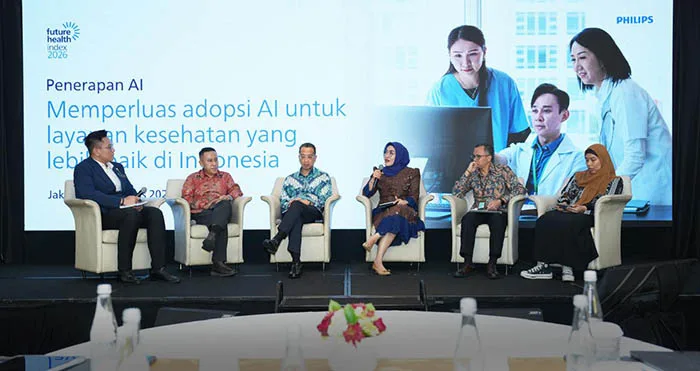
Jakarta, IO – Royal Philips launched the Indonesia report from its 11th annual Future Health Index, revealing that artificial intelligence (AI) is already delivering measurable benefits for clinicians, patients and healthcare organizations in Indonesia.
The findings mark an important shift in Indonesia’s healthcare AI journey.
While the 2025 Future Health Index focused on trust and the conditions needed for adoption, the 2026 report examines what AI is already delivering in practice. Indonesian clinicians report faster workflows and diagnostics, greater capacity to care for patients, better access to information and reduced workplace pressure. However, clinician adoption is advancing faster than the training, integration, monitoring, and governance needed to support safe and consistent use at scale.
The report was launched at AI in practice: Scaling AI for better care in Indonesia, convened by Philips in Jakarta with leaders from the Ministry of Health, healthcare providers and hospital associations to discuss the next phase of responsible AI adoption in Indonesia. “Indonesia’s healthcare AI conversation is entering a new phase. The question is no longer only whether AI can improve healthcare; clinicians are now showing us where it is already giving them back time, strengthening decision-making and helping them care for more patients,” said Astri Ramayanti Dharmawan, President Director of Philips Indonesia.
“The priority now is to turn these early gains into lasting improvements. That means connecting AI with clinical workflows and trusted data, equipping healthcare professionals with the right capabilities, and ensuring human judgment and accountability remain central to care,” she added.
AI is creating capacity where Indonesia needs it most
Indonesian clinicians report strong AI benefits in areas directly connected to healthcare capacity and care delivery. Almost nine in 10 clinicians, or 88%, say AI has improved workflow efficiency, compared with 71% globally. A further 87% report faster access to diagnostic results, while 82% say AI has accelerated diagnostic decision-making.
Three-quarters, or 75%, report improved access to consolidated patient data across care teams, compared with 57% globally. Better access to relevant information can reduce the time spent searching across systems and support more coordinated decisions.
These gains are translating into greater clinical capacity. More than two-thirds of Indonesian clinicians, or 69%, say AI-enabled tools have increased their capacity to see more patients, compared with 50% globally. Among those reporting increased capacity, the median increase is four additional patients a week.
AI is also helping clinicians use their time differently. Nearly six in 10, or 59%, report saving at least 88 hours a year on average, equivalent to more than two full working weeks. Clinicians say this gives them more time and headspace to think through cases carefully, apply greater precision and focus on higher value clinical work.
The benefits extend beyond productivity. Two-thirds of Indonesian clinicians, or 67%, say AI has improved their work-life balance, compared with 50% globally. The same proportion report reduced stress, while half say they are doing less overtime or bringing less work home.
This potential is particularly relevant to Indonesia’s geographically diverse healthcare system. More than eight in 10 clinicians, or 81%, believe AI can help narrow differences in care quality between healthcare settings and improve services in underserved communities.
Early financial benefits are emerging as well. Among Indonesian healthcare leaders, 43% report budget savings from AI implementation, compared with 34% globally, while 69% say the benefits of their investment are meeting or exceeding its costs.
“AI delivers the greatest value when it is integrated into clinical workflows and helps reduce friction in healthcare professionals’ day-to-day work,” said David Utama, President Director of Siloam International Hospitals. “For Siloam, the opportunity is not simply about adopting more technology, but about accelerating Siloam’s transformation toward the Hospital of the Future, with a consistent focus on clinical results and the best possible outcomes for patients. AI helps healthcare professionals make faster and more accurate decisions, while creating more time for meaningful interactions with patients. In this vision, technology serves as an enabler that strengthens clinical capabilities, while doctors and healthcare professionals remain at the center of decision-making and patient care. To scale AI broadly and responsibly, we need strong clinical leadership, trusted and connected data, clear governance, and close collaboration across the healthcare ecosystem.”
Healthcare readiness must keep pace with adoption
The findings show strong demand for AI among Indonesia’s healthcare professionals. Nearly two thirds, or 63%, say their use of AI-enabled tools provided by their organization has increased over the past year. More than half, or 57%, use generative AI to discuss work-related ideas.
Confidence in leadership is also comparatively high. More than three-quarters of clinicians, or 77%, believe their organization’s leaders are taking the right steps to implement AI-enabled tools, significantly above the global average of 59%.
However, clinicians do not always find the tools and support they need within their workplace. More than half, or 58%, turn to personal AI tools when their organization’s options do not meet their needs. This can create risks when tools are not clinically validated, securely integrated or covered by consistent privacy and accountability standards.
Training remains a significant constraint. More than half, or 55%, say training for AI-enabled tools is unavailable, limited or inconsistent. Clinicians want support not only in operating these tools, but also in protecting patient data, understanding legal liability and checking the accuracy of AI-generated recommendations.
Monitoring must also keep pace with deployment. Nearly two-thirds, or 62%, say clear processes for monitoring AI-enabled tools are not yet in place. As AI becomes more embedded in care, healthcare organizations will need clear mechanisms for validation, auditing, traceability and ongoing review.
As Indonesia advances the digitalization of electronic medical records through the SatuSehat ecosystem, the opportunity is not simply to add more AI tools. The next step is to connect trusted AI with clinical workflows, healthcare data and clear governance.
AI is moving from tool to teammate, with clinicians remaining in control
Indonesia’s clinicians are positive about how AI could change their work. More than nine in 10, or 94%, say their role is already becoming, or will become, more focused on higher-value clinical work, while 83% believe AI will help them work at the top of their professional capabilities.
As AI takes on more administrative tasks, processes information and supports clinical reasoning, clinicians increasingly see it as a teammate rather than simply a tool. However, they draw a clear line around autonomy: 94% say it is essential to keep a human in the loop as AI advances, while 91% believe all AI outputs require human oversight.
For most clinical applications, fewer than one in 10 clinicians would be comfortable with AI deciding and acting independently. Instead, they see AI as a partner that can support decisions, while healthcare professionals retain accountability.
Human relationships also remain central to care. Nine in 10 clinicians, or 90%, say AI will never replace the relationships healthcare professionals build with patients, while 87% believe interpersonal skills will become even more important as AI advances.
Read More: These Are the Five Habits That Distinguish Successful Entrepreneurs, Global Health-Products Firm Reveals
Patients are becoming part of this evolving care team. 57% use generative AI to search for health-related information online. While these tools can help patients become better informed, they can also create confusion: 80% of clinicians say they have had to correct AI-generated misinformation brought to them by patients.
Transparency will therefore be essential. Nine in 10 Indonesian patients, or 91% believe they should be told when AI is used in their care, underscoring the need for clear communication, trusted clinical guidance and stronger AI literacy among clinicians and patients.
“Indonesia has an opportunity to demonstrate that innovation and responsibility are not competing priorities,” Astri concluded. “AI can strengthen the human side of healthcare when it is designed around clinical needs, integrated into the way care is delivered and governed transparently. Government, healthcare providers, clinicians, academia and technology partners all have a role in building the connected infrastructure, workforce capability and safeguards needed to move from AI in practice to AI at scale and deliver better care for more people.” (est)