The saga of the disputed section of the Northern Rail Trail in Andover continues, with landowner Leonard Caron asking the courts to give him ownership of parts of the mile-long section or at least allow him to cross it as needed with gravel-hauling equipment, using a railroad bridge over the Blackwater River.
The request comes in Caron’s response to a civil lawsuit that was filed in July by the Department of Transportation. That suit led to the removal of concrete barriers Caron had placed to block access to the popular trail, an action that drew widespread attention.
In his response, Caron is seeking unspecified damages partly because equipment at his gravel operation adjoining the trail has been vandalized, Caron said, and because the state has been “allowing people to stray off the trail, allowing debris to fall onto the railroad bed, and allowing people to snowmobile, ride ATVs and electronic bicycles at excessive speeds and in the dark on the railroad bed and thereby causing dangerous and hazardous conditions” to him and his employees.
The response was filed in Merrimack Superior Court earlier this month. It asks for a jury trial.
Legal documents in the case go into many pages of detail over ownership and use of the long narrow strip land, dating back to the creation of the Northern Railroad in 1845, through the beginning of the end of commercial railroading in the 1970s and onto the state’s obtaining control.
Court documents detail how Caron has long been using or trying to use the trail and railroad bridge to access property which he bought starting in 1994, including 184 acres that contains the Dodge Gravel Pit where he now operates. Among those efforts: In 2004, the state says Caron asked about getting a lease, rather than a temporary use permit, for crossing the land with equipment but the matter was not followed up, and in 2013, he sought permission to haul gravel “parallel to the track” and over the railroad broad. That was rejected as being “incompatible” with people hiking and biking on the rail trail and creating a safety concern, partly due to the effect of heavy equipment on the bridge.
In late 2024 Caron asked the Department of Transportation, which owns rail trails in the state, for a temporary use agreement to cross the railroad bridge to access his gravel property but was denied for the same reason as in 2013. The state alleges that he nonetheless kept driving equipment “along the route NHDOT had rejected, including the railroad bridge.”
Matters heated up in early 2026 when “a Forest Ranger from DNCR observed tire tracks in the snow on the railroad bridge which led him to believe that Defendant was hauling gravel over the bridge. DNCR also observed that Defendant cut chains” placed to block the bridge. They alleged his machinery has damaged the bridge and the rail trail itself.
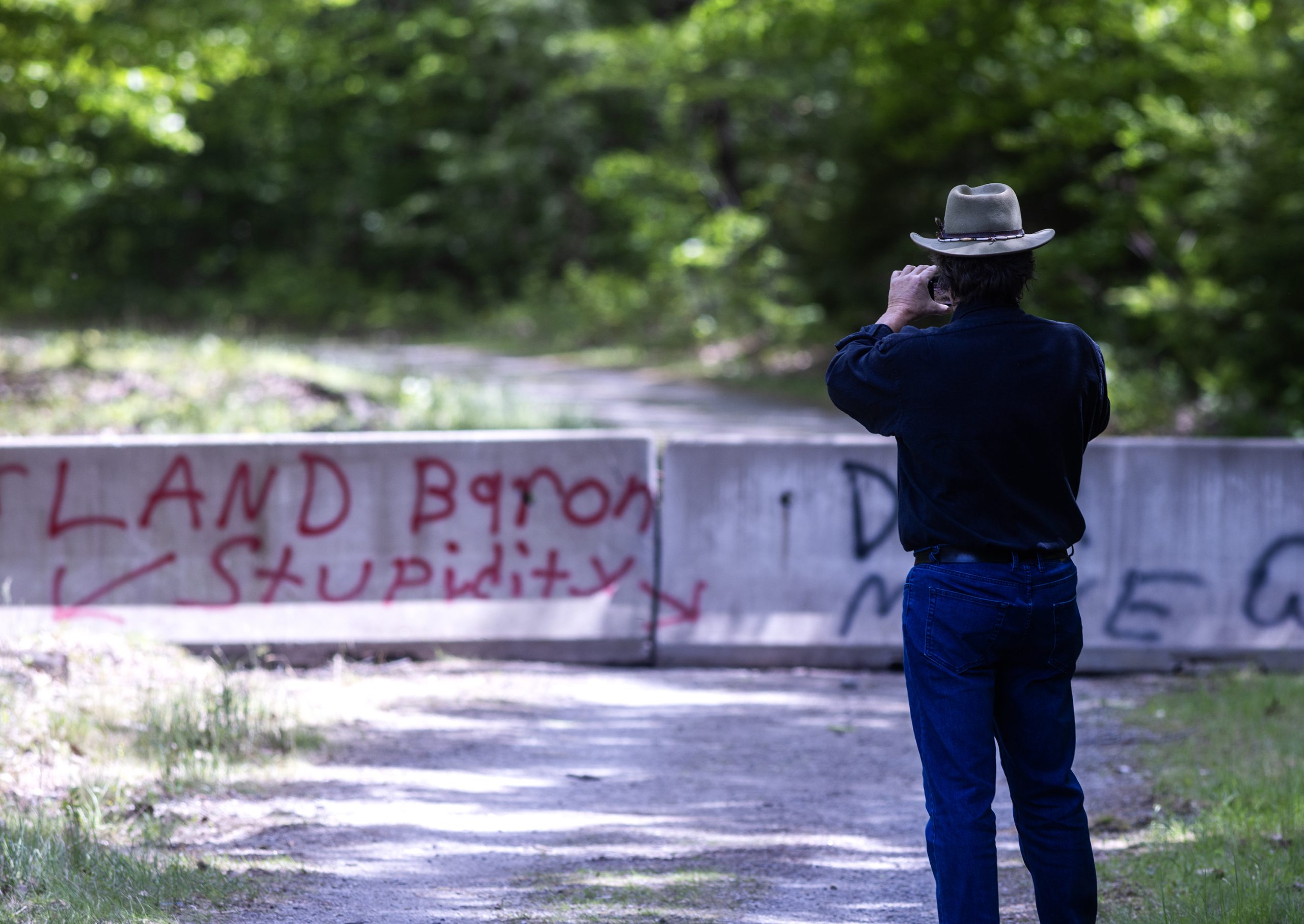
A cease-and-desist order was delivered to Caron in March of this year, spurring more legal discussion, culminating in Caron pacing concrete barriers to block off a mile of the trail over Memorial Day weekend. The state sued Caron in early July and the section was reopened July 10 after the two sides reached a temporary agreement allowing Caron partial use of the property on certain days.
The Northern Rail Trail runs 59 miles from Lebanon to Boscawen, where it connects to the Merrimack River Greenway trail being developed in Concord.
Court documents can be seen at www.courts.nh.gov/media/requested-cases/civil/state-new-hampshire-department-transportation-v-leonard-caron