SNOHOMISH — High school football is back, but it will look a little different for Wesco in 2026.
After Wesco 3A spent the past two seasons split into two divisions for football — North and South — the conference has incorporated a third league into the mix: Central.
The new five-team league pulled Monroe and Everett from last year’s South and Snohomish and Marysville Getchell from last year’s North, with Cascade coming in from Wesco 4A. The realignment leaves the leagues as follows:
Wesco 4A: Arlington, Glacier Peak, Jackson, Kamiak, Lake Stevens and Mariner.
Wesco North 3A: Ferndale, Mount Vernon, Oak Harbor, Sedro-Woolley and Stanwood.
Wesco South 3A: Edmonds-Woodway, Lynnwood, Meadowdale, Mountlake Terrace, Shorecrest and Shorewood.
Wesco Central 3A: Cascade, Everett, Marysville Getchell, Monroe and Snohomish.
Wesco 4A drops to six teams following Cascade’s departure, while the North goes from seven down to five. The South only dropped down to six with Lynnwood returning after spending the past two seasons playing an independent schedule.
Discussions for realignment between coaches and athletic directors started back in December, and the final decision was made in February, according to Jackson athletic director Erik Heinz, who is also the AD in charge of Wesco Football.
“It’s something that’s been discussed for a few years,” Heinz told the Herald. “So this year, with the end of the two-year cycle (the 2024 and 2025 seasons), coaches and myself met, and then the coaches kind of met amongst themselves, discussed a few possible scenarios about how they might want to realign.”
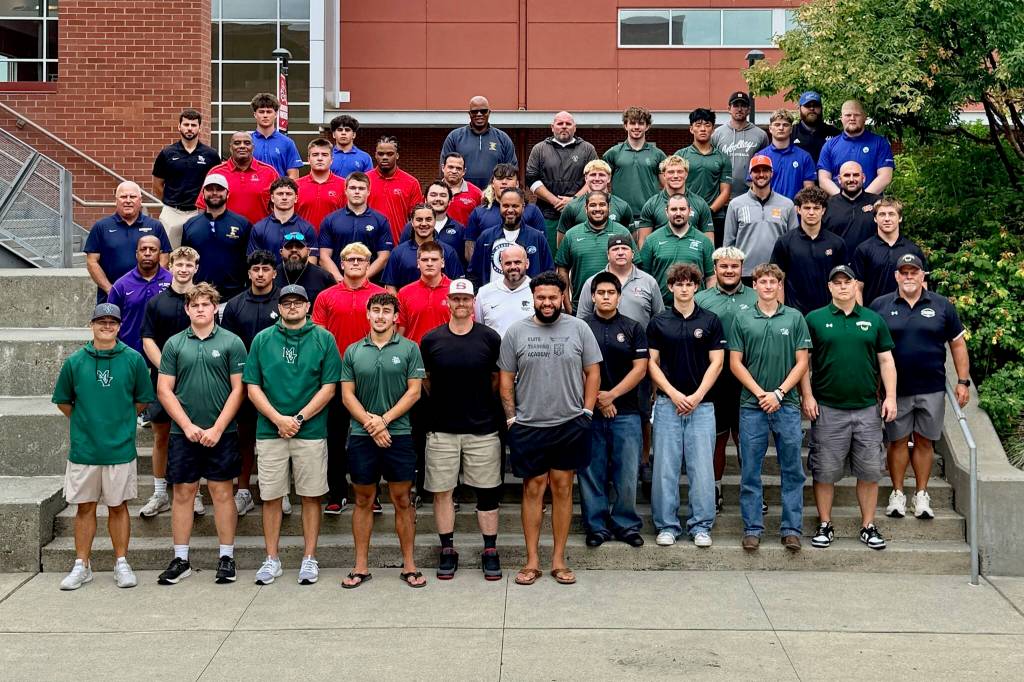
Geography was the biggest factor behind the change, according to Heinz and multiple coaches who spoke on the subject at the Wesco 3A Football Media Day at Snohomish High School on Sunday.
For example, the new South consists entirely of Edmonds and Shoreline district schools, so with the exception of non-league games, each of those teams will only have to travel to Edmonds Stadium and Shoreline Stadium this season.
While neither of the other two divisions can boast travel itineraries that contained, the new Central division still cuts down commutes for those programs.
“We decided as coaches that a little bit has to do with travel,” Marysville Getchell coach Davis Lura said. “Obviously, with our school district, we’re still coming out of financial burden, so this will definitely help out travel for us financially. … We’re excited to be in the league. I think it will be more competitive for us.”
Cascade also made the switch for competitive reasons. With new coach Richard Stuart at the helm looking to rebuild the culture at the program following an 0-10 season, the Bruins view their entry into the Central as a fresh start.
Stuart, who spent the past five years on Jackson’s coaching staff, also cited the difference in enrollment size between Cascade (around 1,650 according to U.S. News & World Report) and the other 4A schools (four with over 2,000) as a factor.
“I think obviously us moving back down to 3A is going to benefit our program a lot more, build confidence in our kids,” Stuart said. “The camaraderie right now is at a high, and these kids are ready to go to work.”
Everett coach Mark Stewart was one of the biggest proponents for the changes, and he views the schedule flexibility as a significant benefit of the new alignment. A larger league allows fewer options for non-league games, especially when factoring non-league rivalries that are locked in for each season, such as Arlington-Stanwood and Glacier Peak-Snohomish, among others.
With each Wesco league now consisting of five or six teams, programs only have four or five league games with the rest of the schedule open to tailor as they see fit.
“I think it definitely helps the top,” Stewart said. “The higher level teams will be able to say, ‘Hey, we think we’re going to make a state run,’ and if you have like three- and four-year starters and you were undefeated the year before, you can schedule (more high-end programs), and that’s going to help you in the seeding at the state tournament.
“Or you can be a team that’s struggling. A couple years ago, we were struggling, and maybe we wouldn’t want to open up with Ferndale. (This season) we really wanted to open up with Ferndale, and now we can open with Ferndale, so I think flexibility and scheduling is probably the (biggest) piece.”
Last year, Everett had six league opponents in the South and non-league rivalry games with Everett Memorial Stadium co-hosts Jackson and Cascade. The shift this season allows the Seagulls to schedule their aforementioned season-opener against Ferndale on Sept. 4, and also squeeze in two more crossover games against Mount Vernon and Shorecrest before the postseason.
Everett is not the only team filling their non-league games with other Wesco opponents, which coaches across the board believe will provide the seeding committee with a better idea of how all the teams stack up entering the postseason.
Last year, the top two North and South teams all qualified for the postseason while the third-, fourth- and fifth-place teams would each play crossover games to determine the rest of the postseason placements. This year, Heinz confirmed the top 14 teams will be seeded across all three divisions, with No. 1 playing No. 14, No. 2 playing No. 13, and so on.
“Everybody’s doing some crossover games (during the regular season),” Stewart said. “So you’ll be able to, at the end of the year… look and say these are the top 14.”
This new alignment will follow the same two-year cycle — which allows for a balance in home-field advantage since the schedules will remain identical in 2027, just with the home and away flipped — and the coaches and athletic directors will re-examine for 2028 and beyond.
Wesco will determine how the coaches feel regarding the schedule flexibility, the competitive balance in each league and any other topics that may arise over the course of the next two seasons.
“We want to make sure that everybody has feedback into this, and it’s a collaboration between the coaches and ADs to try to see what’s going to work best,” Heinz said. “Because again, we’re here for kids, and we want kids to enjoy their experience, and especially playing football, being able to enjoy it, staying safe. All those things factor in.”