Whistleblower group Justice for Myanmar (JFM) has warned that a new digital trade system contracted to a sanctioned Russian IT firm poses severe security risks, potentially granting Moscow access to Myanmar citizens’ personal identity data and sensitive ASEAN trade records.
On Aug. 12, the Myanmar military regime signed an agreement with Russia’s Astra Group—sanctioned by the U.S. and Canada—to build the “National Single Window” online portal to process all import and export paperwork across regime-controlled ministries.
1. Data exposure and digital surveillance
The new portal requires importers and exporters to submit sensitive personal and financial documentation, raising immediate fears of foreign data exploitation and digital dictatorship.
- Sensitive Data Capture: The system will collect national identity card copies, passport details, and personal bank statements mandated under trade licensing rules.
- Intelligence Links: Astra Group’s documented clientele includes the Russian Ministry of Defence and the Federal Security Service (FSB).
- System Expansion: Astra Group confirmed the platform’s architecture is engineered to eventually host all “state digital services” across Myanmar.
“This is part of the junta’s attempt to seize digital control. Any improvement in how the junta captures and analyses data can be used in its campaign of terror,” Yadanar Maung, Justice for Myanmar’s spokesperson, told DVB by email.
2. Threats to ASEAN regional trade networks
The project also threatens regional security by integrating directly with the ASEAN Single Window—a trade facilitation network developed with support from the U.S. Agency for International Development (USAID).
Justice for Myanmar has urged ASEAN member states and international partners to scrutinize Astra Group’s access to regional trade channels and enact coordinated sanctions against the firm.
3. Deepening Naypyidaw–Moscow strategic alliance
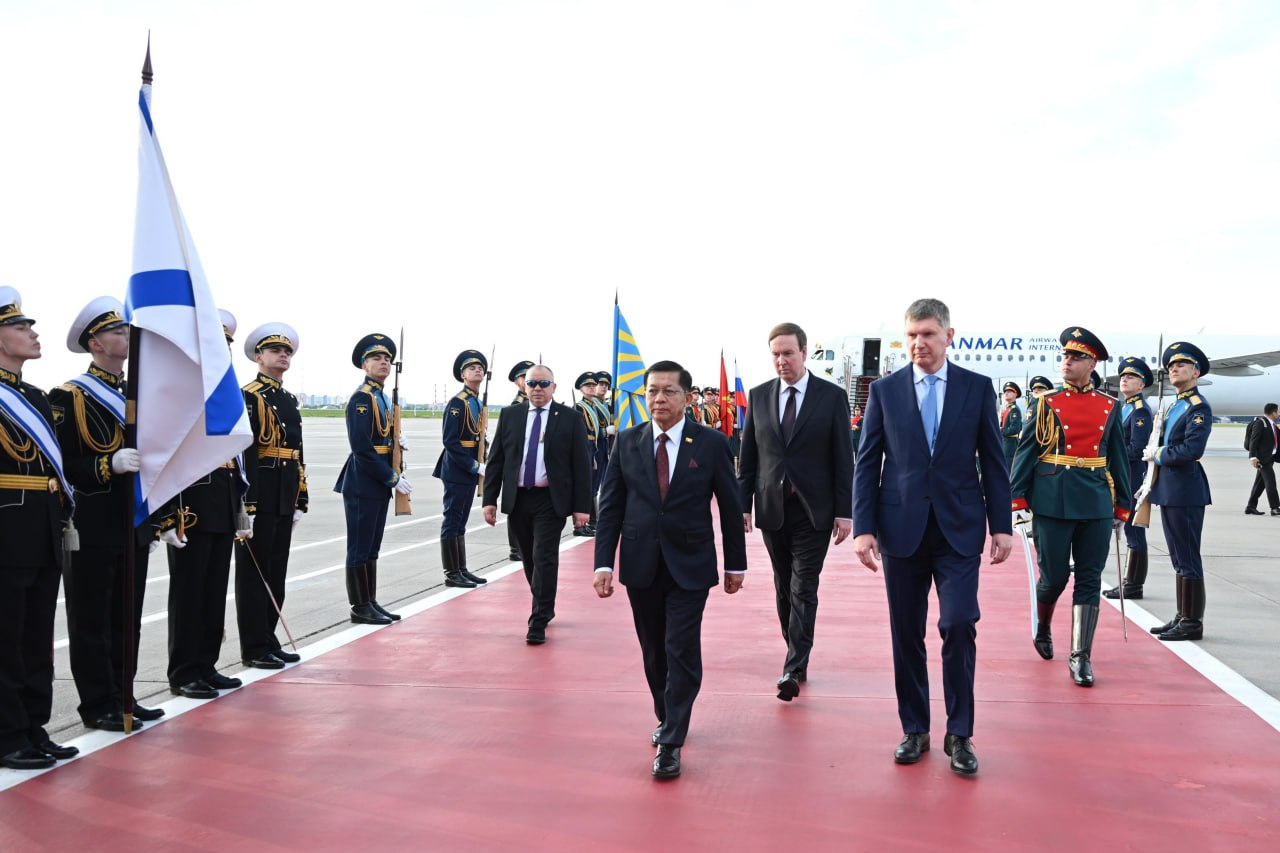
The software contract coincides with regime leader Min Aung Hlaing’s arrival in Moscow on Aug. 17, marking his fourth meeting with President Vladimir Putin and seventh trip to Russia since the February 2021 coup.
Strategic DomainBilateral Initiatives & Defense OperationsDigital & Trade TechImplementation of Astra Group’s National Single Window portal.Energy & InfrastructureDeals for a small-scale nuclear plant, oil refinery, and Dawei SEZ coal plant (Inter RAO).Defense & HardwareJoint “Tropical Storm” military exercise (July 2026); steady supply of Russian UAVs and munitions.
Myanmar remains one of Russia’s key strategic allies in Southeast Asia, backing Moscow’s invasion of Ukraine while relying on Russian military hardware, digital surveillance tools, and diplomatic backing.
The Russian military conducted a joint special operations exercise with the Myanmar military called “Tropical Storm,” in Naypyidaw, July 6–17.
The Armed Conflict Location & Event Data (ACLED) project reported in July 2025 that Moscow has steadily supplied the regime in Naypyidaw with munitions, unmanned aerial vehicles (UAVs), and anti-UAV defence systems.
But the bilateral ties go beyond the military. Naypyidaw and Moscow signed deals in 2025 to build a “small-scale” nuclear power plant in Myanmar, as well as a port, an oil refinery, and a coal-fired thermal power plant at the Dawei Special Economic Zone (SEZ), located in the Tanintharyi Region capital.
Russia’s state-run energy company Inter RAO and the regime-controlled Launglon Economic Development Company signed the agreement to develop the coal-fired power plant at the Dawei SEZ, in Russia, on June 5. Explore our Sanctions Monitor Dashboard