The mural reflects the philosophy of Indonesian cultural savant, philosopher and futurologist Sutan Takdir Alisjahbana
by Tamalia Alisjahbana
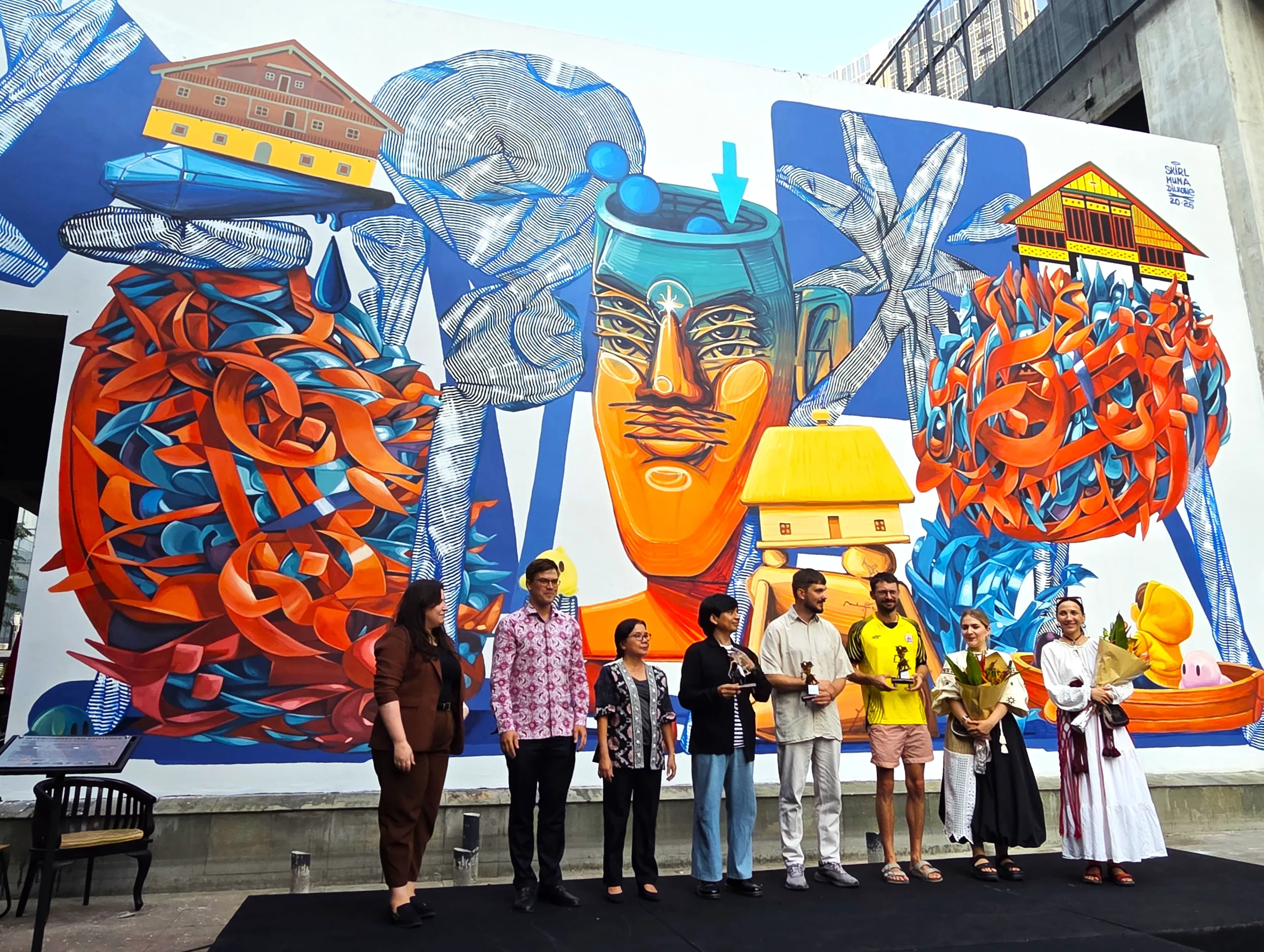
Jakarta, IO – On the 30th of July 2026 the unveiling of a new mural entitled ‘Interconnected Existence’ was held at the Taman Ismail Marzuki Arts Centre in Jakarta. The mural which is located on a wall at the promenade area of the Trisno Soemardjo Building at Taman Ismail Marzuki was created by three artists, Manuel Skirl from Austria, Vitalii Dilkone from Ukraine and Muna Diannur from Indonesia. The project was jointly organized by the Embassy of Austria in Indonesia, the City of Jakarta Cultural Services, the Jakarta Arts Council and the Embassy of Ukraine in Indonesia. Endah Retnoastuti the Director General of Dilomacy, Promotions and Cultural Cooperation, Indonesian Ministry of Culture spoke at the opening as did the deputy heads of missions of the Austrian Embassy (Michael Wislocki) and the Ukrainian Embassy (Yevhenia Shynkarenko).
The mural unites the creative vision of artists from three different cultures and nations while attempting to preserve the unique style and voice of each artist. When the dark curtains were removed what was revealed was an enormous mural covering an entire wall depicting the face of a man consisting of three faces in one, in the background stand blue and white ice shapes and at either side of him are spheres of blue and orange calligraphy. Three different houses were placed in different parts of the mural.
The blue and white ice forms shaded with thin black lines in the form of hatched shading were created by Austrian artist Manuel Skirl who likes to use the colours blue, white and black in his abstract murals in different parts of the world including such diverse places as Palestine, Thailand and the UK. The ice is to remind us of the effects of climate change one of which is the melting ice. One of the ice shapes is in the form of a tree that to an Indonesian eye could well be a banana tree which pleases Skirl who leaves the interpretation of his art to the viewer.
Ukrainian artist Vitalii Dilkone painted the figure of a man with three faces as the mural was created by three artists. There are also three blue balls entering or leaving the man’s head which could represent the three different cultures from which this mural was created. Dilkone’s roots lie in the underground graffiti movement of the 2000s. In Ukraine he evolved from grassroots street art to large scale public murals. With his deep commitment to community, his urban art is much used in community unifying public projects.
Meanwhile, Muna Diannur is an Indonesian artist who loves the use of Arabic calligraphy in her contemporary urban art although in the mural the calligraphy is used more in a decorative form rather than to express words. She is a spiritual person who at first puzzled the two European artists by announcing after hours of work that it was time – not for a lunch or rest break – but for a prayer break which was unheard of to them. However, they forged a bond over their cultural differences and produced a thought-provoking work of art. An interesting aspect of Diannur’s work is that below her razor-sharp calligraphic spheres of blue and orange flames showing the decreasing ice and the increasing heat of the earth, is the figure of a small child in a boat. In complete contrast to the pointed-edged calligraphy, the boat, the child and its toy are in soft and rounded forms. In Indonesian culture totally opposing views or beliefs often exist harmoniously side by side without creating a problem. See Mun Suparmo, a viewer at the unveiling commented softly, “The calligraphy is her mind but the soft round child is her heart.”
Another interesting aspect of the mural are the three houses each painted by a different artist. The house built by the Ukrainian artist sits at a precarious angle and Dilkone explained that this is of course, the effect of the war Russia is waging against Ukraine. The Indonesian house stands completely symmetrical but like the Ukrainian house, the Austrian house is also tilted and Skirl commented that although Austrian society is comparatively peaceful, he is looking further than Austria and the world is not in balance with climate change producing a major existential threat – which is what the mural is about.
The mural exemplifies the theme as well as the type of art encouraged by the philosophy and teachings of Sutan Takdir Alisjahbana, the first head of Taman Ismail Marzuki’s Akademi Jakarta or ‘Jakarta Academy. The Jakarta Academy is an independent advisory council on arts and culture of the Governor of Jakarta. It functions as a cultural think-tank that helps safeguard artistic freedom and shapes the broad intellectual and artistic direction of the Taman Ismail Marzuki arts centre.
Alisjahbana headed the Jakarta Academy for twenty-four years—from 1970 until his death in 1994—setting its guiding foundations. The unveiling of the mural on the 1st of August 2026, would have resonated deeply with him, showcasing the form of art he championed throughout the final phase of his own life and evolution: art in which creators actively help address the great challenges confronting their community, their nation, and most importantly, a world threatened by the danger of extinction.
He was twenty years old when Indonesia’s Youth Pledge of 1928 was first proclaimed by youth groups from different parts of the Archipelago at a Youth Congress in Jakarta (at the time Batavia). They pledged that they were one nation, one people and that they chose one national language, namely Malay.
It was the most important event in Indonesian history; even more important than the Declaration of Independence because Indonesia consisting of 17,000 islands with 1,340 ethnic and tribal groups and over 718 local and regional languages – needed to make sure that all wanted to unite and create a nation together before independence could be declared. That step began with the Youth Pledge of 1928 and was continued with the Cultural Polemics of the 1930s.
Alisjahbana played a pivotal role in shaping the Indonesian language by standardizing and modernizing the market Malay that served as the region’s lingua franca (publishing the first groundbreaking Indonesian grammar in 1936). He was equally influential in helping to define Indonesian national culture by initiating the Cultural Polemics of the 1930s which sparked a national dialogue over the nation’s cultural identity. Ultimately, what emerged was a democratic, inclusive national identity embracing the diverse cultures, ethnicities, traditions and beliefs of the Archipelago.
Endah Retnoastuti the Director General of Dilomacy, Promotions and Cultural Cooperation, Indonesian Ministry of Culture. (Photo credit: Tamalia Alisjahbana/IO)
At the time Alisjahbana said that if Indonesia were one day to become not only free but also a developed, economically prosperous country with democracy and justice for its people, Indonesians would need to learn science and technology from the West and for that our value system would need to promote logic, rational analysis and economic thinking.
However, during the last phase of his life and evolution, he came to realize that in order to create a better future one cannot only use logic, analytical and economic abilities, for the future is a dream and to build a dream one also needs imagination, instinct and creativity and these are the realm of the artist. Therefore, artists must be involved in the creation of that future and in helping to solve the great problems facing humanity which include war, nuclear power, environmental degradation and climate change; problems which if left unresolved would lead to the destruction of the planet.
Alisjahbana meant artist in the large sense of the word including not only painters but also musicians, dancers, sculpturers, writers, poets and so forth. At first, I had difficulty understanding what he meant with the role of artists in shaping a society and helping to solve the challenges of society. It was only when I went to Manila and at the Jose Rizal Museum saw his book Noli Mi Tangere that I began to understand. Once Filipinos had read his book, Philippine society understood the importance of freedom and demaned it. His book played an important role in the Philippine struggle for independence. It was the same with Raden Ajeng Kartini’s book ‘Through Darkness Towards Light’. Once people had read her book, society changed and accepted the idea of education for women. Such a transforming power is also present in art, music and dance which too have the ability to act as catalysts for profound societal shifts.
Sutan Takdir Alisjahbana. (Photo: copyright remains with the heirs of Sutan Takdir Alisjahbana)
Pablo Picasso’s painting Guernica (1937) created after the bombing of the town of Guernica during the Spanish Civil War captured the horror and suffering of innocent civilians. Until then art glorified war as heroism and victory. Guernica reframed it as a devastating tragedy of human suffering and helped alter public values and international consciousness.
In music, Va, Pensiero or the ‘Chorus of the Hebrew Slaves’ from Giuseppe Verdi’s 1842 opera Nabucco, is one of the most famous examples of music serving as a unifying cry for national freedom. It is sung by Jewish exiles in Babylon as they yearn for their lost homeland with the unforgettable lines: ‘O mia patria, sì bella e perduta!’ or ‘Oh my country, so beautiful and lost!’. At the time northern Italy was under the control of the Austrian Empire and the audience hearing the music immediately recognized their own political struggle. It became the unofficial anthem for Italian unification and independence.
The same can be said for the Italian song Bella Ciao or ‘Good Bye, Beautiful’ where a song of women’s labour resistance in the rice paddies of the Po Valley evolved into a major global symbol of resistance and liberation. Recently, a group of tourists in Israel began to sing Bella Ciao in front of Israeli guards at the gates into Palestine.
Pablo Picasso’s Guernica. (Photo credit: Angela Hu from United States, CC BY 2.0, via Wikimedia Commons)
It is not however only the words that transform but the music itself that can speak to us bypassing the conscious mind and addressing our subconscious directly and thereby reshaping culture, triggering social movements, and altering human consciousness. ‘Finlandia’ by Jean Sibelius (1899) is an example of such music. Finland was under the Russification policies of the Russian Empire and this purely orchestral piece stirred such intense Finnish patriotism and anti-imperial sentiment that it became a covert Finnish anthem. Just as the opening four notes of Beethoven’s 5th Symphony became the primary acoustic emblem recognised as the Allied victory symbol for occupied Europe during the Second World War.
In dance we can see examples of dances used as instruments of healing. An example is how in response to the 1621 Massacre of the Bandanese islanders by the Dutch East India Company, the survivors (mainly women and children) secretly conveyed the story of the massacre into their traditional war dance transforming a war dance into a dance drama. Arts therapy is today a recognized instruments of healing for conflict related post-traumatic stress.
The reason art has such transformative powers is because it can force empathy over argument by making the viewer or listener experience another’s reality which can dismantle prejudices that logic alone cannot touch. Art can make the invisible visible, exposing hidden injustices, unspoken taboos, or suffering but also great sacrifice, hope and love. Finally, art is able to create a collective consciousness. When thousands read a book or sing ‘Va, Pensiero’ a psychological shift occurs and the resulting emotional bond is the base needed for political solidarity and social movements to form.
1906 labour protests in Vercelli, Italy, where female rice-paddy workers successfully fought for an 8-hour workday. It is from such workers that the song Bella Ciao emerged. (Photo credit: Al*from*Lig, CC BY-SA 4.0, via Wikimedia Commons)
The artist is not just a motivator or a ‘social engineer’ stirring up emotions for a cause. The artist can also be a searcher of the human soul and reality, diving into the subconscious to discover an unarticulated truth, and bringing it up into the light. The social transformation that follows is simply the natural reaction of a society coming face-to-face with a truth it can no longer deny.
Logic and analytical ability are indispensable tools—they act as the chisel—but imagination and intuitive vision are the spark that decides where to strike. To reach the ultimate truth and the best balance a society needs logic and analysis but also emotions, empathy, instinct, imagination and creativity. This complete integration sits at the very heart of Alisjahbana’s intellectual legacy.
In the final phase of his own evolution, he advocated for a new synthesis: a humanity that embraces the expressive, intuitive, and spiritual fire of culture alongside the mastery of analytical intellect and technology. To build a truly great future, a civilization cannot walk on one leg. It needs both the head and the heart—the scientist’s rigor to discover the mechanics of the universe, and the artist’s soul to make that universe meaningful.
Alisjahbana began by helping to give a newly emerging nation its voice; he concluded his life by asking that voice to speak for the future of the Earth itself.
If after the Youth Pledge of 1928 he helped to define and give expression to: one nation, one people, one language, decades later when he had reached the end of his life having witnessed the realization of a sovereign Indonesia, the dawn of the nuclear age, global environmental degradation, and the challenges of rapid technological development and challenges—he recognized that the scope of human responsibility had also grown. He said that one nation, one people and one language had been accomplished and that now our responsibility had expanded from one nation, one people, one language to become: one humanity, one planet, one fate and one future.
Cakalele dance in the Banda Islands. (Photo credit: Tamalia Alisjahbana (private collection))
If this article interested you and you are interested in realted articles by the same writer: