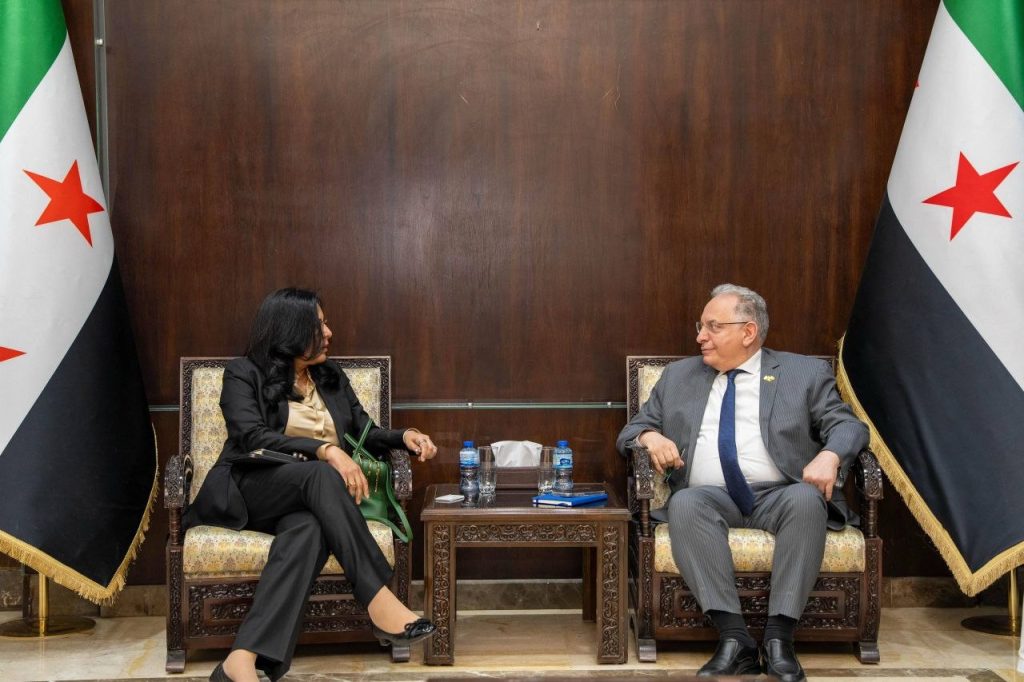
Syrian Minister of Finance Mohammad Yusr Barnieh met on Thursday with Dalia Khalifa, the newly appointed World Bank Regional Director for the Middle East, to explore expanded avenues of support for Syria’s financial reform agenda and long-term development priorities.
According to an official statement released on Telegram, Mr. Barnieh received Ms. Khalifa and her accompanying delegation in Damascus, with representatives from the Ministry of Foreign Affairs and Expatriates also present.
During the talks, the Minister reaffirmed Syria’s commitment to deepening cooperation with the World Bank and broadening joint operational frameworks that align with current national priorities, particularly in advancing financial, economic, and institutional reform. Both sides reviewed progress in ongoing collaboration between the World Bank, the Syrian government, and public institutions, underscoring the importance of sustaining momentum and accelerating the implementation of programs financed through World Bank grant mechanisms.
The discussions addressed targeted support for comprehensive pension and social security reform, as well as the structural reorganization of relevant public institutions. Delegates also examined the development of Syria’s real estate finance ecosystem, including the Real Estate Financing Supervision Authority, the modernization of legislative structures and mortgage-related financial instruments, and efforts to expand access to affordable housing finance.
Further deliberations focused on improving governance, operational performance, and competitiveness across state-owned economic and financial enterprises. This included exploring the gradual conversion of select public entities into joint-stock companies and restructuring state financial institutions in line with broader fiscal and economic reform mandates.
The meeting also provided an overview of Syria’s public finance policies, economic indicators, and the Ministry of Finance’s strategic roadmap. Discussions highlighted World Bank support for national strategies aimed at improving livelihoods and strengthening social safety nets to ensure more effective targeting of vulnerable communities.
Both parties examined measures to advance digital transformation across financial institutions, complete ongoing grant-funded sectoral projects, and establish a Public-Private Partnership (PPP) Knowledge Center to support the design and execution of developmental infrastructure initiatives.
Additional agenda items included the “Syria Without Camps” initiative within the national recovery framework, potential World Bank support for the voluntary and dignified return of displaced persons through multi-sectoral projects, and reforms intended to improve the business environment and stimulate domestic and foreign investment.
World Bank representatives affirmed the continuation of technical assistance and announced plans to dispatch specialized missions to Damascus in the coming period to reinforce ongoing economic development and reform efforts.
Last week, the World Bank’s Board of Executive Directors approved a $100 million grant from the International Development Association (IDA) to help Syria establish the foundations of a modern, secure, and digitally enabled financial sector. This latest allocation is the fifth grant extended to Syria—following earlier support for electricity, health, water, and public financial management—bringing total approved World Bank grants for the country to $491 million.
This article was translated and edited by The Syrian Observer. The Syrian Observer has not verified the content of this story. Responsibility for the information and views set out in this article lies entirely with the author.