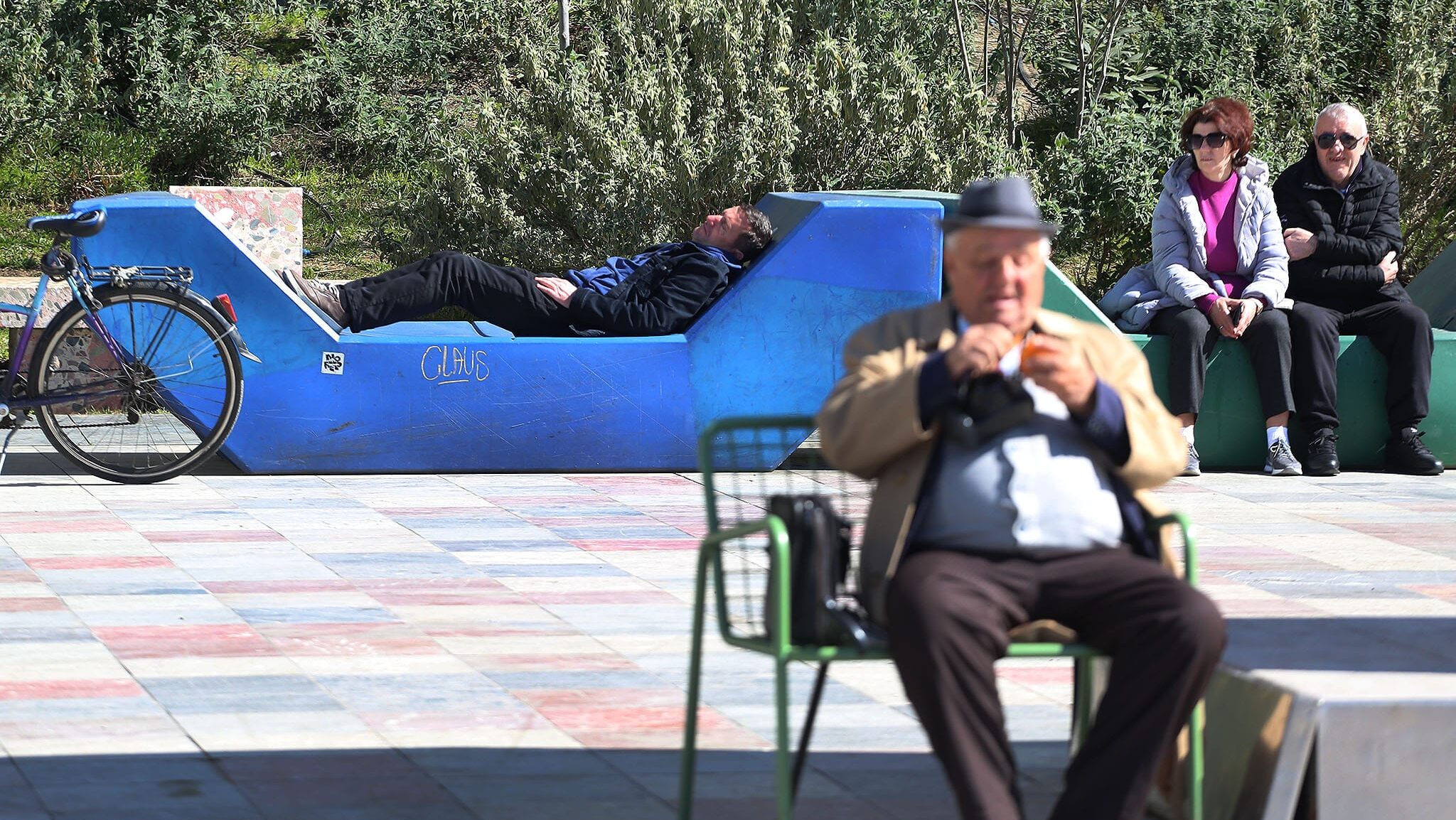
Pensioners in the park in Skenderbej Square in the centre of Tirana. Photo: LSA.
Documents produced by governing Socialist Party experts for a reform of the country’s municipal set-up, seen by BIRN, reveal an ageing population that could have adverse economic consequences for Albania.
The “Administrative-Territorial Reform 2.0” documents, prepared by experts on a special parliamentary committee, also show how emigration and internal migration have emptied out small towns and rural areas while concentrating the population in a few urban centres.
At one end are several urban centres where both population and economic activity are increasingly concentrated. At the other end are peripheral areas, particularly in the northeast, southeast and mountainous regions, which are caught in a vicious cycle of population decline and subsistence economies, with few formal jobs.
In these areas, municipal budgets survive largely on central government transfers, with funds often used mainly to cover the salaries of local administration staff.
The Urban Mass Index, UMI, one of three analytical documents underpinning the proposed new map of 46 municipalities – which would merge 15 local government units with larger municipalities – documents the territorial transformation of Albania since the 1990s, with a few centres continuing to grow as an increasing number of municipalities lose residents.
The “dependency ratio” in the index, which measures the burden that children and elderly people place on the working-age population, shows that in 51 municipalities out of 61 in total, this burden is higher than the national average. In many of them, the number of elderly residents exceeds the number of children.
The data highlights an Albania divided into three distinct realities: a small group of municipalities that continue to attract population and economic activity; a group of municipalities with intermediate potential; and a majority of the country’s territory, which is losing the critical mass of population needed to sustain local economies and public services.
The analysis is based on data from the 2023 census and, as part of the technical report accompanying the reform proposal, suggests that Albania is experiencing a growing concentration of its population in an ever-smaller number of urban centres, while the rest of the country is losing residents, functions and development capacity.
The index results show that only 13 municipalities are classified as having a high level of urban mass and are home to 62.5 per cent of the population.
By contrast, 30 municipalities – covering almost half of the country’s administrative map – are classified as having a low level of urban mass and account for just 14.2 per cent of the population.
Another 18 municipalities fall into the intermediate or medium category.
According to the data, the country’s population is concentrated in the capital, which is home to more than half a million people, followed at a considerable
distance by the municipalities of Durres, Vlora, Elbasan, Shkoder, Fieri, Kamza and Berat.
At the other end of the scale, municipalities such as Pustec, Libohova, Himara, Kelcyra, Memaliaj, Selenica, Dropull, Finiq, Delvina and Kolonja have the smallest populations.
The ruling-party experts did not build the index solely on population size. It also combines other indicators, including population density, the spatial distribution of residents, the demographic dependency ratio and the level of urbanisation.
This means that a municipality may cover a large area, but if its population is concentrated in a small town while the rest of its territory is largely empty, it is considered structurally weak.
One of the most significant findings is that, on average, 57 per cent of Albania’s territory is uninhabited.
The analytical document notes that the country no longer has the same population distribution it had in 2014, when the current administrative-territorial division was introduced with the aim of creating larger and more efficient municipalities.
“Some areas have grown, while others have lost a significant share of their population,” the report says, arguing that some municipalities are struggling to secure sustainable finances, qualified staff and adequate administrative capacity.
The Socialists have submitted a bill to parliament proposing a new administrative-territorial map that would merge several smaller municipalities with larger neighbouring ones – without explaining how the proposed map would address these underlying problems.
The proposal has faced opposition from residents in the affected areas. Some fear mergers will leave them with even more limited access to public services.