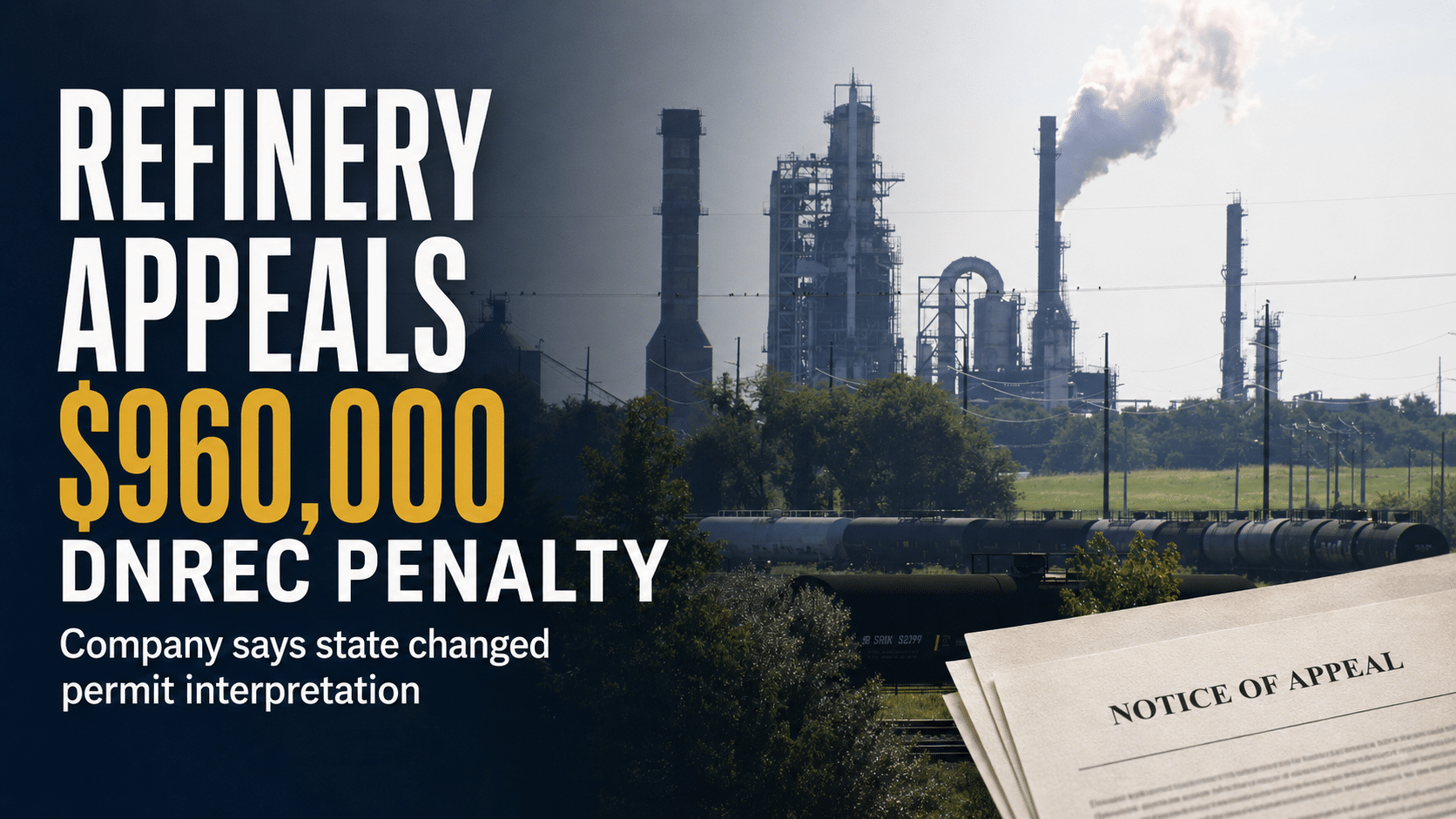
The refinery argues that the Department of Natural Resources and Environmental Control changed the way it interprets the refinery’s air permit. Image created with AI on 8/13
Company says state regulators changed how they interpret its air permit and failed to consider efforts to reduce emissions
By George D. Rotsch, Editor, Delaware LIVE
DELAWARE CITY, Del – Delaware City Refining Company is appealing a $960,000 state penalty tied to an equipment outage in May.
The refinery argues that the Department of Natural Resources and Environmental Control changed the way it interprets the refinery’s air permit. It also says DNREC failed to give enough weight to the company’s efforts to reduce emissions and safely complete repairs.
The appeal was filed July 30 with the Delaware Environmental Appeals Board. The board can uphold, change or reverse DNREC’s decision.
The case involves the refinery’s fluid coking unit, commonly called a coker, and a boiler that is part of the unit’s main pollution-control system.
The boiler was taken offline from May 7 through May 30 after workers found a leak. The refinery continued operating the coker while replacing the damaged equipment. Exhaust was sent through a backup incinerator during the repairs.
DNREC said the event released about 745 tons of sulfur dioxide and 50.5 tons of nitrogen oxides.
The department fined the refinery $40,000 for each of 24 days, the maximum daily penalty allowed under state law.
Dispute centers on permit language
The refinery does not appear to dispute the amount of pollution released. The disagreement is over whether the emissions violated the refinery’s permit.
DNREC says the coker has an annual sulfur dioxide limit of 182.3 tons. The department says that limit includes emissions released through the backup incinerator.
Under that interpretation, the 745 tons released during the May outage far exceeded the annual limit.
The refinery argues that the annual limit applies only during normal operations, when exhaust passes through the main boiler and a wet-gas scrubber. The scrubber removes sulfur dioxide from the exhaust before it is released.
The backup incinerator controls carbon monoxide and particulate matter, but it does not control sulfur dioxide or nitrogen oxides.
The refinery says its permit has separate rules for operating during periods when the main boiler and scrubber are unavailable. Those rules limit the coker’s production rate, the sulfur content of its feedstock and its hourly sulfur dioxide emissions.
The company argues that those backup rules would serve little purpose if the refinery were required to shut down the coker every time the main pollution controls went offline.
DNREC’s record is mixed
DNREC has previously said the refinery violated its permit by continuing to operate the coker when the main pollution controls were unavailable.
A 2016 violation notice covered two similar outages in 2015. DNREC said continued coker operations without the boiler and scrubber violated the refinery’s operating requirements.
In that respect, DNREC’s current position is consistent with its earlier enforcement.
However, the 2016 notice did not accuse the refinery of violating the 182.3-ton annual sulfur dioxide limit. That was true even though the two outages released a combined total of more than 570 tons of sulfur dioxide.
DNREC clearly applied the annual limit to backup-incinerator emissions in a September 2025 violation notice. It applied the same interpretation again in the current case.
The refinery says DNREC issued about 12 earlier violation notices involving similar outages without applying the annual limit in this way.
That suggests DNREC has been consistent in questioning continued coker operations without the main pollution controls. But counting backup-incinerator emissions against the annual limit appears to be a newer or expanded enforcement position.
The appeals board will have to decide whether DNREC properly applied the permit or changed its interpretation without enough explanation.
Refinery points to safety concerns
DNREC argues that the refinery should not have continued operating the coker while the main pollution equipment was offline.
The refinery says an immediate shutdown could have created other environmental and safety problems.
According to the appeal, an emergency shutdown could increase flaring, damage equipment and place workers at risk. Because the coker is connected to several other refinery systems, shutting it down could also force other parts of the refinery to reduce or stop operations.
The company says it can take about six weeks to return the coker to normal operations after a long shutdown.
Those claims are the refinery’s arguments and have not yet been tested during a hearing.
Company says it reduced emissions
The refinery says it informed DNREC, elected officials, Delaware City representatives and community members before beginning the work.
The company also says it:
- Reduced the coker’s operating rate.
- Reduced activity in another major refinery unit.
- Used material with a lower sulfur content.
- Stopped certain processing work.
- Added sulfur dioxide monitoring.
- Published real-time air-monitoring information.
- Finished the repairs eight days earlier than expected.
The refinery estimates that reducing its operations cost the company about $4.3 million.
It also says air readings around the refinery remained within public-health standards during the repairs.
Those air readings do not prove the refinery complied with its permit. Air-quality readings in the surrounding community and emissions limits at the refinery are separate regulatory measurements.
Monitoring showed no reported community harm
No injuries, illnesses or known exposures were reported during the release, according to the refinery’s appeal.
Air monitors at the refinery’s property line and nearby state monitoring stations showed ground-level sulfur dioxide concentrations remained below federal public-health standards throughout the repairs. DNREC had also told the public before the work began that emissions could increase at the refinery while air quality at ground level remained in the “good” range.
The refinery argues that those readings show the release did not reach levels expected to harm the surrounding community.
The monitoring results do not settle the permit dispute. Public-health standards measure the air people breathe at ground level, while the refinery’s permit limits the amount of pollution released from its equipment. DNREC can therefore allege a permit violation even when nearby air readings remain below levels considered harmful to the public.
Maximum penalty questioned
DNREC said the large amount of sulfur dioxide released, the refinery’s history of violations and the economic benefit of continuing production justified the $960,000 penalty.
The department also said the refinery had not done enough to prevent repeated boiler outages.
The refinery disputes those findings. It says it ordered a replacement part after a 2025 outage and installed it in May rather than making another temporary repair.
The company also argues that DNREC did not adequately explain why the maximum penalty was appropriate. It says the state failed to fully consider the reduced production, extra monitoring, repair costs and safety risks of an immediate shutdown.
DNREC has a duty to enforce environmental laws and protect nearby communities. The refinery, however, is entitled to clear permit requirements, consistent enforcement and a penalty that reflects all the facts.
The Environmental Appeals Board will decide whether DNREC reached the proper balance.
To Go Box:
Case: Environmental Appeals Board No. 2026-06
Company: Delaware City Refining Company LLC
Penalty: $960,000
Outage: May 7-30
Reported emissions: 745 tons of sulfur dioxide and 50.5 tons of nitrogen oxides
Refinery’s request: Reverse DNREC’s findings and penalty
Status: Appeal pending
Delaware LIVE collaborates with a network of professional journalists to cover a diverse range of stories across various fields. Staff Writers include experienced journalists and young professionals. If you have questions, please feel free to contact [email protected] or our publisher, George D. Rotsch, at [email protected]