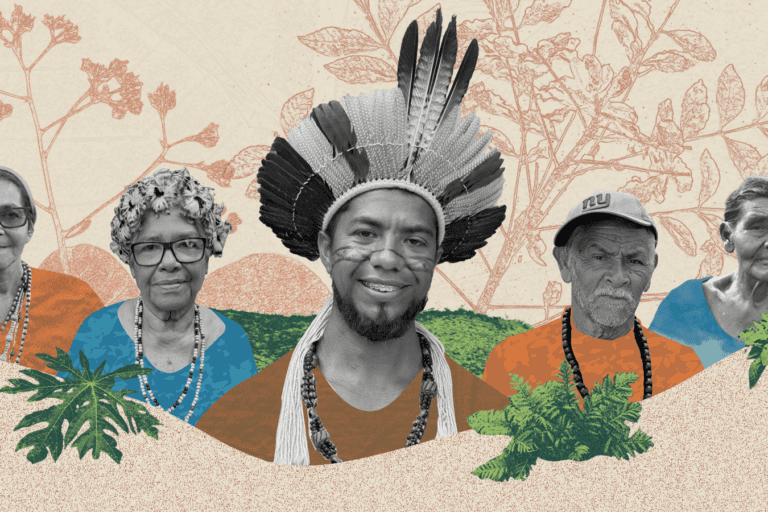
CARAMURU/PARAGUASSU INDIGENOUS TERRITORY, Brazil — Looking at the landscape of dry and cleared mountains around her house, Marta Xavier de Oliveira remembered when it was a forest. “When we got sick, that’s where we got our medicine from,” Oliveira, known as Dona Marta, 87, told Mongabay. An Indigenous elder of the Kariri-Sapuyá people, she stands amid her ancestral land in Brazil’s northeastern Bahia state and her vegetable garden where she’s kept several medicinal plants going. Beside her is an embaúba tree (Cecropia pachystachya), used to treat diabetes and prostate issues, in the backyard of her house in the village of Caramuru. “It was all over there. They knocked everything down. Everything was cleared and they destroyed the forest.” Some native species, including embaúba, were planted here 44 years ago. Others, however, disappeared from the territory over the past decades, when outsiders invaded the area and cleared the forests for cattle pastures, Dona Marta said. She cited a specific plant: puaia, used to treat snake bites, plague — an illness elders said includes fever, headaches, and leaves the body all twisted — and various other diseases. “It was there in the woods,” she said, pointing to the cleared mountains. “It’s gone.” On Dec. 27, 2025, Dona Marta passed away. Her knowledge, however, is alive today in a study published in the Journal of Ethnobiology and Ethomedicine, which cited her. The paper is authored by Indigenous ethnobotanist Hemerson Dantas dos Santos Pataxó HãHãHãi and Eliana Rodrigues, a professor and coordinator of ethnobotanical…This article was originally published on Mongabay