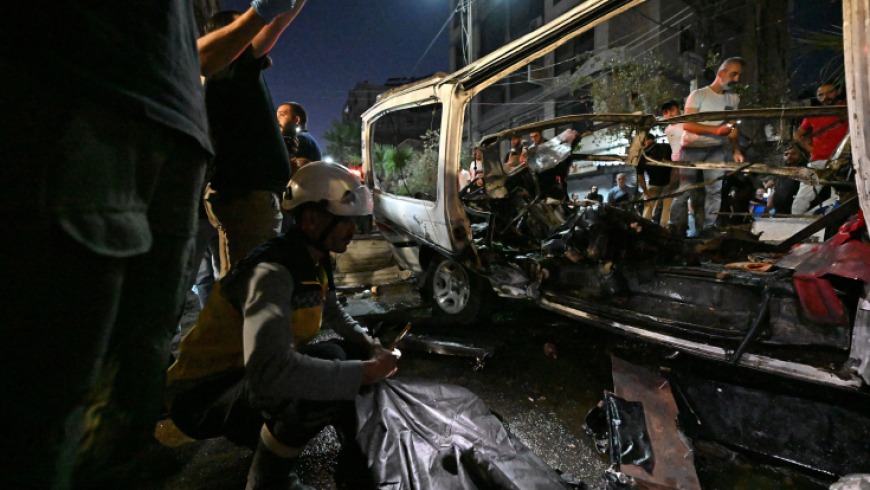
A WhatsApp channel calling itself “Ansar al-Rasul Platform” has claimed responsibility for the 6 August bombing of a minibus in Jaramana, southeast of Damascus. Nothing currently rules out the possibility that the group was indeed behind the attack. Its channel has been active since March 2025, and the rhetoric it has circulated since mid-July aligns with the escalation that culminated in the explosion.
The shift began after Druze residents in Jaramana held a demonstration marking last year’s killings of members of their community in Suwayda. On the same day, the channel abandoned its earlier description as a “social and religious outreach platform” and issued a sharply worded message directed at the city’s Christian and Druze communities. It warned that the statement represented “a clear proclamation and a final warning,” and claimed that Sunnis were “the predominant weight and the largest and strongest community in this city.”
The message framed Jaramana as “deeply rooted Sunni Islamic land,” asserting that Sunnis would not accept being treated with suspicion or contempt. It portrayed the Sunni community as “a nation of dignity” that now carried the responsibility of building a new Syria and holding the reins of governance.
The channel claimed that it had exercised restraint for the sake of civil peace, yet argued that “systematic harassment and repeated abuses” against Sunnis in Jaramana had crossed every boundary. It accused local actors of daily provocation, including hostile reactions toward men who maintain conservative religious appearances such as full beards. The language reflected tensions between long-standing Druze residents and newer arrivals whose displacement has altered the city’s demographic balance.
Two days later, the group praised security forces for dispersing what it described as a “rabble demonstration inciting rebellion and treason.” It used coarse language to attack protesters who had chanted against “His Excellency President Ahmed al-Sharaa,” and celebrated the speed with which security forces “descended upon them like a thunderbolt.”
At the beginning of August, the group escalated further. It claimed that its “cyber arm” had compiled names, phone numbers and photographs of Druze residents, placing them “in the hands of the Ansar al-Rasul Brigade.” It declared that all opponents were now under surveillance and entered into a target list “from the youngest among you to your elders, and even those newly born among you.”
Hours after the 6 August bombing, the group issued a claim of responsibility. It described the attack as one in a series of promised operations in what it called “the stronghold of the infidel, oppressive swine.” It framed the bombing as retaliation for “harassment, contempt and humiliation” directed at Sunnis, and insisted that earlier statements had been peaceful attempts to resolve grievances. “We were never aggressors,” it said. “We were advocates of peace and guardians of civil peace.”
A follow-up statement the next day attempted to present a more structured narrative. The group described itself as entirely independent, unaffiliated with any political or military actor, and respectful of “the law, the government and the Sharia.” It claimed to seek a peaceful life in Jaramana, yet argued that when Sunni rights were violated and ignored “amid the deep slumber and complete absence of the state,” confrontation became inevitable.
The group accused Druze members of the Interior Ministry’s “General Security” forces in Jaramana of contributing to an atmosphere of intimidation. It alleged that one Druze officer collaborated in the bombing by helping procure explosives and ensuring the minibus passed through security without inspection.
The statement then addressed the authorities directly, asking: “Why, our government, do you assign Druze security personnel to police us in Jaramana when Sunnis have become the majority there, just as they are in Syria as a whole?” It called for the General Security forces in the city to be staffed entirely by Sunnis and reinforced with personnel from Damascus, arguing that the city must be “swept clean of remnants of the former regime and pockets of the treacherous Hijris.”
The group’s discourse mirrors the contradictions that define Syria today. It is marked by linguistic inconsistency, oscillating between grandiose religious rhetoric and colloquial threats. It expresses loyalty to the state and pride in its security apparatus, yet carries out an attack that targets civilians and undermines state authority whenever its demands are not met. Its grievances reflect the anxieties of a group that perceives itself as marginalized in a city transformed by large-scale internal displacement.
The authorities’ own support base exhibits similar contradictions, shifting between triumphalism and a sense of victimhood, and between appeals to civil peace and threats of annihilation. The boundary between political positioning and sectarian hostility remains perilously thin.
Given this landscape, and given the group’s rhetoric, posture and escalation, there is little reason to dismiss the possibility that the “Ansar al-Rasul Platform” was indeed responsible for the attack.
Disclaimer: Groups that employ violent extremist tactics, including those claiming responsibility for the Jaramana bombing, are responsible for severe harm, loss of life and destabilization. Information about such groups should be verified through trusted sources.
This article was translated and edited by The Syrian Observer. The Syrian Observer has not verified the content of this story. Responsibility for the information and views set out in this article lies entirely with the author.