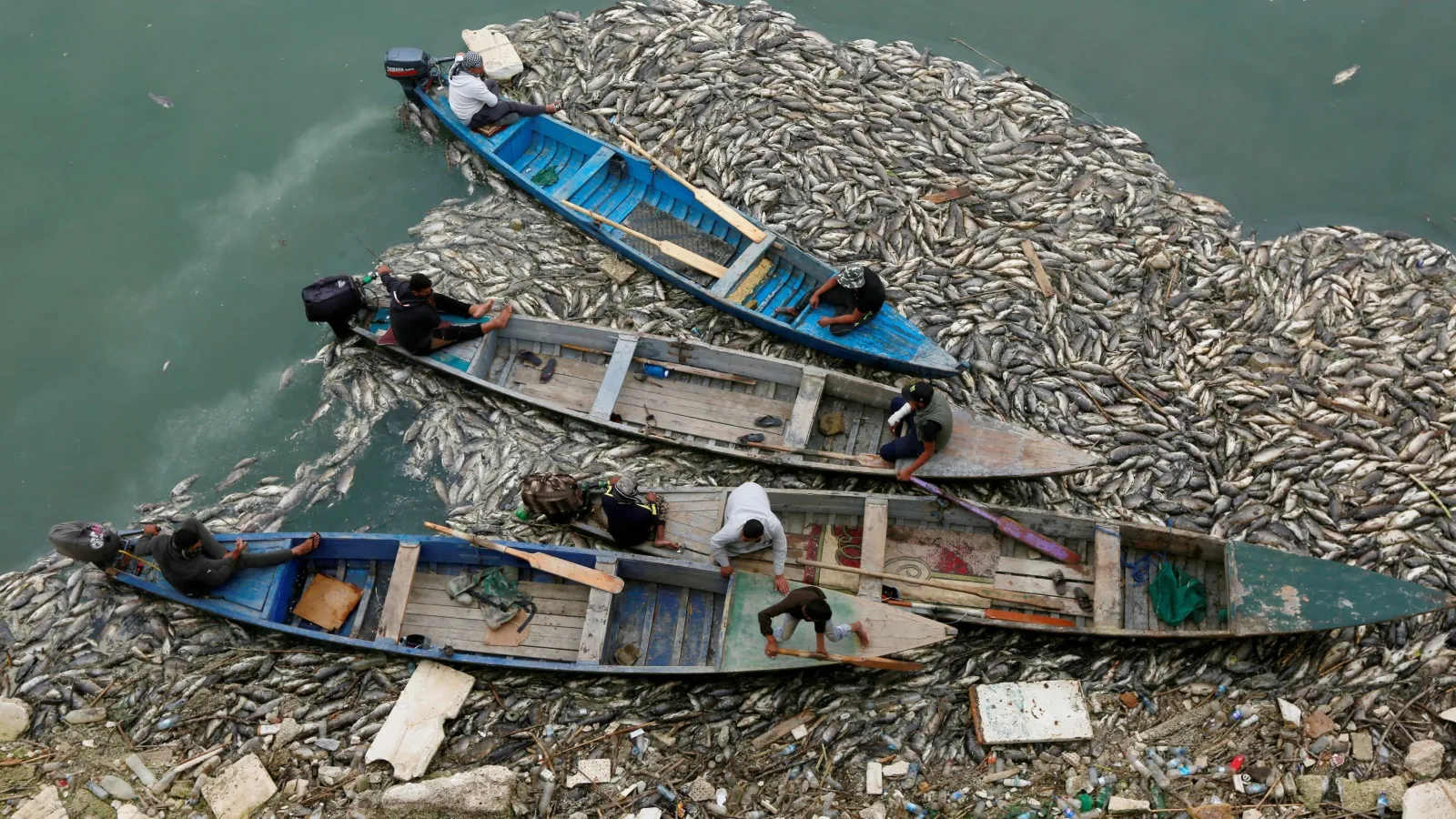
Baghdad (IraqiNews.com) – Recurring Iraq fish deaths are becoming an increasingly serious environmental and economic warning, with the Green Iraq Observatory describing the phenomenon as an annual pattern that reflects the accumulation of two interconnected crises: worsening water scarcity and persistent pollution.
Rather than representing isolated incidents caused by temporary changes in river conditions, the repeated deaths of large numbers of fish across Iraq’s rivers, canals and marshlands suggest that the country’s aquatic ecosystems are coming under sustained pressure from declining water flows, untreated wastewater, industrial pollution and weaknesses in water management.
The latest incidents, recorded in April and August 2026, have once again raised concerns about the condition of Iraq’s freshwater resources and the government’s ability to protect them. According to the observatory, more than 1,000 tonnes of fish died in the Tigris and Diyala rivers during April, with particularly heavy losses reported in Wasit province, while a separate incident occurred earlier this month in the Al-Amshan Canal in Maysan.
Although the two incidents were associated with different immediate circumstances, they demonstrate how vulnerable Iraq’s aquatic ecosystems have become when declining water levels interact with pollution and inadequate environmental controls.
Iraq fish deaths are becoming an annual warning sign
The Green Iraq Observatory argues that the recurrence of mass fish deaths should no longer be treated as a series of unrelated environmental emergencies. According to its assessment, similar incidents have occurred repeatedly across different parts of Iraq over the past several years, yet the underlying causes have not been addressed with sufficient consistency to prevent them from returning.
This pattern is particularly concerning because rivers and wetlands are not only ecological assets; they also support fisheries, agriculture and the livelihoods of communities that depend directly on healthy waterways.
The observatory said the April incident involved more than 1,000 tonnes of dead fish in the Tigris and Diyala rivers, with the largest losses concentrated in Wasit. It attributed the event to severe contamination caused by untreated sewage and industrial waste, while also pointing to increased water releases from Hamrin Dam that reportedly moved accumulated pollutants downstream toward the Tigris.
The organization further said that more than 20 people experienced poisoning or skin-related injuries and were taken to hospital, illustrating how deterioration in water quality can potentially extend beyond damage to aquatic life and become a broader public-health concern.
A second incident was reported at the beginning of August in the Al-Amshan Canal in Maysan. According to the observatory, the agriculture and water committee of the Maysan Provincial Council attributed the fish deaths to a sharp decline in the water releases allocated to the canal.
This episode is significant because it demonstrates that pollution is not necessarily the only immediate trigger for fish mortality; inadequate water flows can also create conditions in which fish become increasingly vulnerable to high temperatures, reduced oxygen levels and the concentration of pollutants already present in the water.
Water scarcity Is only part of the problem
Iraq’s water crisis is frequently discussed in terms of declining river flows, prolonged drought and reductions in water arriving from upstream countries. Those factors are undoubtedly important, but the recent fish deaths suggest that the country’s environmental problems cannot be explained simply by saying that Iraq does not have enough water. The quality, distribution and management of the water available can be just as important as its overall volume.
The Green Iraq Observatory highlighted this distinction by noting that the country’s total water storage had reportedly risen to around 34 billion cubic meters at the time of the latest incident.
From the organization’s perspective, the fact that fish mortality continued despite an increase in total reserves indicates that administrative decisions concerning water distribution may be contributing to the problem alongside genuine resource scarcity.
This does not mean that Iraq’s wider water shortage is unimportant. On the contrary, prolonged drought and declining inflows can weaken the natural ability of rivers and wetlands to dilute pollutants and maintain ecological balance. However, when available water is distributed unevenly or when polluted water is allowed to enter already stressed waterways, the consequences can become significantly more severe.
In other words, the crisis is not simply about how much water Iraq has, but also about where the water goes, what quality it has and how effectively it is managed.
Pollution can turn a water shortage into an ecological emergency
Untreated sewage and industrial waste are among the most serious threats facing Iraq’s waterways because they can fundamentally alter the chemical and biological conditions required for aquatic life. When large quantities of organic material enter a river or canal, microorganisms consume oxygen while breaking that material down, potentially reducing dissolved oxygen to levels that fish and other aquatic organisms cannot tolerate.
The situation can become even more complicated when water temperatures rise or when algae proliferate excessively. Some forms of harmful algae can contribute to oxygen depletion, particularly when large quantities of organic matter subsequently decompose.
At the same time, reduced water flows can prevent pollutants from being dispersed naturally, leaving them concentrated in particular sections of a river, canal or wetland.
This combination of factors helps explain why pollution and water scarcity should not be treated as completely separate problems. A waterway with strong flows may have a greater capacity to dilute certain pollutants, whereas a shallow and poorly circulated waterway can become significantly more vulnerable to contamination.
Consequently, environmental protection requires both adequate water releases and strict control over what is discharged into the country’s rivers.
Iraq has experienced similar fish mortality events for years
The latest incidents are not without precedent. The Green Iraq Observatory cited a long record of mass fish mortality events in Iraq, including a major incident in the Euphrates in Babylon in 2018, when tens of thousands of tonnes of fish were reportedly affected.
This was followed by the death of millions of fish at the Hindiya Barrage and another major incident in Al-Dalm Marsh in Diwaniyah in 2020.
Further incidents were reported in the Al-Ezz River in Maysan in 2023, while extensive fish deaths occurred in Ibn Najm Marsh in Najaf last year. Particularly worrying is the recurrence of fish mortality in the Maysan area where a similar incident had already been recorded, because repeated events in the same geographic location can indicate that the environmental conditions responsible for the original problem have not been adequately corrected.
The observatory argues that the repeated nature of these incidents is difficult to reconcile with a system that relies primarily on temporary investigative committees after environmental damage has already occurred. Investigations can establish causes and responsibility, but they cannot substitute for permanent monitoring mechanisms capable of identifying dangerous changes in water quality before they result in large-scale ecological losses.
Iraq’s Marshlands face particular risks
The Iraqi marshlands are especially sensitive to changes in water availability and quality because their ecological health depends on a delicate relationship between water flows, seasonal conditions and the surrounding environment. These wetlands provide habitat for fish and birds while supporting communities whose economic and cultural lives have developed around them over generations.
When water levels fall sharply, sections of the marshes can become isolated or excessively shallow, increasing temperatures and reducing oxygen circulation. If polluted water enters these already stressed environments, the damage can become significantly more difficult to reverse.
Protecting Iraq’s marshlands therefore requires a long-term approach that connects water policy with environmental policy. Maintaining adequate ecological flows, reducing pollution and establishing continuous monitoring systems would be far more effective than treating each fish mortality event as an isolated emergency.
What Iraq can do to prevent future fish deaths
The Green Iraq Observatory has called for several measures aimed at addressing the structural causes behind recurring fish mortality. Among its recommendations is the establishment of fair and sustainable water allocations for provinces and marshlands, rather than relying on short-term decisions that may leave some waterways dangerously depleted.
The observatory has also called for stronger environmental oversight of wastewater treatment facilities and industrial establishments located near rivers. Effective enforcement would require more than regulations on paper; authorities would need regular inspections, reliable water-quality testing and meaningful consequences for facilities that discharge untreated or inadequately treated waste.
Another important proposal is the creation of an early-warning system that monitors dissolved oxygen and pollution levels. Such a system could bring together government agencies, universities and civil-society organizations, allowing scientific data to be collected continuously and shared quickly when dangerous changes are detected.
Finally, rapid compensation for fish farmers affected by major environmental incidents could provide essential economic relief while investigations determine responsibility and long-term solutions.
No. Water scarcity is an important contributing factor, but pollution and poor water management can also play major roles. Even when overall water reserves increase, individual rivers, canals or marshes may experience insufficient flows or deteriorating water quality.