By Avela Makoyi, Dr Wiseman Ndlovu and Dr Agnus Mathaulula
It may sound strange elsewhere on the continent, but South Africans have their own edible caterpillars known as Mopane worms.
These are the caterpillars of the emperor moth or as described by their scientific name, Gonimbrasia belina.
They may look scary for others, but the Mopane worms are widely sold and consumed in Southern Africa as a high-protein delicacy.
But now they are becoming scarce and the question which lingers is …
“When the mopane worms disappear, what happens to people, culture, livelihoods, and the environment?”
Looking beyond a rural delicacy
Before experiencing a place firsthand, it is difficult to fully understand the realities on the ground.
Many people know mopane worms (Imbrasia belina) primarily as a traditional food and rural delicacy.
People know that the worms are commonly sold in markets and along roadsides, but that understanding only scratched the surface of their significance.
We did not fully appreciate how deeply they are connected to people’s livelihoods, culture, and the environment.
A deeper understanding can only be gained by spending time with the people whose lives are shaped by this resource.
This is exactly what we did over a two-week period, speaking with traders, harvesters, and community members across the Collins Chabane, Thulamela, and Musina Local Municipalities in Limpopo, South Africa. It was through these conversations that a much broader picture emerged.
The work formed part of the Insect Trade and Markets Project, a partnership between the African Wildlife Economy Institute (AWEI) at Stellenbosch University and the University of Venda’s Institute for Rural Development (IRD).
When traders describe how income from mopane worms has enabled them to build houses, buy vehicles, pay school fees, and support their families, while simultaneously expressing concern about declining availability, important questions arise: What will happen to people’s livelihoods if mopane worms disappear?
What will be the consequences for local economies, cultures, and the environment?
For many communities, this is a livelihood crisis slowly unfolding.
Although the project also investigates other edible insects, including stink bugs, termites, and caterpillars, this article focuses specifically on mopane worms, known locally as mashonzha.
One of the first things that may surprise people unfamiliar with the mopane worm trade is the price.
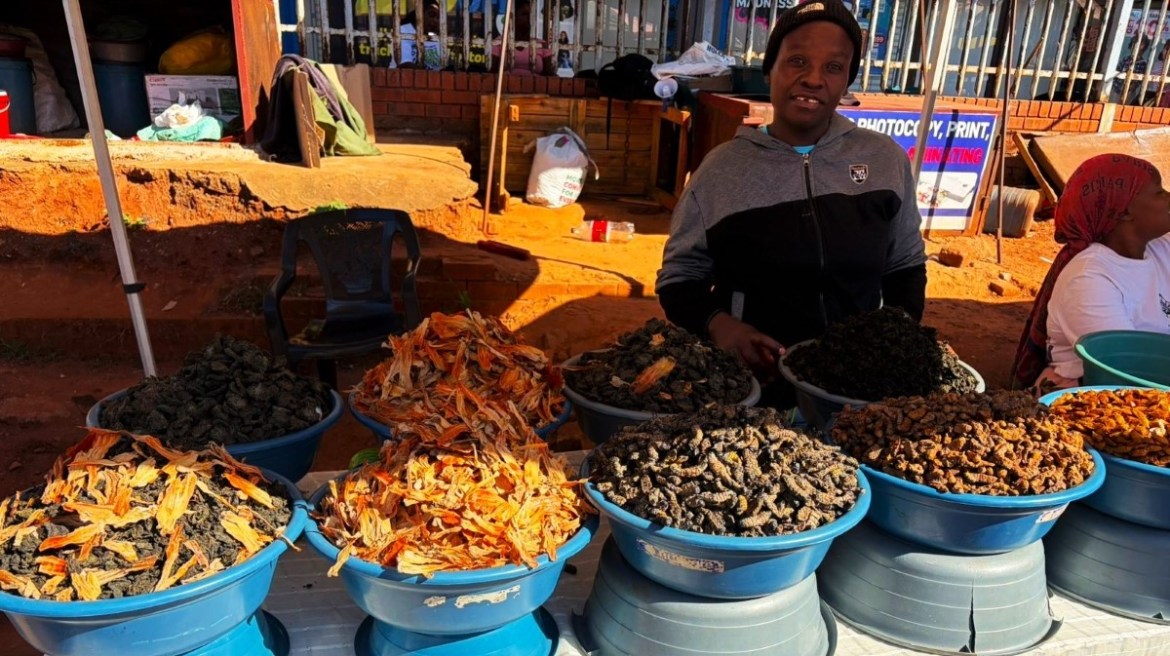
A single cup of mopane worms, weighing approximately 120 to 180 grams, sells for around R50.
A 20-litre bucket, containing roughly 5 to 6 kilograms, can cost between R1,500 and R2,200, depending on the season and availability.
They are also sold in quantities ranging from 5 litres to 50 kilograms.
Because there are no standardised measurements across markets, these figures should be regarded as estimates.
Mopane Worms Traders in South Africa
These prices naturally raise a number of questions. Are mopane worms really worth this much? How much income do traders earn from the trade? And how important are they to household livelihoods?
The answers became clearer with every conversation we had.
Many traders explained that income from mopane worms has helped them build homes, purchase vehicles, pay school fees, and start small businesses.
For many households, mopane worms are not simply insects found in the bush; they form part of a local economy.
Most traders, particularly in Musina and Collins Chabane, sold mopane worms alongside other food products and household goods to diversify their income.
Traders also explained that earnings help cover healthcare costs and other household expenses.
Several highlighted the nutritional value of mopane worms, noting their role as an important source of protein and their contribution to addressing malnutrition-related conditions such as kwashiorkor among children.
Despite this importance, many fear that the future of this valuable and nutritious resource is increasingly uncertain.
From abundance to scarcity
Traders told us that mopane worms are no longer available in many villages in Limpopo where they were once abundant and could be harvested freely.
In parts of Collins Chabane and Thulamela, people now speak about mopane worms almost as memories rather than seasonal realities.
Harvesters also reported that the worms have become increasingly scarce in areas where they were once common, including Mutale, Giyani, and Phalaborwa near the Kruger National Park.
In the past, harvesting was more than a source of income.
It was a social activity that brought families and communities together. During harvesting seasons, families would travel to collection sites early in the morning, carrying buckets and knowing that the harvest would help sustain their households for months.
As mopane worm populations declined in South Africa, harvesters and traders increasingly sourced supplies from neighbouring countries, including Zimbabwe, Zambia, Botswana, and Mozambique.
This strategy worked for a time, but declining supplies in countries such as Zambia and Mozambique shifted greater attention to Zimbabwe and Botswana.
Traders noted that mopane worms from Botswana are particularly preferred because of differences in taste and quality.
As a result, demand for Botswana-sourced worms has increased significantly, placing additional pressure on that country’s mopane worm populations and creating risks for the broader regional trade.
What is driving the mopane worm decline?
Several recurring explanations emerged during our discussions about the decline of mopane worm populations.
While overharvesting is often cited as the primary cause, our conversations suggested that it is only one part of a much larger problem.
The most consistent concern raised by traders and echoed by officials from the Limpopo Department of Agriculture was the weak or inconsistent enforcement of harvesting rules, whether customary or formal. Other contributing factors included the cutting down of mopane trees and the use of insecticides.
In the past, some worms were intentionally left undisturbed to complete their life cycle and reproduce, ensuring future harvests.
This practice was supported by community norms and local oversight.
However, that restraint has weakened in many harvesting areas, particularly in South Africa and Zimbabwe.
While growing demand has played a role, communities pointed to the lack of effective enforcement, both customary and governmental, as a major factor.
Without systems that hold harvesters accountable, increasing numbers of worms are removed before populations have an opportunity to recover.
Significantly, traders noted that mopane worm populations have declined even in areas where mopane trees remain abundant. This suggests that demand itself is not necessarily the problem.
Rather, the challenge is demand in the absence of effective regulation and sustainable management.
A growing regional challenge
What was once largely a sustainable harvesting system has gradually shifted towards more intensive extraction, driven by economic necessity, growing market demand, and weak enforcement of sustainable harvesting practices.
Veld fires have also contributed to the problem. Community members described how fires destroy mopane trees and damage the surrounding habitats on which the worms depend.
Environmental degradation, coupled with unpredictable climatic conditions, appears to be worsening the situation.
These accounts reveal that local communities are already witnessing the effects of environmental change firsthand.
The shortage has become so severe that many traders now rely heavily on imports from Botswana.
The fact that traders are travelling deeper into Botswana in search of supplies highlights that this is no longer merely a local issue. It has become a regional challenge.
The cost of losing mopane worms
What stayed with us most after these conversations was a question that nobody could answer with certainty: What will happen if mopane worms disappear completely?
For outsiders, the loss may seem insignificant.
However, for many rural households, the mopane worm trade represents one of the few accessible economic opportunities available.
Women selling mopane worms along roadsides are not simply participating in informal trade.
They are supporting their families by paying school fees, buying groceries, covering medical expenses, and building livelihoods through a resource that has sustained communities for generations.
Without mopane worms, what will replace that income?
What will happen to households that have depended on harvesting seasons year after year?
What will happen to the knowledge passed down through generations about harvesting, processing, and trading? And what becomes of communities when a resource so closely tied to culture, identity, and livelihoods gradually disappears?
Conservation is about people, too
Our visit to Limpopo changed the way we think about conservation. Even relatively small species, such as insects, can play a critical role in human well-being. The disappearance of mopane worms would not simply represent the loss of a species from the environment. It would also mean the loss of livelihoods, traditions, and economic resilience for many rural families.
The road ahead
These realities raise urgent questions for policymakers, traditional leaders, and communities alike.
Could stronger enforcement of harvesting regulations, whether through customary institutions or formal government systems, help restore balance?
What role could the protection of mopane trees play, given that mopane worms depend entirely on them for survival?
Should communal lands and areas that are managed through Communal Property Associations (CPAs) be prioritised for the conservation of remaining mopane worm populations?
And as pressure on wild populations continues to grow, is it time to seriously explore mopane worm farming as a complementary and more sustainable alternative to wild harvesting?
The answers to these questions may ultimately determine whether future generations inherit a thriving mopane worm economy or only stories about what once existed.
What are mopane worms?
Mopane worms (Imbrasia belina) are the edible caterpillars of the emperor moth, harvested from mopane trees across southern Africa.
They are a traditional food, a valuable source of protein, and an important source of income for many rural households.
Why are mopane worms disappearing?
Traders and harvesters point to several linked causes: overharvesting, weak enforcement of harvesting rules, the cutting down of mopane trees, insecticide use, and veld fires.
Populations have declined even where mopane trees remain abundant, which suggests the core problem is demand without effective regulation and sustainable management.
Where are mopane worms still harvested?
As South African populations have declined, traders increasingly source mopane worms from Zimbabwe, Zambia, Botswana, and Mozambique.
Botswana-sourced worms are especially sought after for their taste and quality, which is placing growing pressure on that country’s populations.