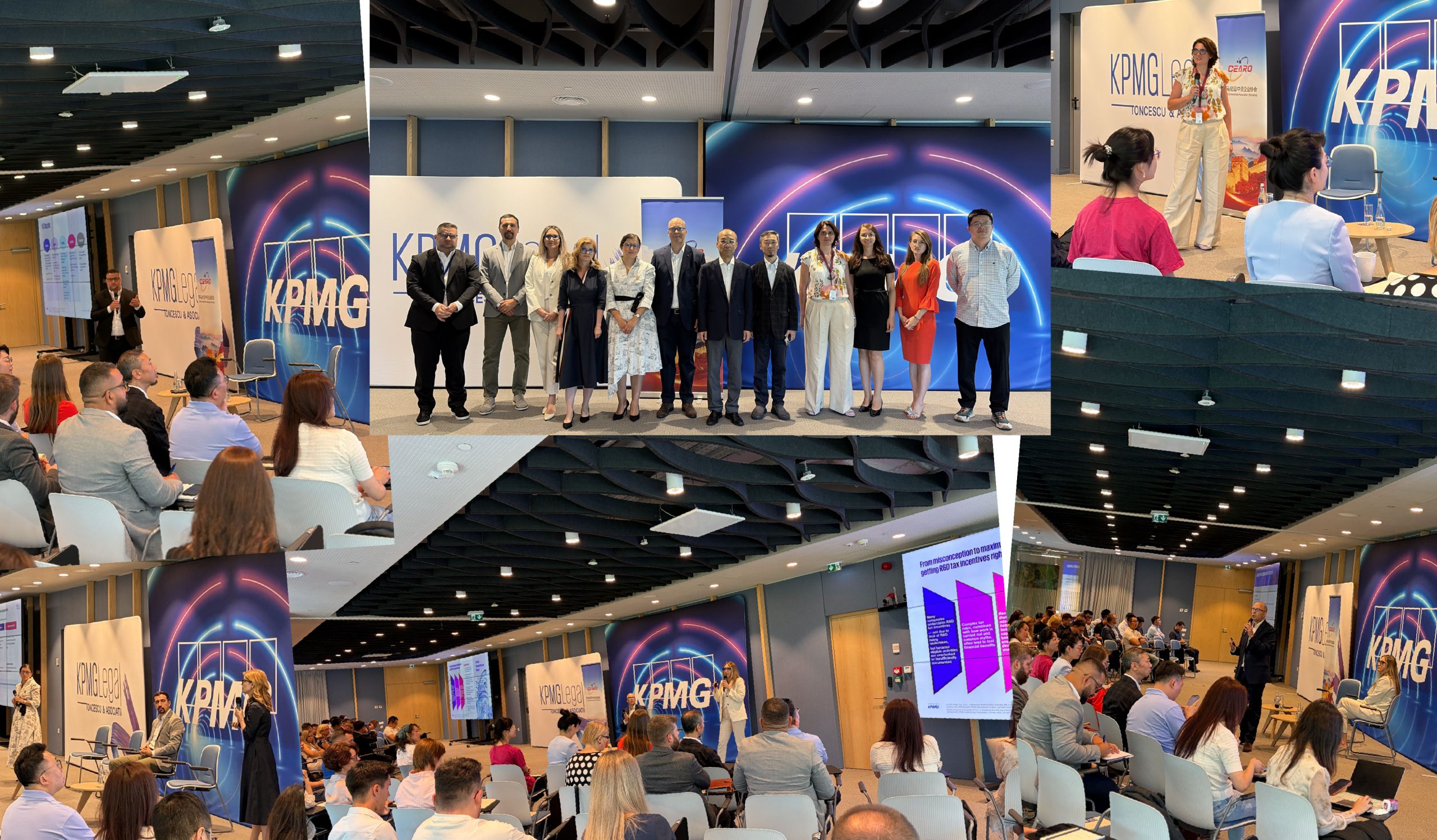
KPMG in Romania and Chinese Enterprises Association in Romania hold joint conference
For several years, China has been an important investor in Romania and the CEE region and there have been numerous success stories in many sectors. When planning an investment, and doing business in Romania, Chinese investors need to consider a number of practical aspects. These are generally similar to those which other non-EU investors need to take into account, although there are some specific considerations relating to Chinese-Romanian commercial exchanges.
On 3 August 2026, a joint workshop organised by KPMG Tax & KPMG Legal in Romania and the Chinese Enterprises Association in Romania (CEARO) gave a wide-ranging review of key factors for Chinese investors, from immigration to taxation, legal aspects and R&D incentives as well as state aid. The event took place at KPMG in Romania’s Bucharest headquarters. An opening address was given by Mr. Zhao Yuewei, President of the China Enterprises Association in Romania, who emphasised the importance of commercial relations between China and Romania and China and the wider CEE region. Mr. Zhao Yuawei highlighted the role of the Association in supporting Chinese enterprises investing in Romania, fostering business collaboration, and promoting constructive dialogue and exchanges with Romanian counterparts. There followed presentations by KPMG Tax & KPMG Legal specialists on practical issues and opportunities for Chinese investors.
New Romanian Immigration Rules
Daniel Jinga, Director, People Services in KPMG in Romania’s Tax Department, outlined the latest immigration rules. Under the new legal framework, there is now a single application in WorkinRomania, a simplification of the previous procedure under which a work authorisation and visa had to be applied for separately. Other aspects which have simplified the immigration process include the new single platform for online submission, communication and status tracking. There is now improved communication between authorities (ANOFM, REGES, ANAF, the Ministry of Education etc.). Clearer processing timelines have been introduced (generally 30 days for the single application from appearing at the diplomatic mission or consular office). Moreover, there are no annual quotas for D/AM1 and posted workers (a quota applies only to D/AM2 visas).
Some rules, however, have become stricter. Employer eligibility filters are tighter, with more rigorous assessment of track record, financial standing, and the minimum number of employees. There is a special regime for employers/intermediaries (registered employer vs authorised employer vs temporary work agency). D/AM2 visas are only granted for roles on the Shortage Occupations List.
Tax and Social Security
Daniel Jinga also gave an overview of tax and social security aspects. Tax residency is an important consideration, with non-resident individuals being subject to tax only on Romanian source income, while tax residents in Romania are subject to income tax on their worldwide income. One complication specifically related to Chinese workers is that while there is a double taxation agreement between Romania and China which aims to avoid the same income being taxed twice, there is no bilateral social security agreement, meaning that contributions may be due in both jurisdictions, depending on the contractual arrangements.
Key employment law developments.
A number of important developments have taken place in recent years in relation to employment law, and some of these were outlined by Carmen Cretu, Managing Associate, KPMG Legal – Toncescu si Asociatii and Ioana Barbu, Managing Associate, KPMG Legal – Toncescu si Asociatii.
Pay Transparency
In line with EU requirements, Romania is preparing the implementation legislation on pay transparency. For employers, the key challenge this brings is to build remuneration practices which can be objectively explained if questioned. Comparable work needs to be defined, with clarification of employee categories, and the criteria used to compare roles, responsibilities and work value. Pay differences need to be explainable, based on objective factors like experience, seniority, responsibility and performance. Managers need to be equipped for broader employee information rights and plan reporting once deadlines apply.
Anti-harassment legislation, reorganisations and other relevant employment law related topics
The employment law presentation also covered the need to comply with anti-harassment legislation, which includes having clearly defined policies and procedures in place.
Furthermore, in the case of managing business transitions – any restructuring involving redundancies requires clear justification as to why certain roles are no longer needed.
The presentation also addressed three practical areas of relevance for international employers in Romania — performance management, collective labour relations and the local implementation of global HR policies — highlighting the importance of aligning business practices with Romanian employment law requirements.
Interactions between Corporate Income Tax and the Global Minimum Top-up Tax (GloBE Pillar 2)
Ionut Mastacaneanu, Associate Partner in KPMG in Romania’s Tax Department first gave an overview of the general Corporate Income Tax (CIT) framework in Romania, including details of the minimum turnover tax. He then provided an update on the Global Minimum Top-up Tax (Globe Pillar 2) rules, which apply to internationally and domestically operating large groups with annual revenues of EUR 750 million or more. The minimum tax level is 15% and to establish liability, the Effective Tax Rate (ETR) must first be calculated. If the ETR is lower than 15%, a top-up-tax is payable. It is also important that the accounting standard used for the Global Minimum Tax is compliant with the legal requirements.
As Ionut Mastacaneanu explained, even though the standard rate of corporate income tax in Romania is 16%, the Global Minimum Tax is still relevant because the ETR can be lower than 15% if there are significant deductions or if tax credits (such as for reinvested profit) are applied. Another example would be if tax depreciation for the year is significantly higher than accounting depreciation (e.g. shorter depreciation periods for tax purposes), hence reducing the ETR. However, the newly introduced mechanism for claiming the tax credit for Research and Development activities (“R&D tax credit”) ensures that this tax credit is not reversed by the applicable global minimum tax, as explained in further detail below. Thus, the preservation of certain incentives, such as the R&D tax credit, highlights the continued importance of carefully structuring and managing tax benefits in a Pillar Two environment.
Tax incentives for Research and Development
Research and Development (R&D) is an important generator of economic growth. Consequently, Romania offers important tax incentives to encourage R&D activities. Cristina Spirescu, Associate Director in KPMG in Romania’s Tax Department gave a presentation in which she explained the R&D incentives available.
There is a 50% supplementary deduction for corporate income tax purposes (8% discount of the value of eligible R&D expenditure). Alternatively, a refundable tax credit of 10% of the value of eligible R&D expenditure may be applied. This is subtracted directly from the tax due. Any remaining difference (if applicable) may be offset against other tax obligations or claimed as a refund within the next 4 years. This is also aligned with Pillar 2 regulations.
Moreover, an exemption from personal income tax applies for employees involved in R&D activities. This is the only incentive of this type in EU jurisdictions. Moreover, there are plans for increases in the percentages of the corporate tax incentives, taking into account that R&D is an EU priority.
Eligible activities for R&D incentives are defined in legislation, and fall into two broad categories. Applicative research involves the use of scientific knowledge to improve products, technologies or services or to create new ones. Technological development/Experimental development involves activities oriented towards the transformation of the applicative research’s results into plans, schematics or documentation for new products, processes or services. There are also five criteria for defining activities as R&D. They must be novel and creative, the project must be systematic and also the results must be uncertain and transferable. The process of assessing eligibility is complex and requires expertise, but application of these incentives can bring significant benefits.
VAT considerations
Alexandru Comanescu, Associate Partner in KPMG in Romania’s Tax Department, gave a general overview of the VAT rules, including import VAT, VAT refunds, VAT deferrals and VAT registration, required for all non-EU entities. A key aspect to consider by Chinese companies doing business in Romania is VAT recovery.
Navigating the Foreign Direct Investment Screening regime
A further important consideration is investment screening, which applies to all third country (non-EU) investors, as explained by Mona Banu, Counsel, KPMG Legal – Toncescu si Asociatii. This was introduced in the EU under Regulation 2019/452 and in Romania under Government Emergency Ordinance 17/2026, with the aim of protecting national security and public order. Screening applies to a wide range of categories of investments and not just to M&As. Some key points to remember are that authorisation must take place before a deal is completed, and that the ultimate owner matters.
State Aid
A number of state aid schemes are available in Romania for different types and sizes of investment, with advantageous terms for investments in less developed regions. Lidia Ene, Senior Manager in KPMG in Romania’s Tax Department, highlighted that ad hoc state aid can apply for certain large investments with a value of over EUR 200 million. Smaller investments can benefit from aid schemes focused on manufacturing sectors with trade deficits, the tech sector, and also for critical raw materials and net zero products. The launch of the call to submit applications for the aid scheme focused on manufacturing sectors is expected to occur around September – October of this year.
Romania: an attractive destination for Chinese investments
A key message from the event is that Romania and the wider CEE region continue to offer attractive opportunities to Chinese investors. The key to successful investment is having the right expertise to understand the market. As this event showed, KPMG in Romania has a wide range of specialists who have many years’ experience of supporting Chinese clients, with Tax, Legal, Audit and Advisory services. Please get in touch if you would like more information.
KPMG in Romania and Chinese Enterprises Association in Romania hold joint conference
The diplomatic daily newspaper Nine O’Clock does not assume responsibility for the information received and published on the public website. The responsibility for the content lies solely with the issuer of the press release.
The diplomatic daily newspaper Nine O’Clock cannot be held accountable for false information transmitted by the recipients of the press releases/announcements.
The diplomatic daily newspaper Nine O’Clock reserves the right not to publish press releases that contain inappropriate expressions or accusations and violations of the rights of other individuals, guaranteed by the Constitution of Romania.
The content of the website www.nineoclock.ro is intended for public information. Copying, reproduction, recompilation, modification, as well as any form of content exploitation from this website are prohibited. The use of the Comments section signifies your agreement to abide by the terms and conditions regarding the publication of comments on www.nineoclock.ro.