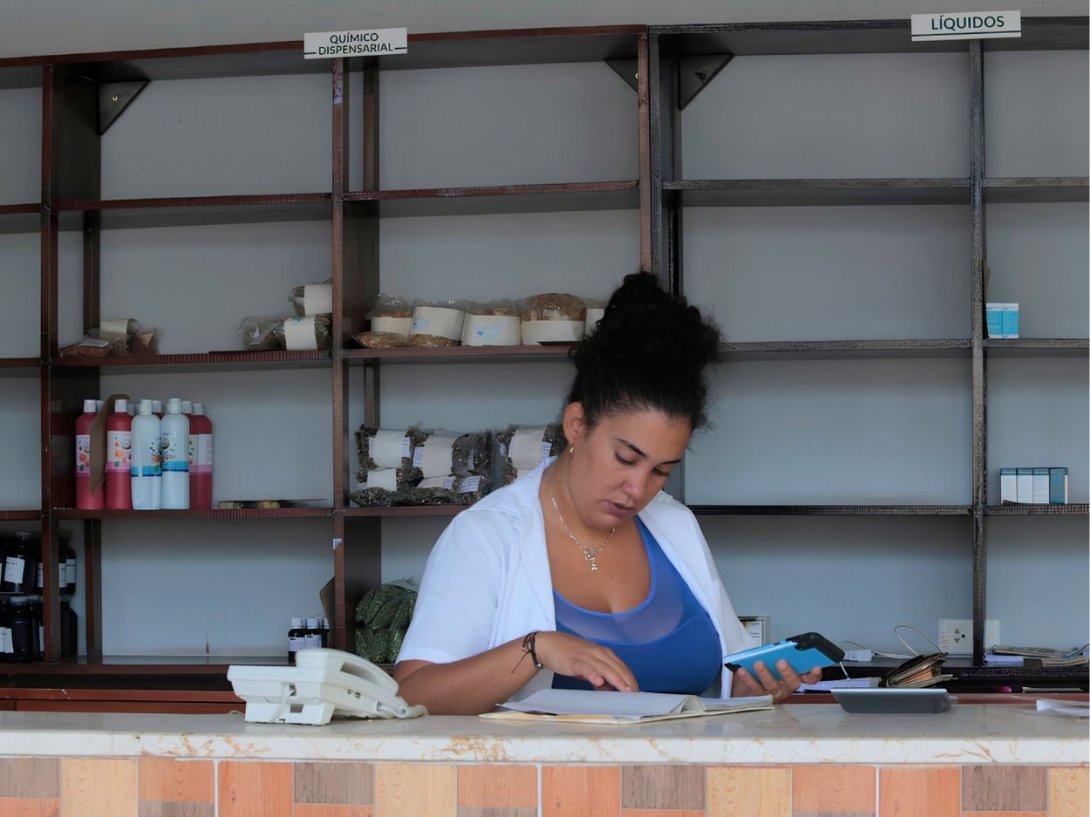
A typical Cuban pharmacy almost without medicines. Foto de archivo: Jorge Luis Baños/IPS Cuba
By Kamil Kenders
HAVANA TIMES – My friend Valentina waited for months before finally getting the call to have an MRI. At just 26 years old, pain had already changed the way she lived. Walking long distances had become a problem. Sitting for too long was just as difficult. Some nights, sleep turned into a battle against her own back. I accompanied her to several medical appointments, realizing that pain also has waiting rooms, that diagnostic tests can take months, and that a diagnosis, though frightening, can sometimes bring relief simply because it finally gives a name to what hurts.
The MRI confirmed what the orthopedic specialist had suspected: two herniated discs. Then came the referral to the Pain Clinic.
That name has always caught my attention, as if pain itself needed an address where it could be treated.
There they gave her ozone injections, and she hoped they would work. For weeks, my friend wanted to believe that this would be the solution. And although the treatment brought some relief, it wasn’t enough for her to even try to live a somewhat normal life.
Then another palliative measure appeared, along with a bit of hope: gabapentin, a medication used, among other things, to treat neuropathic pain. The doctor started her on one dosage and later increased it. She thought that perhaps, with the adjustment, the pain would finally begin to ease.
But another problem arose.
Gabapentin is almost never available at the pharmacy. Every time she asked, the answer was the same.
“There isn’t any.” “We haven’t received it.” “Shipments are three weeks behind.”
Given the importance of taking the medication, my friend decided to look for it on the informal market, where there is always everything you need.
And she found it.
The medicine that was never available at the pharmacy was available somewhere else.
There, it wasn’t in short supply—it simply had a different price.
A blister pack of ten tablets costs around 1,200 pesos, sometimes 1,400, and a bottle can cost as much as 5,000 pesos.
We did the math several times. The calculator doesn’t lie. It comes to several thousand pesos a month, considering she needs four pills a day. Several thousand pesos for someone who simply wants a little relief from the pain.
It made me think that some illnesses aren’t measured only by an MRI.
They’re also measured by everything a person has to give up: going out, walking, sleeping, working without fearing that one wrong movement will trigger another painful episode.
Valentina is 26 years old today, and sometimes she talks about her future with the caution of someone who has stopped making long-term plans.
What hurts me most is not seeing her walk slowly or watching her search for a position that gives her pain a moment’s respite.
What hurts me most is hearing the resignation in her voice.
A few days ago she told me, with a calmness that was sadder than tears:
“I don’t think I’m ever going to get better.”
It wasn’t a sentence born of pessimism.
It was the exhaustion of someone who knows exactly what treatment she needs, who has a prescription signed by her doctor, and who still cannot obtain it.
Sometimes we think hope arrives with a diagnosis.
But for some people, hope ends at that very moment.
On a sheet of paper. In a prescription.
In a medicine that exists…
…only for those who can afford it.
Read more of Kamil Kenders’ diary here at Havana Times.