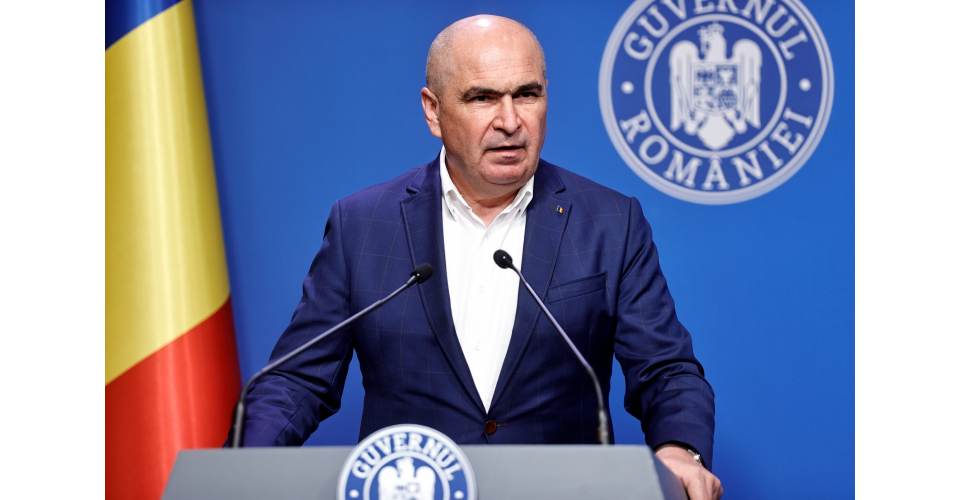
Prime Minister Ilie Bolojan Holds Press Conference at Victoria Palace
Monday, August 3, 2026
Prime Minister Ilie Bolojan: “Good afternoon!
About an hour and a half ago, we concluded an important meeting on the energy sector with the country’s largest electricity consumers, as well as representatives of employers’ organizations and industry associations. More than 140 participants joined the meeting, during which we agreed on a set of voluntary measures aimed at reducing electricity consumption during the evening peak hours.
As you know, Romania is facing a regional energy crisis caused by the severe drought affecting the region. Water levels on the Danube have fallen to their lowest point in the past 40 years. The previous historic low was recorded in 2003, at 1,474 cubic metres per second, while today the flow has dropped to approximately 1,450 cubic metres per second and is expected to decline further, reaching around 1,400 cubic metres per second during the second half of this week.
Prime Minister Ilie Bolojan Holds Press Conference at Victoria Palace
As a consequence of these extremely low water levels, both on the Danube and across other river basins, the electricity generation capacity of hydroelectric power plants has been significantly reduced. At the Iron Gates Hydropower Plant alone, Romania has lost approximately 2,000 MW of generating capacity.
Nuclear power production has also been affected across the region. Hungary has reduced the output of three of the four units at its nuclear power plant, with only one unit operating partially. Its nuclear generation has fallen from 2,000 MW to approximately 1,750 MW. Romania is facing a similar situation after shutting down one unit at the Cernavodă Nuclear Power Plant, resulting in a loss of approximately 550 MW.
Overall, the region is experiencing a production shortfall of more than 4,000 MW, affecting Hungary, Serbia, Bulgaria, Romania, and the Republic of Moldova. During the evening peak hours, between 7:00 p.m. and 11:00 p.m., Romania faces a significant electricity deficit that must be covered through imports.
Daily electricity demand currently exceeds 7,000 MW, reaching between 7,500 and 7,600 MW on weekdays, while consumption falls below 7,000 MW during weekends, as was the case on Saturday and Sunday. Under these conditions, Romania imports between 2,000 and 2,500 MW of electricity every day.
For comparison, Hungary imports approximately 4,500 MW, while the Republic of Moldova imports around 500 MW. This illustrates the considerable pressure on regional electricity imports during the evening hours.
The drought-related challenges are further aggravated by the limited cross-border electricity interconnections between Southeastern Europe and Central and Western Europe. As you may recall, expanding these interconnections has been one of the government’s priorities in recent months. Romania has been working with Hungary and Austria to increase transmission capacity, enabling larger electricity imports from Central Europe during periods such as the current one. These efforts are already underway, as most of our electricity imports currently come through these interconnections or from Southeastern Europe.
The government has already implemented several emergency measures. As I mentioned previously, all available electricity generation capacities in Romania are now operating at maximum output. Gas-fired power plants supplying the country’s major cities are running at full capacity, photovoltaic generation has been maximized, and every possible authorization has been issued to accelerate the commissioning of new energy storage facilities. More than 400 MW of storage capacity have been authorized over the past 20 days alone.
In other words, we have done everything possible to maximize Romania’s domestic electricity production.
Another key priority is keeping Unit 2 of the Cernavodă Nuclear Power Plant in operation. Every additional day that this reactor remains online provides more than 650 MW, accounting for nearly 10% of Romania’s electricity production. Since nuclear power provides stable baseload generation, it is particularly valuable during the evening peak hours, contributing significantly to the stability of the national power system.
To keep Unit 2 operating, the cooling water pumps must continue drawing sufficient water from the Danube. This requires maintaining the water level in the intake basin above the minimum operational threshold. According to current forecasts, there is a reasonable possibility that Unit 2 will remain operational over the next three to four days.
To secure additional water flow despite the exceptionally low river levels entering Romania, one of the measures already implemented involved removing a natural rock formation that had been obstructing water flow toward the Old Danube branch, which supplies the Cernavodă plant.
In the coming days, starting tomorrow evening, further operations will be carried out, including the controlled sinking of barges to redirect a greater volume of water toward the Old Danube branch. This measure is intended to maintain—and slightly increase—the water flow needed for the continued operation of the Cernavodă Nuclear Power Plant.
Another key element of the government’s response is the voluntary reduction of electricity consumption, given the limited capacity for additional imports. We have taken every possible step to ensure that Romania can import electricity from all available sources.
Once again, I would like to appeal to citizens, businesses, and public authorities to voluntarily reduce their electricity consumption. I also want to thank all Romanians and all companies that have already responded to the Government’s request in the face of this extraordinary situation, which is beyond our control.
The results are already visible. For example, this morning electricity consumption was, on average, around 200 MW lower than on comparable mornings, clearly reflecting the contribution made by businesses that have voluntarily reduced their energy use.
The greatest pressure on the electricity system occurs in the evening hours, and during today’s discussions with Romania’s largest energy consumers, we agreed that each company would adopt voluntary measures tailored to its production profile and technological processes.
Some companies are able to temporarily suspend their operations during the evening peak and resume production without affecting their industrial processes. Others, however, must maintain a minimum level of electricity consumption in order to ensure the safe operation of their facilities.
One of the measures already implemented by several major industrial consumers is to bring forward scheduled maintenance and repair works. Two of Romania’s largest industrial companies, Dacia and Ford, have suspended production starting today until 19 August, resulting in electricity savings of approximately 200 MW. Several other companies are expected to adopt similar measures in the coming days, contributing to a further voluntary reduction in electricity demand during peak evening hours.
I also call on local authorities and all public institutions to reduce electricity consumption in public buildings and architectural lighting during the evening. Municipalities that operate smart public lighting systems should reduce light intensity wherever possible between 9:00 p.m., when public lighting is typically switched on, and 11:00 p.m., thereby generating additional energy savings.
I would like to thank all Romanians for understanding that we are facing an exceptional situation unlike any we have experienced in many years. If we act together—if every company, every public institution, and every household makes even a small effort to reduce consumption—these individual savings will add up and help ensure sufficient electricity supplies for all consumers, including households, hospitals, public institutions, and industry.
In the coming days, the Government will also adopt a supplementary Government Decision designed to be used only if voluntary reductions prove insufficient to ensure electricity supply during evening peak hours.
This mechanism is already provided for under existing legislation and would allow the National Energy Dispatcher at Transelectrica to introduce temporary consumption limits if necessary.
Under this mechanism, major industrial consumers would receive 24 hours’ notice, informing them of the electricity consumption levels that would apply based on their technological requirements and the National Energy System’s capacity to meet overall demand during the relevant period.
I want to stress that this is a contingency measure. It is a legal instrument that we are preparing in advance so that, should it become necessary in the coming days, coordinated action can be taken quickly and efficiently to safeguard the stability of Romania’s electricity system”. Source gov.ro
The diplomatic daily newspaper Nine O’Clock does not assume responsibility for the information received and published on the public website. The responsibility for the content lies solely with the issuer of the press release.
The diplomatic daily newspaper Nine O’Clock cannot be held accountable for false information transmitted by the recipients of the press releases/announcements.
The diplomatic daily newspaper Nine O’Clock reserves the right not to publish press releases that contain inappropriate expressions or accusations and violations of the rights of other individuals, guaranteed by the Constitution of Romania.
The content of the website www.nineoclock.ro is intended for public information. Copying, reproduction, recompilation, modification, as well as any form of content exploitation from this website are prohibited. The use of the Comments section signifies your agreement to abide by the terms and conditions regarding the publication of comments on www.nineoclock.ro.