The six Democrats seeking the three Vermont Senate seats in the Windsor District check pretty much all the boxes in their party’s broad coalition.
To take them in alphabetical order: Pomfret resident Ben Brickner is a lawyer and Selectboard chairman; State Rep. Elizabeth Burrows is a member of the Mount Ascutney School District board and a self-described policy wonk; former state Rep. Heather Chase is a nurse and a business owner; longtime Hartford firefighter Chris Dube is a labor organizer; incumbent Sen. Joe Major leads the nonprofit Upper Valley Aquatic Center and is the first African American to serve the Windsor district; and Sen. Becca White is a Hartford native from a working class background and one of the youngest members of the state Senate.
“I think that whoever wins… will be well equipped to succeed,” White said. “There’s no bad vote in this primary.” The election might come down to “who you think will provide the best constituent services,” she said.
Handling constituents’ needs was a specialty of Alison Clarkson, the longtime legislator from Woodstock who opted not to run for a sixth term in the Senate. Her departure set off the biggest Democratic primary race for the district’s three seats in recent, and distant, memory. While the candidates stand more or less shoulder to shoulder on policy, they approach a legislator’s work from different angles.
Ben Brickner: Keep small towns in mind
Brickner, for example, points out that lawmakers don’t always seem aware of how their policies affect rural parts of the state, a position that puts him in line with criticisms of state government’s land use and education policies.
“The policies enacted in Montpelier don’t always have small towns in mind,” Brickner, 44, said in an interview. A New Jersey native, Brickner and his wife have lived in Pomfret for eight years. They have a daughter, age 6.
He’s a partner at Pierson Ferdinand, working out of the law firm’s New York office, where he handles “corporate finance, securities, and capital markets transactions, with a focus on start-up and venture financings, SEC compliance, and broker-dealer and investment adviser regulation,” according to his profile on the company website.
On education reform, the most wrenching issue facing the state, Brickner said the state is “barking up the wrong tree.”
Pomfret, he noted, gave up its town school district to merge with Bridgewater under Act 46, with the promise that costs would go down and quality would go up. Under the reform bills of the past two years, “we are being asked to do the same thing again,” he said, adding that is “skeptical” that anything short of lowering the cost of health care would reduce school spending
Like the other Democratic candidates, he’d like to see the state tax second-home properties at at least the same rate as primary residential ones, noting that most of the towns around Woodstock tax primary residences at higher rates.
“This year, that gap is 22%,” he said. “We are effectively subsidizing second homeowners through our tax code.”
To make health care more affordable, Vermont might consider bringing more people into its market from neighboring states, Brickner said.
Elizabeth Burrows: Get spending under control
While Brickner talked in broad strokes, Burrows waded into the details of policymaking. She spent last summer attending all of the meetings of the state’s school redistricting committee, the Commission on the Future of Education in Vermont and the small schools and construction aid subcommittees of the State Board of Education.
A West Windsor resident who has represented her town, Hartland and Windsor in the House since 2021, Burrows, 57, has family roots in the area, but is widely traveled. She has worked in human rights, as an editor and as a hospice volunteer before settling in West Windsor in 2008. She and her husband are raising two teen boys who are at Windsor High School.
The state’s education reform effort has been “shoddy,” she said, noting that it would contract the school system, to the detriment of smaller communities.
“I feel that the bills of the last two years have treated education as a business,” she said. As much as the state needs to get spending under control, neither drastic consolidation nor a switch to a foundation formula, both proposed by Gov. Phil Scott, will result in much savings, she said.
While she’s glad the Legislature took a step back from forcing districts to consolidate, she said that the cost constraints in the funding bill approved this year will have the effect of forcing districts to consolidate anyway, in search of savings that might not appear.
The state would be better off focusing on student outcomes, on shifting expenses out of the state Education Fund and on moving toward an income-based tax system.
“We are the only state in the country that pays for mental health and social services (for students) through our education fund,” Burrows said.
On affordability more broadly, Burrows said she thinks “providing universal primary care would do a lot to reduce health care expenses,” and that the state needs to encourage housing development, particularly for seniors, people transitioning from homelessness and for the disabled. That would free up single-family homes for parents with children, she said.
Heather Chase: State needs more students
Heather Chase, of Chester, is the lone candidate from the southern end of the district, which includes every town in Windsor County except Rochester, and the Rutland County town of Pittsfield, and Thetford, which is in Orange County. It’s the largest district, by area, in the state.
Chase, 65, has had a 40-year career as a nurse and also runs a business that provides lactation consultants to nursing mothers and to companies. She has served on the Chester Selectboard for nine years, and won a House seat in 2022, but lost by a narrow margin in 2024. The southern end of the district hasn’t been represented in the Senate since Alice Nitka, of Ludlow, decided not to run in 2022.
“This is my community and I want to represent it,” said Chase, who was born in Canada and did most of her growing up in Wyoming, the only state with fewer people than Vermont. She’s been in Chester for 25 years, has four grown children and is no longer married.
The education reform bill of the past two years are “a start,” Chase said, adding that she was “happy to see that the forced consolidation was off the table.”
But education costs aren’t likely to decline “until we really do something about healthcare,” she said. “All of our systems are connected.”
What the state needs is more students, and that leads directly to affordability, which means not just lower costs, but “raising salaries.”
Like the other candidates, Chase is in favor of looking more closely at how the state taxes second homes.
Affordability is not simply a local or state problem, she said, pointing to global markets and to tariffs that raise the price of goods. People are stressed, both by the unforgiving economic conditions and by the political mood. “We just need to take care of Vermonters as best we can,” Chase said.
Chris Dube: Streamline permit process
Chris Dube is the lone candidate without experience of elected office, but he’s president of the Professional Firefighters of Vermont and has been an officer in the state union since 2016, serving as secretary and treasurer. He was a Hartford firefighter for over 32 years before retiring in 2024 and is an Upper Valley native. Dube, 59, lives in Wilder with his wife and son, who’s a senior at Hartford High School.
Encouragement from state labor unions spurred him to run, he said. Like the other candidates, he noted that the cost of health care drives the rising cost of education. The attention to detail has been lacking in education reform, he noted. Under a consolidation plan, existing schools might not be able to accommodate an influx of new students without costly renovations, he said. And he sees little public buy-in of the plans coming out of Montpelier.
Second homes, “at a minimum, need to be taxed at least the same,” as primary residences, Dube, 59, said, so “everybody pays their fair share.”
To improve the affordability of housing, the state should further streamline its permitting process, so projects don’t have to go through both local and state approvals, he said.
What’s most important to Dube is “bringing people to the table,” a phrase he repeated in an interview. Other candidates said they want to encourage public participation in developing a way forward for the state, but Dube, who stressed that he’s “not a career politician,” put a particular emphasis on it.
“The core of the community is your working class people who work 40 hours a week” and find it “harder and harder” to get by, he said.
Windsor County Senate candidate Chris Dube shows off his suit to fellow candidate Joe Major, right, and former Senator Dick McCormack, second right, after a forum for Windsor County’s Democratic State Senate primary candidates at the Woodstock, Vt., Town Hall Theater on Saturday, July 25, 2026. Dube’s son Jacob, 17, is at left, and his wife, Sherry is at center. JAMES M. PATTERSON / Valley News Credit: Valley News – James M. Patterson
Joe Major: Look closely at education spending
It’s rare to be elected to the state Senate without first serving in the House, but Joe Major managed the feat in 2024. (Brickner was quick to point this out during an interview.)
In addition to serving as Hartford’s town treasurer, two years on the Selectboard, and as executive director at UVAC, Major has been on the boards of the Haven, and Headrest, social service agencies, the Vermont League of Cities and Towns, and on the Governor’s Committee of the Employment of People with Disabilities. He moved to White River Junction, where he now lives with a partner, in 2018 to take the UVAC job, part of a 30-year career managing fitness facilities up and down the East Coast.
Major, 61, said the state needs a course correction on education reform. Gov. Scott vetoed a bill that would bring down health care costs, particularly for teachers, Major said. And this year’s education funding bill ramps up penalties that would hit Windsor County taxpayers the hardest, he said.
“I’m not convinced that how we’re going forward is going to be a big cost savings,” he said. There needs to be a more thorough look at education in the state if reform is going to work. “I think everything has to be on the table,” he said.
He brought up the candidacy for governor of Aly Richards, who spurred an effort to subsidize childcare, as a hopeful sign that the state could do more to make life more affordable for families. (Burrows also brought up Richards’ proposal to drop the state sales tax on building materials to help lower the cost of housing.)
Rebecca White: Change school spending formula
It’s an interesting quirk of electoral politics that Rebecca “Becca” White is now both the senior senator from the Windsor District and also, at age 32, the youngest Democrat in the race.
A Wilder native now living in White River Junction with her husband and her mother, White was elected to the Hartford Selectboard at 20, to the House at 24 and to the state Senate at 28. When a reporter reached out to the six candidates, she was first to respond, even though she was in Chicago at the National Council of State Legislatures conference.
She also was quick to bring up her record, saying she’d voted for the education reform bill because it dropped forced mergers and went ahead with a plan to share education services across wider areas. And she voted against the education funding bill, because of the stiffer tax penalties on Windsor County.
“I support the move, at this point, toward a foundation formula,” to pay for schools, White said. While it will diminish local control of school spending, that control has been reduced already by how little say local school boards have over spending and by how hard the state’s funding system is to understand.
“Local control is only as good as the information you have to make a decision,” White said.
Raising taxes on second homes “has been part of my campaign since I ran for state representative,” White said. The rising number of second homes makes it less affordable for residents and dents the sense of community.
Health care is the main reason education has become so expensive, she said.
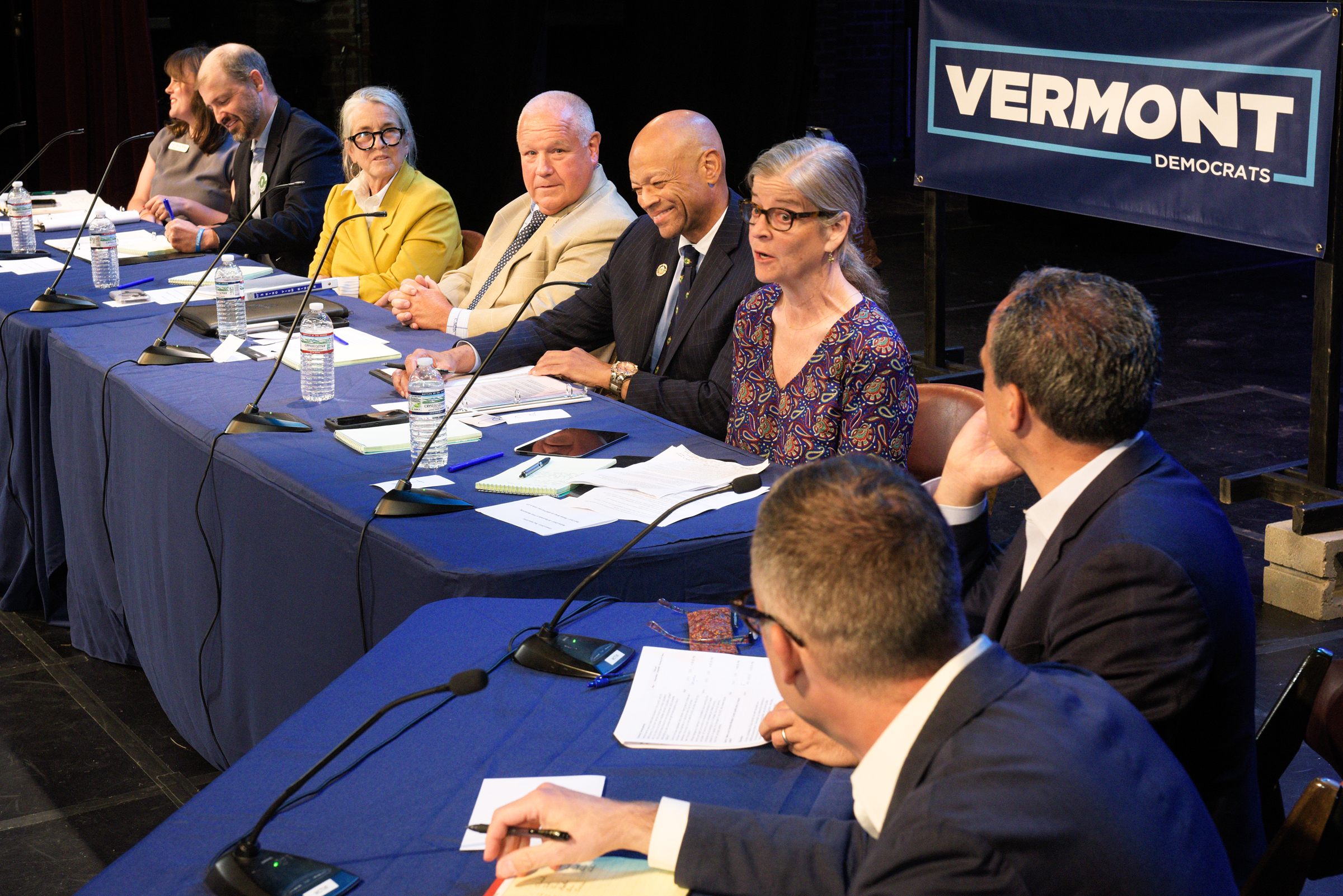
Windsor County Democratic State Senate Primary candidates, from left, Becca White, Ben Brickner, Heather Chase, Chris Dube, Joe Major, and Elizabeth Burrows gather for a forum to introduce themselves to voters at the Woodstock, Vt., Town Hall Theater on Saturday, July 25, 2026. JAMES M. PATTERSON / Valley News Credit: Valley News – James M. Patterson
White called affordability, “a political football of a term.” The range of ways to address it is vast. There’s a federal housing measure that would curb the ability of private equity companies to buy homes, which should help Vermont, she said.
But there are smaller proposals. It costs $75 a year to get a car inspected in Vermont, even though “there’s no data that vehicle safety inspections done annually reduce accidents,” White said. She introduced a bill to end inspections this year, noting that “the cost of vehicle ownership is higher than it’s ever been.”
And though it’s not the top of voters’ concerns, White said she wants to keep working on climate change. She’s co-chair of the Legislature’s Climate Solutions Caucus. “It’s connected to everything in our lives,” she said.
Voting in Vermont’s primary elections takes place on Tuesday, Aug. 11.