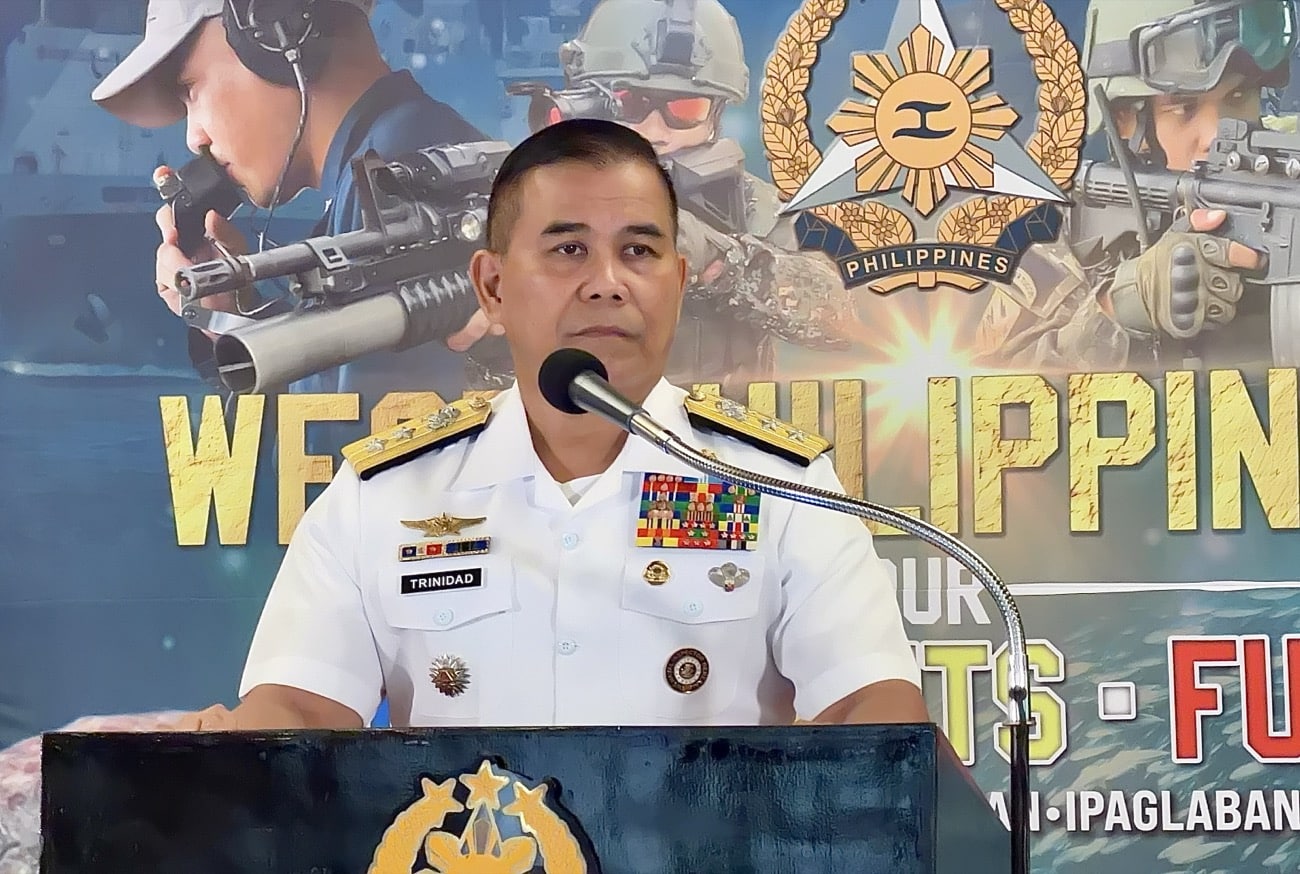
Photo: AFP spokesperson for the West Philippine Sea Rear Adm. Roy Vincent Trinidad (Reserve) (File photo/ Gabryelle Dumalag)
MANILA, Philippines — The Armed Forces of the Philippines (AFP) monitored 48 Chinese coast guard and navy vessels in the West Philippine Sea in July, as Beijing continued to maintain its presence in waters within the Philippines’ exclusive economic zone (EEZ).
AFP spokesperson for the West Philippine Sea Rear Adm. Roy Vincent Trinidad (Reserve) said on Tuesday that the military tracked 40 China Coast Guard (CCG) vessels and eight People’s Liberation Army Navy (PLA-N) warships around Panatag (Scarborough) Shoal, Ayungin (Second Thomas) Shoal, Escoda (Sabina) Shoal and Pag-asa (Thitu) Island from July 1 to 31.
The July total was lower than the 74 Chinese vessels the AFP monitored in June.
Article continues after this advertisement
READ: PH deposits Panatag Shoal chart with UN, despite China control
The largest concentration was recorded at Panatag, where the AFP monitored 19 CCG vessels and three PLA-N warships. The shoal, also known as Bajo de Masinloc, lies about 220 kilometers west of Luzon. It has been a site of prolonged Chinese presence since a 2012 standoff between Philippine and Chinese vessels.
The AFP also tracked 14 vessels near Ayungin Shoal, a low-tide elevation about 194 kilometers west of Palawan. They included 13 CCG vessels and one PLA-N warship. The Philippines maintains the grounded BRP Sierra Madre there as a military outpost.
Around Pag-asa Island, about 480 kilometers west of Palawan, the AFP monitored eight vessels — five CCG ships and three PLA-N warships. Pag-asa is the largest Philippine-held feature in the Kalayaan Island Group and is home to a civilian community.
Near Escoda Shoal, a low-tide elevation about 140 kilometers west of Palawan, the AFP recorded three CCG vessels and one PLA-N warship.
Article continues after this advertisement
Trinidad said the figures underscored the continued conduct of China’s “illegal, coercive, aggressive and deceptive” (Icad) activities in the West Philippine Sea.
READ: AFP monitors 74 Chinese vessels
Article continues after this advertisement
“These figures underscore the continued conduct of Icad activities that undermine the rules-based international order and challenge the Philippines’ sovereign rights and jurisdiction within its maritime domain,” the spokesperson said in a statement.
“Such actions contribute to regional tensions and highlight the importance of continued vigilance and adherence to international law,” he added.
Despite the continued presence of Chinese vessels, the AFP said it remains committed to safeguarding the country’s maritime interests through sustained operational presence, enhanced maritime domain awareness, stronger interagency coordination and continued capability development.
Foreign vessels challenged
The Philippine Navy also monitored 20,749 vessels across the country’s maritime domain in July.
Of the total, 3,071 were domestic vessels and 17,678 were foreign vessels. The Navy said 14,180 vessels responded to radio challenges, while 6,569 did not.
The AFP said the Navy’s “monitor and challenge” procedures are a key part of its maritime domain awareness efforts, enabling the timely detection, identification and assessment of vessels operating within Philippine waters.
Beijing claims nearly all of the South China Sea, including waters within the Philippines’ EEZ in the West Philippine Sea.
Your subscription could not be saved. Please try again.
Your subscription has been successful.
It has rejected the 2016 arbitral award, which invalidated the legal basis of its sweeping “nine-dash line” claim in the South China Sea, later expanded to a “10-dash line.” /mr
For comprehensive coverage, in-depth analysis, visit our special page for West Philippine Sea updates. Stay informed with articles, videos, and expert opinions.