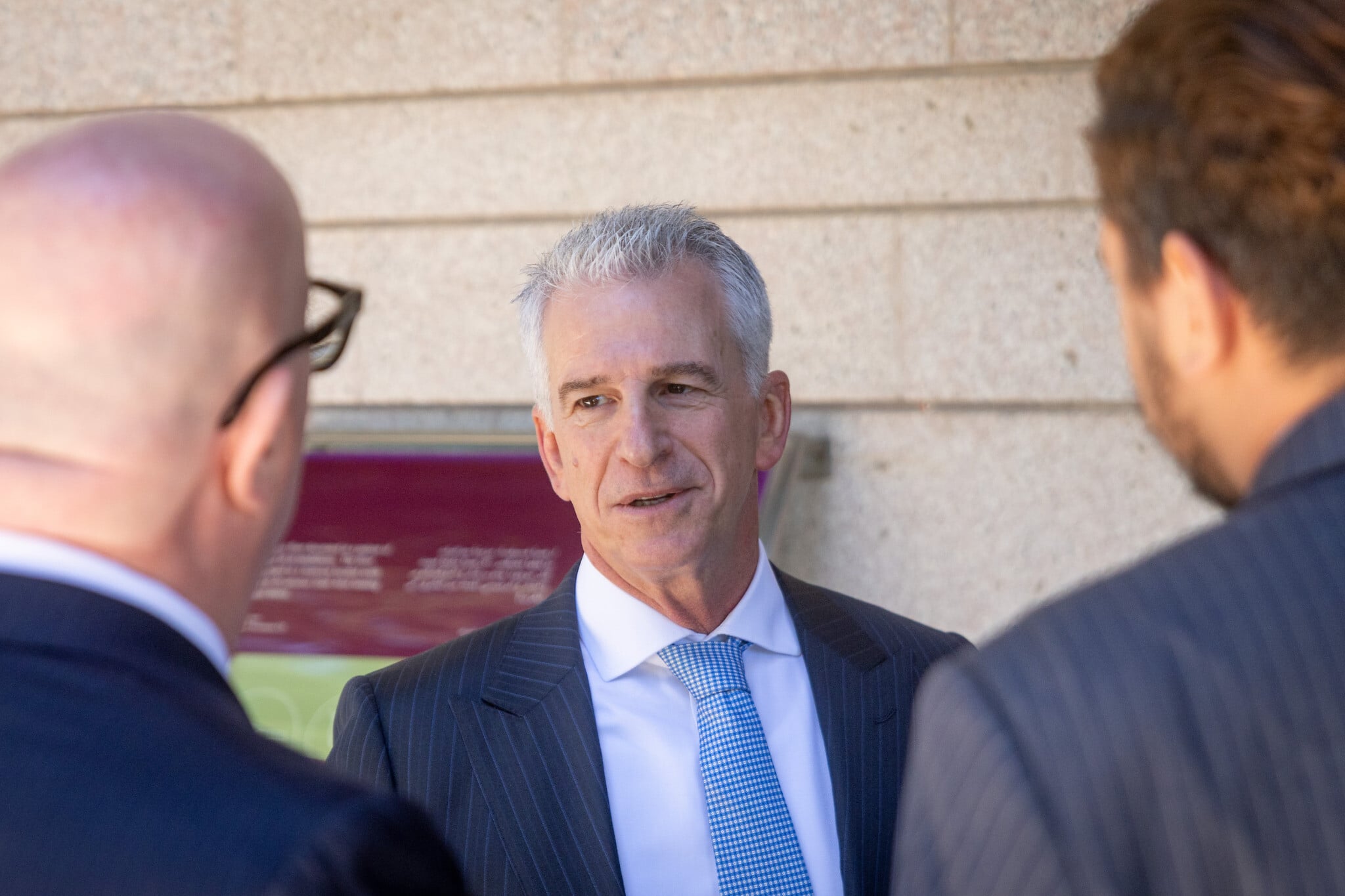
Former Mossad chief David Barnea is joining Ondas Defense Ltd. as its global president and chairman, the NASDAQ-traded company announced on Monday.
The defense technology company said in a statement that Barnea will focus on “the Middle East, Europe and Asia, where governments are accelerating investment in autonomous defense, counter-UAS, intelligence, surveillance and reconnaissance, resilient communications, precision-strike and ground robotic systems.”
Barnea, 61, said in the statement that “the nature of warfare is changing rapidly, as demonstrated by the conflicts in the Middle East and Ukraine.”
He added that “operational advantage increasingly depends on the ability to combine intelligence, artificial intelligence, resilient communications, autonomous platforms and precision capabilities into one coordinated operational environment.” Barnea said he was looking forward to working with Ondas to “help develop the next generation of AI-enabled, multi-domain defense systems.”
Ondas says that its company mission is to provide “autonomous systems, robotics, and mission-critical technologies” to “government, defense, and commercial customers.”
Get The Times of Israel’s Daily Edition
by email and never miss our top stories
By signing up, you agree to the terms
In its press release announcing Barnea’s hire, Ondas stressed that the former Mossad chief “will not use or disclose classified, confidential or otherwise restricted government information” in his new role.
IDF Chief of Staff Lt. Gen. Herzi Halevi (center) is seen at a command center for the release of hostages held by Hamas, on January 25, 2025, alongside Mossad chief David Barnea (right), Shin Bet head Ronen Bar (2nd from right), hostage pointman Maj. Gen (res.) Nitzan Alon (2nd from left), and Maj. Gen. (res.) Yoav Mordechai (left). Also in the room are IDF Intelligence Directorate chief Maj. Gen. Shlomi Binder and Prime Minister Benjamin Netanyahu’s military secretary Maj. Gen. Roman Gofman. (Israel Defense Forces)
Barnea served as Mossad chief from 2021 to 2026, including during the October 7, 2023, Hamas invasion, the subsequent wars against Hamas and Hezbollah, and the multiple Israeli bombing campaigns against Iran.
He was credited with major operational successes in the 2.5 years since the Hamas onslaught, including the exploding-beeper operation against Hezbollah in Lebanon, the assassination of Hamas leader Ismail Haniyeh in Tehran, and operations during the 12-day war against Iran’s nuclear and ballistic missile programs. He also played a major role in years of talks to release the hostages being held in Gaza.
“Barnea radically changed Mossad,” a senior defense official told The Times of Israel last year. “He flipped the script and reached new heights in the use of technology for things like smart surveillance cameras and facial recognition. It wasn’t easy for him. Mossad is still a conservative organization, and Barnea had to fight many internal battles. In the end, he won, and we are seeing the result on the streets of Iran.”
Before assuming the position of Mossad chief, Barnea served in the spy agency for 25 years, including as a deputy to then-director Yossi Cohen from 2019 to 2021.
He served as a combat soldier in the elite Sayeret Matkal commando unit and later received a bachelor’s degree in business administration from the New York Institute of Technology and an MBA in finance from Pace University. He worked in investment banking until 1995, when he left the private sector to join the Mossad.
Barnea was replaced by Roman Gofman in June. Gofman’s nomination and confirmation as Mossad chief were shrouded in controversy, and Barnea wrote a letter to the High Court arguing that Gofman was unfit for the role. Gofman was ultimately, however, cleared to assume the position.
Should Barnea wish to enter politics after he leaves office, he will have to wait a three-year “cooling off” period.
We can’t do this work alone.
The war with Iran has been draining for all of us in Israel. But when I heard about a high casualty incident – ballistic missile impacts in Arad and Dimona that left nearly 200 people wounded – I drank a cup of coffee, packed a bag, and headed south.
There, I spoke with Shilgit, the head of an after-school program for underprivileged youth. Standing outside her destroyed center, Shilgit said it was a miracle that no children were hurt and spoke about the community coming together in the hours since.
As a Times of Israel reporter, I’m committed to telling stories of resilience like Shilgit’s. But my colleagues and I can’t do this alone. If you value work like this, please consider joining our reader support group, The Times of Israel Community. Your financial support is essential to keep real human reporting like this going.
— Stav Levaton, military reporter
Yes, I’ll join
Yes, I’ll join
Already a member? Sign in to stop seeing this
You’re a dedicated reader
We’re really pleased that you’ve read X Times of Israel articles in the past month.
That’s why we started the Times of Israel – to provide discerning readers like you with must-read coverage of Israel and the Jewish world.
So now we have a request. Unlike other news outlets, we haven’t put up a paywall. But as the journalism we do is costly, we invite readers for whom The Times of Israel has become important to help support our work by joining The Times of Israel Community.
For as little as $6 a month you can help support our quality journalism while enjoying The Times of Israel AD-FREE, as well as accessing exclusive content available only to Times of Israel Community members.
Thank you,
David Horovitz, Founding Editor of The Times of Israel
Join Our Community
Join Our Community
Already a member? Sign in to stop seeing this