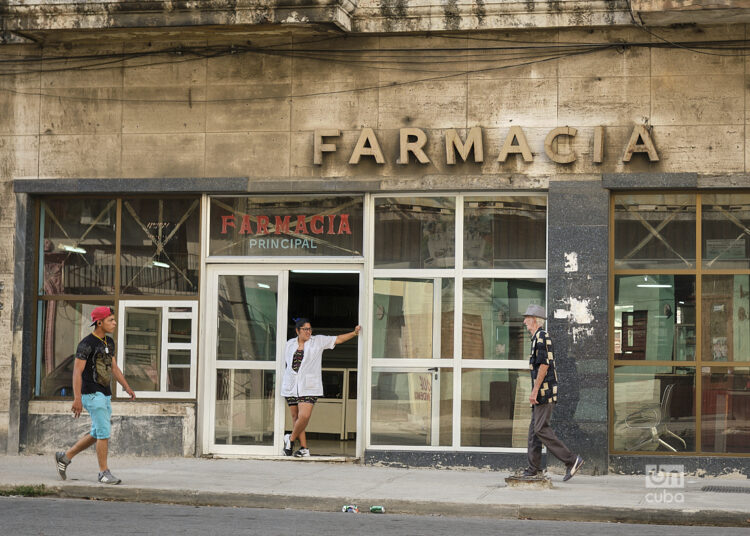
A nearly empty Cuban state pharmacy in March 2026. Photo: Reuters
By Amado Viera
HAVANA TIMES – A few weeks ago, when it was time to renew her medication card, Iraida Lezcano almost decided not to bother. The process required her to visit a family doctor’s office farther away than her usual one (which closed about a year ago due to a shortage of doctors) and then make trips to the polyclinic and pharmacy assigned to her neighborhood, collecting signatures and official stamps for a certificate confirming her dependence on several medications to control her high blood pressure. All of this under the relentless June sun, at 75 years old, with persistent arthritis in her left knee.
Year after year, nearly one million Cubans with chronic illnesses must go through the same bureaucratic process to continue receiving the medications they need.
“It’s as absurd as it sounds. Do you know any hypertensive or diabetic who has been cured? These are lifelong diseases. Yet some bureaucrat came up with the ‘brilliant’ idea of putting an expiration date on these medication cards just to make people’s lives harder. We elderly people are the ones who suffer the most from this whole renewal ordeal,” Iraida lamented.
The worst part is that all this effort does not guarantee access to the medications. The “medication card” is a booklet listing the patient’s medical conditions and required treatment, certified by the family doctor and the polyclinic administration. Once registered at the neighborhood state pharmacy, it entitles the holder to purchase those medications at heavily subsidized prices. In the past, cardholders could be certain the medicines would be available. But that reality is long gone.
For nearly a decade, supplies at Cuban pharmacies have been insufficient and erratic. During the past two years, the crisis has deepened further. By the end of 2025, the Ministry of Public Health (MINSAP) acknowledged that 69% of the 651 medications included in the country’s essential medicines list were “affected”—the bureaucratic term used to indicate they are unavailable at pharmacies and healthcare facilities, many of them for more than a year.
According to MINSAP, maintaining that essential medicines list requires more than $300 million annually. A similar amount would also be needed for basic hospital supplies—gauze, disinfectants, sutures, and the like—which patients and their families are now often forced to provide themselves.
“What medication do you need?”
That is the phrase medicine sellers typically post on social media to signal that they are accepting new orders. In the comments, people write the names of the drugs they are seeking, and the seller then contacts them privately to arrange prices and delivery.
“No one writes ‘I’m selling medicines’ because they want to avoid problems with the police. Until now, it was an illegal business and openly advertising it on Facebook or WhatsApp could lead to a report. Over time, both customers and sellers got used to this kind of password. We’ll have to see what happens now that private pharmacies have been authorized,” a man I know, who has spent years selling medicines sent by a relative in Mexico, told me.
He has never dealt in Cuban medicines “because that’s a disaster. There’s no way to justify having them unless they were stolen from a hospital or resold from a pharmacy. Plenty of people do it anyway, but they take enormous risks,” he added.
The informal pharmaceutical market has spent the last seven or eight years filling an ever-growing share of Cuba’s demand for medicines. It began as a side business for the mulas—private traders who traveled to Guyana, Panama, and other destinations primarily to buy clothing and electronic devices for resale in Cuba. But it became increasingly important and profitable to also bring medicines as state pharmacies and hospitals grew less able to meet demand.
The decisive boost came in 2021, when the government exempted “non-commercial” imports of food, medicines, and medical supplies from customs duties.
The quotation marks are intentional. During the past five years, customs authorities have only rarely confiscated medicines or medical supplies, even when it was obvious, based on the volume and nature of the cargo, that they were intended for resale.
“They know they can’t really crack down because the shortages are so severe. I’ve even had customers who needed me to find surgical supplies for their operations! The only thing customs gets strict about is psychiatric medications, because they’re worried about drugs. But anyone who wants to protect their business simply doesn’t bring those,” the seller explained.
Informal-market medicines, however, have two major drawbacks: questionable safety and very high prices.
For years there have been reports of counterfeit medicines, some of which have even caused deaths. In August 2024, for example, MINSAP warned about three medications circulating in Cuba without sanitary controls. The most serious case involved a Domperidone supposedly manufactured in Canada. Tests conducted by Cuba’s drug regulatory authority found that it was a poor-quality counterfeit. The identification codes on its label also did not match records in Canada’s healthcare system.
High prices are another consequence of the numerous intermediaries involved in the trade, along with the depreciation of the Cuban peso against the US dollar, the currency used as the benchmark for purchases made outside Cuba.
Even a basic medicine like paracetamol can sell for more than 2,000 pesos per bottle, about two-thirds of the new monthly minimum wage, depending on the province and whether the country is going through one of the recurring epidemics that have affected Cuba in recent years.
Outside a Cuban state pharmacy. File Photo: Nester Nuñez / Oncubanews.com
Pharmacies yes, private medical practices no… for now
At the beginning of July, economist Juan Triana speculated in an interview with the digital publication La Joven Cuba that medical professionals might eventually be allowed to divide their time between public employment and private practice.
“We have historical precedent. During the early years of the Revolution, doctors were allowed to maintain private practices while also working in hospitals, polyclinics, and even teaching. I’d much rather see a doctor with a private practice than one working as an employee in a cafeteria. Give them a contract, let them work two days a week at the polyclinic and spend two days seeing private patients.”
His reflections also extended to dentistry and primary healthcare services.
Those who dismissed Triana’s remarks overlooked the fact that he is one of three economists with “independent positions”—often critical of the government—whom President Miguel Díaz-Canel reportedly invited to advise on the current reform program.
A dispatch from the EFE news agency, dated from Havana in mid-June, revealed the existence of this advisory group and underscored its significance by noting that it includes, among others, former Vice President of the Council of Ministers Jose Luis Rodriguez, who also served as Minister of Economy and Planning and promoted Cuba’s first openings to private enterprise and foreign investment during the 1990s and 2000s.
Just days later, Triana’s speculation was partly confirmed with the publication of a decree authorizing the creation of private pharmacies and optometrist stores. Although the same regulation reaffirms the ban on private medical and dental offices, many Cubans have begun speculating that those services could also be legalized in the near future.
It would not be the first time the government has introduced controversial reforms gradually to minimize public resistance.
Despite lacking official recognition, dozens of private dental clinics already operate throughout Cuba, openly advertising on social media. They are usually located in private homes, without large exterior signs, but they make little effort to conceal their activities.
“The treatments aren’t cheap, but at least they offer an alternative for people with greater purchasing power, allowing them to avoid state clinics, where supplies are almost always lacking or services are interrupted because there’s no water or electricity,” explained a young dentist who divides her time between a state job and a private clinic in the city of Camagüey.
Some dental services offered privately.
The income she earns in a single day at the private clinic is roughly equivalent to what she used to earn in an entire month working for MINSAP, before the government announced wage increases this week.
Something similar will likely happen with private pharmacies. They should help reduce prices to some extent and decrease the circulation of counterfeit medicines. But at least initially, they will remain a luxury for most Cubans.
Just as was the case with the now-defunct foreign-currency pharmacies operated by the Cuban Medical Services Corporation before the pandemic, whose principal customers were Cubans with relatives abroad and foreign residents on the island.
None of this will help elderly people like Iraida, who depend on pensions that lose value every year. They will have to continue waiting for the occasional distribution of medications through the state-run medication card system. And who knows for how much longer that will exist at all.
Read more from Cuba here on Havana Times.