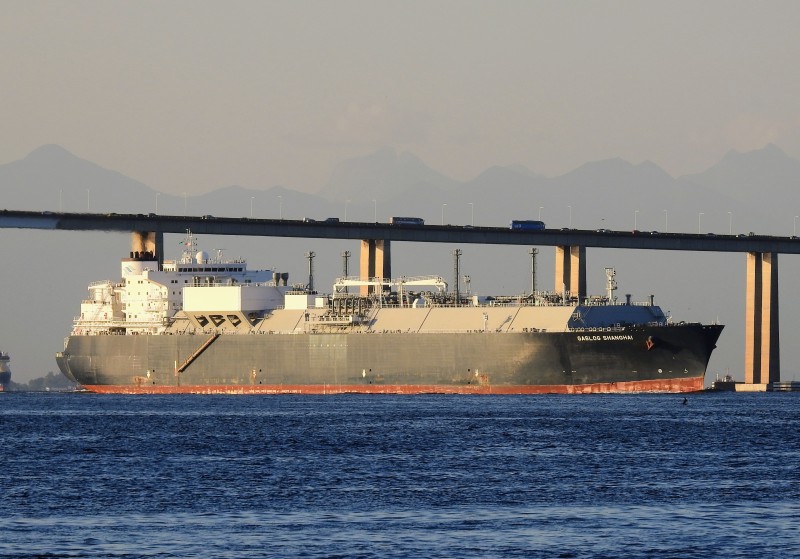
A liquefied natural gas (LNG) tanker carrying a Qatari cargo was struck by a projectile while traversing the Strait of Hormuz, threatening super-chilled fuel supplies and driving oil prices to their biggest gains since March amid escalating regional conflicts.
According to Bloomberg, security consultancies Vanguard Tech and Marisks identified the vessel as the LNG tanker Gaslog Shanghai. A spokesperson for the vessel’s Greece-based manager, Gaslog, said in a statement that the ship’s operator confirmed it was hit by an unknown projectile that caused a power outage. She added that no crew members were injured and a resulting fire was extinguished. Gaslog had not immediately responded to requests for comment outside of official working hours.
The United Kingdom Maritime Trade Operations (UKMTO) reported that a vessel was attacked overnight in the strait off the Omani coast, confirming that no environmental impact has been recorded so far. In a separate alert on Saturday, the UKMTO stated another tanker observed an explosion in nearby waters but suffered no damage.
The Gaslog Shanghai loaded an LNG cargo from Qatar around July 27 before it stopped transmitting its signals on July 31 near the western entrance of the Strait of Hormuz, according to ship-tracking data compiled by Bloomberg and Kpler. The vessel did not appear to be broadcasting its signal at the time of the attack.
The incident threatens to further disrupt LNG shipments through the Strait of Hormuz, a critical waterway for about one-fifth of global super-chilled fuel flows. In early July, an attack on another Qatari tanker near the strait prompted Qatar, the world’s second-largest LNG exporter, to suspend shipments through the corridor for three weeks.
The escalating violence, spanning from the Gulf to the Russian Black Sea, has significantly impacted energy markets. Oil prices recorded their largest gains since March. Brent crude futures for October settlement rose 1.2% to $87.93 a barrel, while September contracts, which expired on Friday, traded at $90.12 a barrel. West Texas Intermediate (WTI) futures rose 1.3% to settle at $84.67 a barrel.
Energy markets surged throughout July, with the global benchmark Brent gaining nearly 24%. Products including diesel and natural gas also recorded substantial increases.
US President Donald Trump stated he has lost faith in Iranian negotiators, in the latest indication of likely continued armed hostilities that could further disrupt Middle East energy shipments. This month, a fragile truce between Washington and Tehran collapsed. The United States has imposed a total naval blockade on ships stopping at Iranian ports, while Tehran has continued to threaten vessels crossing the Strait of Hormuz.
The conflict has steadily broadened, with Yemen-based Houthis entering the fight and Saudi forces launching targeted strikes on Iran-backed groups in Iraq. Furthermore, a series of attacks on oil-loading vessels at or near the Caspian Pipeline Consortium terminal in the Russian Black Sea has added upward pressure on prices, while US inventories have continued to decline.
The ongoing supply disruptions have bolstered corporate energy earnings. Shell announced on Thursday its second-highest quarterly profit on record, fuelled by a boom in trading and refining tied to the Middle East conflict. US major Chevron said it expects fuel production margins to remain elevated as the global refining system struggles to keep pace with the volume of supply disruptions.
Despite the market rally, the International Monetary Fund (IMF) continues to see a risk that a Middle East oil shock could push the global economy into recession, though the impact would be limited if the Strait of Hormuz reopens soon, according to Managing Director Kristalina Georgieva.