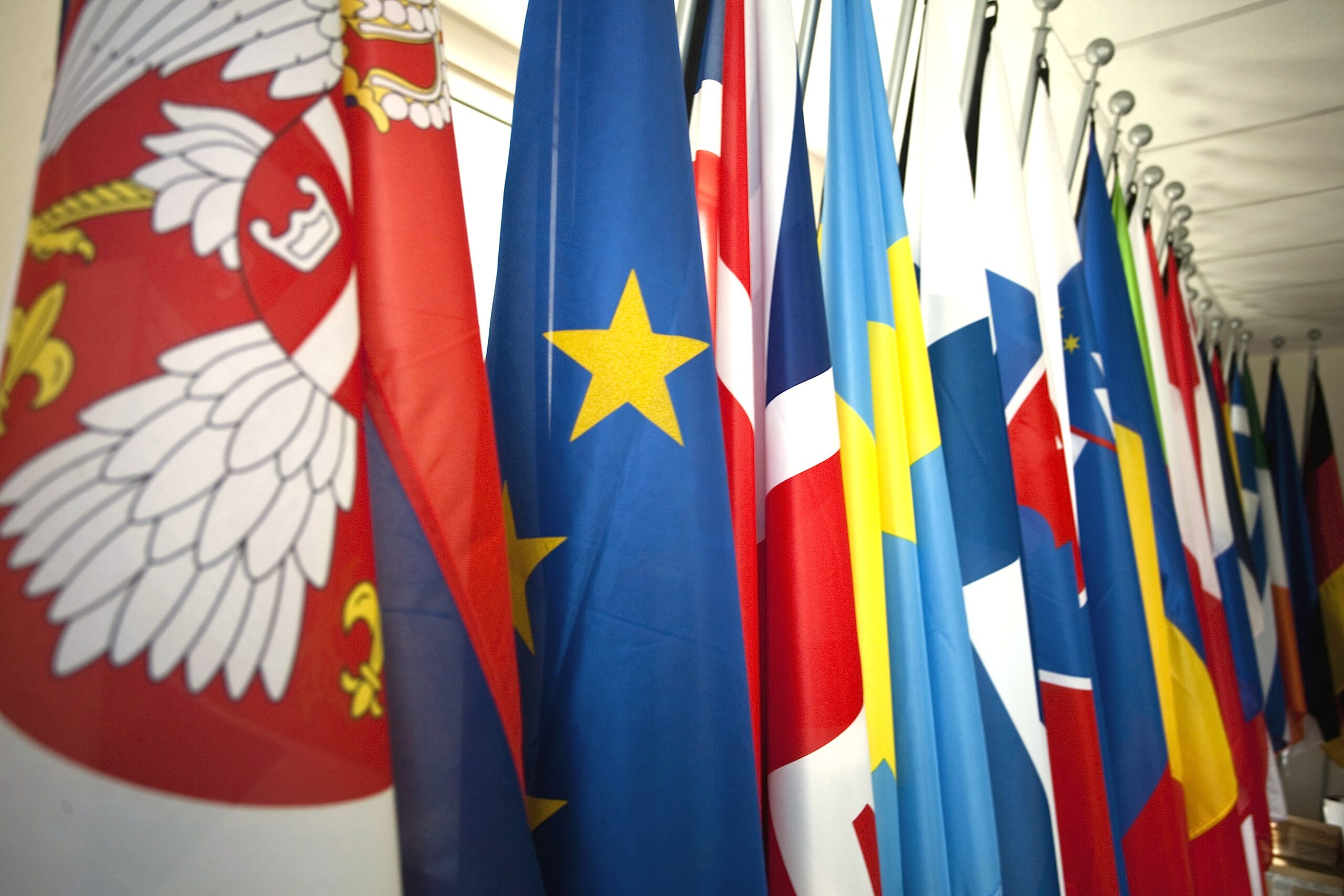
Even Brussels is probably uncertain as to when the enlargement of the European Union (EU) to the Western Balkans might actually occur. For now, Montenegro holds the best chances of becoming the newest Union member, potentially as early as 2028. However, new ideas are emerging in the interim, so we hear increasingly often about gradual accession to the EU, membership without veto rights, and the integration of candidate states into the single market and Schengen area.
Serbian President Aleksandar Vučić is actively advocating for this latter option. That proposal, however, raises several questions, and experts on European affairs point out that serious reforms must precede access to both the single market and Schengen.
Vučić last spoke on this topic about ten days ago, during a visit by Czech Prime Minister Andrej Babiš to Belgrade.
“As a rational and realistic person who understands how things unfold in the EU and respects the position of European leaders and everything happening around us, I said that the most important thing for Serbia in the coming years is to be part of Europe’s single market and to have open borders both within the region and with all EU member states,” Vučić stated at the time.
Interestingly, accession to the single market and the Schengen zone was requested jointly at the beginning of this year by Vučić and Albanian Prime Minister Edi Rama. On that occasion, they co-authored an opinion piece for the Frankfurter Allgemeine Zeitung.
“We wrote this text together because we recognize that Europe today has two equally legitimate objectives: candidate countries are seeking a realistic path to full membership, while member states wish to preserve the EU’s capacity to act and its internal unity. That tension does not have to be a zero-sum game. With imagination and political will, it can – and must – become a strategic opportunity. That is why we advocate for the accelerated integration of prepared candidate countries into the single market and the Schengen area. This could deliver tangible benefits to citizens while simultaneously strengthening the EU’s economic and geopolitical standing, without overburdening its decision-making architecture or altering the institutional balance. It would involve no veto rights, no additional commissioners, no extra MEPs in the European Parliament, and no changes to voting structures. We are convinced this would ease the concerns of those member states hesitant about further enlargement – partly because it would be considerably easier for them to present this process persuasively to their public,” they wrote in the piece.
How realistic is it and what does it depend on?
The Secretary General of the European Movement in Serbia, Dragana Đurica, explains to NIN that single market access, entering Schengen, and full EU membership are three interconnected, yet legally and institutionally distinct processes.
“The gradual inclusion of Western Balkan states into specific segments of the single market has already been offered via the Growth Plan for the Western Balkans in areas such as the free movement of goods and services, SEPA, road transport, energy, the digital market, and European industrial supply chains. However, the Commission itself defines this process as preparation for membership and drawing closer to membership, rather than as a substitute for it. That is the critical distinction that should not be blurred. Article 26 of the Treaty on the Functioning of the EU defines the internal market as an area of free movement for goods, people, services, and capital. But access to specific segments of that market does not make a country an EU member state. Membership is acquired exclusively through the procedure outlined in Article 49 of the Treaty on European Union, completing accession negotiations, and concluding and ratifying an Accession Treaty. Only then can a state obtain full participation in EU institutions, representatives, voting rights, and the ability to shape rules that it must first implement,” Đurica states, adding:
“That is why gradual integration can be beneficial for citizens and the economy, but it also carries a serious political risk of remaining in the European waiting room with limited economic perks, lacking full membership and any influence over decisions that directly affect citizens’ lives. This might suit authorities like ours, who desire European funds, investment, and market benefits while attempting to avoid fundamental reforms, political accountability, and real limits on their own power.”
According to her, access to the single market must not become a “cheaper membership package” for the government, nor a political concession for a stalled accession process. She recalls that in its conclusions of 19 June 2026, the European Council explicitly stated that gradual integration must take place alongside the enlargement process, be merit-based, and remain reversible – in other words, it should accelerate the path to membership rather than replace or delay it.
“Even access to parts of the single market requires reforms – not just technical alignment with standards, but also institutions capable of applying those rules impartially. One cannot evade obligations to maintain independent courts, a reliable public administration, state aid controls, transparent public procurement, free competition, consumer protection, and legal certainty. The single market is not merely a trading space; it is a legal order built on shared rules and mutual trust,” Đurica adds.
She points out that Schengen is even more demanding.
“It is true that countries exist that are not EU members yet participate in Schengen, but they have special international agreements with the Union and adopt the relevant Schengen acquis. The removal of border controls requires full implementation of rules on external borders, visas, police and judicial cooperation, data protection, and information systems, followed by expert evaluations and a unanimous decision by Schengen member states. Even Croatia, as an EU member, had to undergo evaluation and secure a unanimous decision from the Council before controls were lifted. Therefore, I would say that gradual access to specific parts of the EU single market is realistic, whereas Serbia entering Schengen before full membership is politically and legally far more complex, with no concrete European offer currently on the table. But most importantly, citizens should not be deceived: neither of these options equates to full membership, and neither can be achieved without fundamental reforms,” Dragana Đurica concludes.
Macron and Merz in favour of gradual integration
As a reminder, the question of enlargement is once again high on the agenda in Brussels, and it is now evident that serious consideration is being given to how to anchor the Western Balkans to the “European ship” in an increasingly turbulent world. If not through swift accession, then via other means. Leaders from the EU’s two most powerful nations – France and Germany – have advocated for this approach. At the recent summit in Tivat, French President Emmanuel Macron and German Chancellor Friedrich Merz presented a non-paper proposing, among other things, gradual EU integration instead of waiting for full membership so that candidate countries can gain tangible benefits, earlier access to the EU single market, and entry into specific European programmes for states meeting designated reform goals.
Thus, the proposal suggests potential participation in EU student exchange and research programmes, as well as possible integration in sectors such as energy, industry, and the bloc’s emissions trading system, provided the candidate country meets required standards. It also raises the possibility of allowing representatives from Western Balkan countries and Moldova to attend parts of EU ministerial meetings and summits, albeit without voting rights.
France and Germany also emphasize that none of this serves as a replacement for full membership or its postponement, but rather creates additional incentives for faster reform implementation and accelerates the EU accession process.
At the Tivat summit, Merz remarked among other things that the EU must demonstrate its capacity and readiness for enlargement.
“Of course, there are a number of questions we need to answer, but above all, this part of Europe must be viewed in relation to the European Union. The fact that we have not admitted a single new member state in 13 years shows that shortcomings exist within the European Union itself, and that is what we want to overcome today. I expect certain conclusions to be drawn today that will subsequently be implemented in Brussels,” Merz stated.
(NIN, 31.07.2026)
https://www.nin.rs/politika/vesti/119639/jedinstveno-trziste-i-sengen-pre-clanstva-u-eu