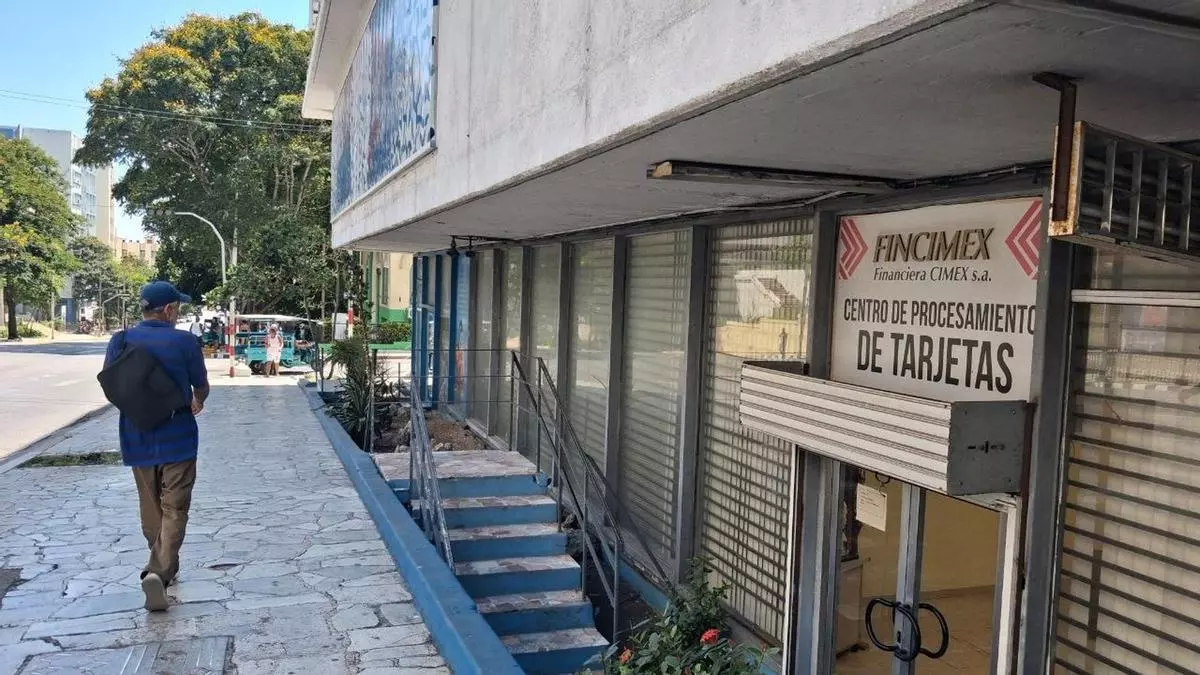
Fincimex office on 23rd Street in Havana’s Vedado neighborhood. / 14ymedio
A walk through El Vedado reveals the decline of the commercial network the military built to control remittances, tourism, and hard-currency stores.
By Yoani Sanchez (14ymedio)
HAVANA TIMES – Some buildings collapse with a deafening crash, while others quietly crumble away. The former Fincimex card processing center on 23rd Street in El Vedado belongs to the latter category.
As I pass its entrance, I find little more than a faded sign still proclaiming the greatness of a company that once controlled much of the dollars flowing into the country. Behind the dusty windows there are no longer lines of customers, hurried employees, or Cubans waiting to receive the magnetic card that opened the door to remittances sent by relatives abroad. All that remains is the echo of another era.
For years, that office was the funnel through which the money of thousands of families passed. A household’s prosperity fit onto a piece of plastic with a magnetic strip and the Fincimex logo. You had to wait days to get one, but anyone who walked out holding that card felt as though they had secured a lifeline. Today, the entrance looks abandoned, plaster peels from the walls, and silence has taken the place once occupied by impatience.
I cross the street and retrace my steps. The heat turns the asphalt into a griddle, and the shade from the trees is scarce. Along the way I stop at one of those dollar stores that, just a few years ago, symbolized the power of Cimex—that vast corporate web belonging to the Business Administration Group S.A. (Gaesa), the military conglomerate that sought to control almost everything: remittances, hotels, hard-currency stores, imports, ports, and every last cent a Cuban received from abroad.
The employee barely looks up when I walk through the door. She fans herself with a folded piece of cardboard while waiting for the workday to end. Her face is weary, and her sour expression contradicts the air of confidence with which many Cimex clerks once served customers, back when working there meant holding a privileged position. I ask about a product, and she answers without enthusiasm. Before I can press further, she sighs: “I haven’t even had a snack today.”
She doesn’t need to say anything more. Her appearance tells the rest of the story. Gone are the bags of frozen chicken that some employees once received as incentives, the transportation that picked them up and dropped them off at the store, the monthly food packages that arrived on schedule, and even the discreet tips left by grateful customers lucky enough to find a liter of cooking oil or a package of detergent. Now, with no US coins available for making change and customers receiving bouillon cubes or candy instead, almost no one leaves them even a few pennies as a token of appreciation—not even in Cuban pesos.
Decline has a very particular way of making everyone equal. Workers who once seemed part of a commercial elite now share the same exhaustion as the rest of the country. Their privileges evaporated just as quickly as the products disappeared from the shelves.
I continue down toward the sea. Around the Grand Aston Hotel, the scene is unsettling. The facilities look immaculate, yet an unnatural silence hangs over what should be a bustling tourist establishment. The only sound is the steady pounding of the waves against the nearby Malecón seawall. It is hard to believe this was once one of Gaviota’s most ambitious projects—the tourism company owned by the Cuban military—which managed it alongside a foreign partner that ultimately left the Island. Where a constant stream of visitors had been promised, there is now mostly stillness and the feeling of endless waiting.
For years, Gaesa built an economic empire with the ambition of controlling every profitable business of the country. Remittances ended up under Fincimex; tourism passed into Gaviota’s hands; stores operating in freely convertible currency mushroomed under the TRD and Caribe chains; imports and much of the country’s logistics also came under its grip. It seemed like an impregnable model, a machine designed to concentrate resources and power.
But that very concentration ultimately became its greatest weakness. The sanctions imposed by Washington struck precisely the nodes where the conglomerate had amassed its greatest influence. Once the core of the system began to falter, the shockwaves spread to offices, stores, hotels, and employees whose daily lives had been built around that enormous structure.
As I make my way back, I glance once more at the Fincimex building on 23rd Street. It occurs to me that ruins are not always piles of rubble. There are administrative ruins, commercial ruins, and symbolic ruins as well. They remain standing, with their doors closed and their signs still hanging, as if waiting for an impossible return.
Perhaps that is the final fate of empires that tried to embrace too much: discovering, when it is already too late, that size itself can also be a form of fragility.
First published in Spanish by 14ymedio and translated and posted in English by Havana Times.
Read more from Cuba here on Havana Times.