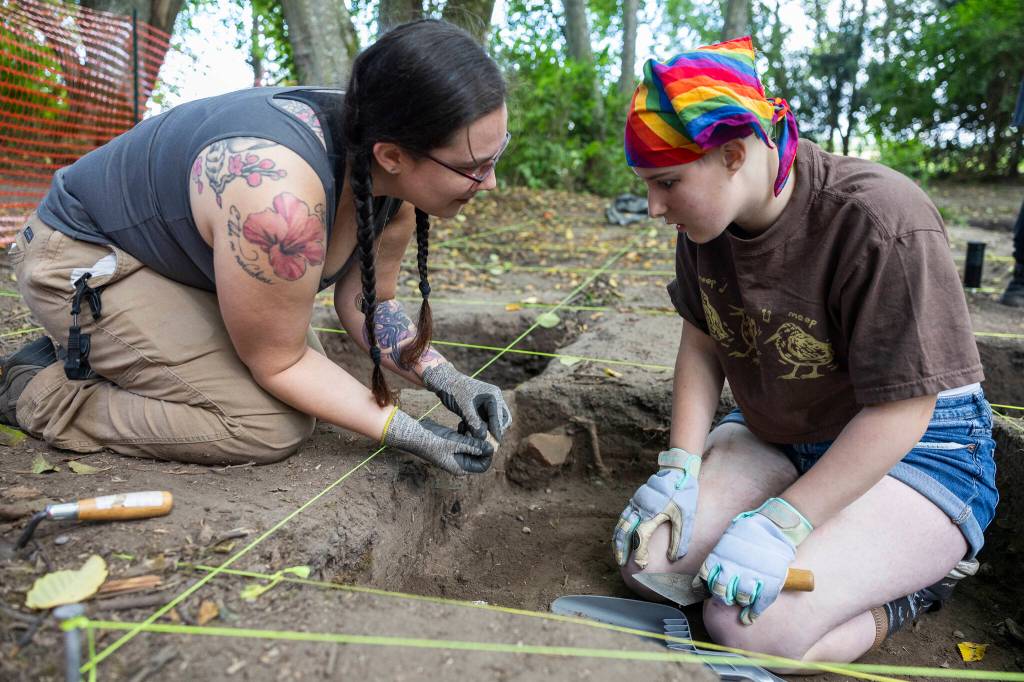
MUKILTEO — Edmonds College students have returned to the Japanese Gulch in Mukilteo for the second year in a row to dig up artifacts, revealing insights into the daily lives of Japanese immigrants in the early 1900s.
In 1903, the Mukilteo Lumber Company, later the Crown Lumber Company, opened in Mukilteo. The lumber mill hired several Japanese immigrants and provided them housing in what’s now known as the Japanese Gulch. By 1905, Mukilteo’s population of approximately 350 people included 150 Japanese immigrants or people of Japanese descent, according to the Mukilteo Historical Society.
But during the Great Depression, the lumber mill closed its doors, causing a mass exodus of workers.
“We don’t know exactly what happened after it was abandoned,” student Melissa Fuentes said.
Now, the Edmonds College archaeology field class is working to piece together what happened next, as well as what life looked like in the Japanese Gulch during the mill’s operation.
Since this year’s work began in early July, the group has found a wide variety of artifacts, from medicine and perfume bottles to toothbrushes and marbles. The group is using the artifacts to answer questions in four main areas of research: how the land has changed over time since the early 1900s; the activities the community engaged in when they lived in the gulch; how connected they were to their Japanese heritage; and other identity demographics, such as age and gender.
For example, they’ve found that everyday items likely came from a local convenience store, but more important items, such as medicine, were ordered from Japan, said student Ryan Babjack.
One group found an intact blue medicine bottle with Japanese inscription that showed it was from a company located at Nihonbashi, Tokyo’s business district.
The presence of kids’ toys, perfume bottles and nail polish bottles are consistent with reports that there were many women and children living in the gulch, student Vi Douglas said.
“That’s an unusual historical feature of this site is that there was a lot of women and children present, which was important in Japanese immigrant communities during that time,” she said.
Many of the students came from out of state for the field class, including some from Oregon, Wisconsin and Kentucky. Field research is a requirement for getting hired as an archaeological technician, said Ashley Pickard, head of the anthropology department at Edmonds College and the lead on the excavation project.
“This is one of the only archaeological field schools in the Pacific Northwest, so it’s a great opportunity for students from the area to come and learn about different field techniques, which is really important if you want to enter the field and have field experience.” said Douglas, who’s a history student at the University of Washington.
Edmonds College’s archaeology field school is a more affordable option than many other schools in the country, Pickard said.
“In many ways, archaeology is prohibitively expensive,” she said. “It’s very important to us that we keep our fees and costs as low as possible, so that archaeology is accessible to everybody.”
Hannah Greengrass, a freshman at Edmonds College, is hoping to go into wildlife and conservation management after college. She is also pursuing a minor in Pacific Northwest History.
“I’ve always been interested in archaeology since a young age,” she said. “I was like, this is a perfect opportunity to kill two birds with one stone and experience archaeology for the first time.”
Since the beginning of the dig, Greengrass and her group have found a harmonica, part of a bike tire and lots of ceramic pieces.
One important part of the class is community archaeology, or involving the community in the process. The class has taken trips to the Mukilteo Lighthouse to visit with the Mukilteo Historical Society. Last year, a grandson of one of the kids who lived in the Japanese Gulch came to visit, student Toby Haaf said.
“He was really appreciative that we’re looking into it because outside of minor historical records, there’s not a lot here,” Haaf said. “Interviews said that this was like a haven for the kids that were here, so being able to give that childhood back to their families is really important.”
Haaf is one of several students who have returned to the project for a second year and now serves as a mentor for the first-year students.
“I absolutely loved it,” Haaf said. “I went to Ashley crying, and I was like, ‘This is what I’m supposed to do with my life.’ I told her I’d come back every day no matter what.”
As of Tuesday, the group had some artifacts buried in the dirt left to uncover, such as a large piece of leather and some painted porcelain.
“We call them artifacts, we’re going through this in a scientific manner, but these are belongings,” said Laurel Diciuccio, a faculty member for the program. “They belonged to the actual people, and finding things like clothing, like a perfume bottle or a medicine bottle, it reminds you of the humanity of the site, and that’s really cool.”
In the fall, some students will take a lab methods class, during which they’ll curate, catalog and research the artifacts. Last year, several students presented their research at local conferences, Pickard said.
Part of community archaeology is also reminding the community that if they see an artifact, to leave it where it is and contact their local museum or state historical office, student Allison Mooney said.
“Leaving pieces in place lets us know where it was and the context of it, so we can then explore it further,” she said.
While this is the field school’s second year at the Japanese Gulch, the school has done other excavations at the North Seattle College campus. Pickard said she hopes the program continues at the Japanese Gulch.
“Depending on our relationship with the city, if it’s meaningful to the city and community, we would like to be here for several more years,” she said.
Jenna Peterson: 425-339-3486; jenna.peterson@heraldnet.com; X: @jennarpetersonn.