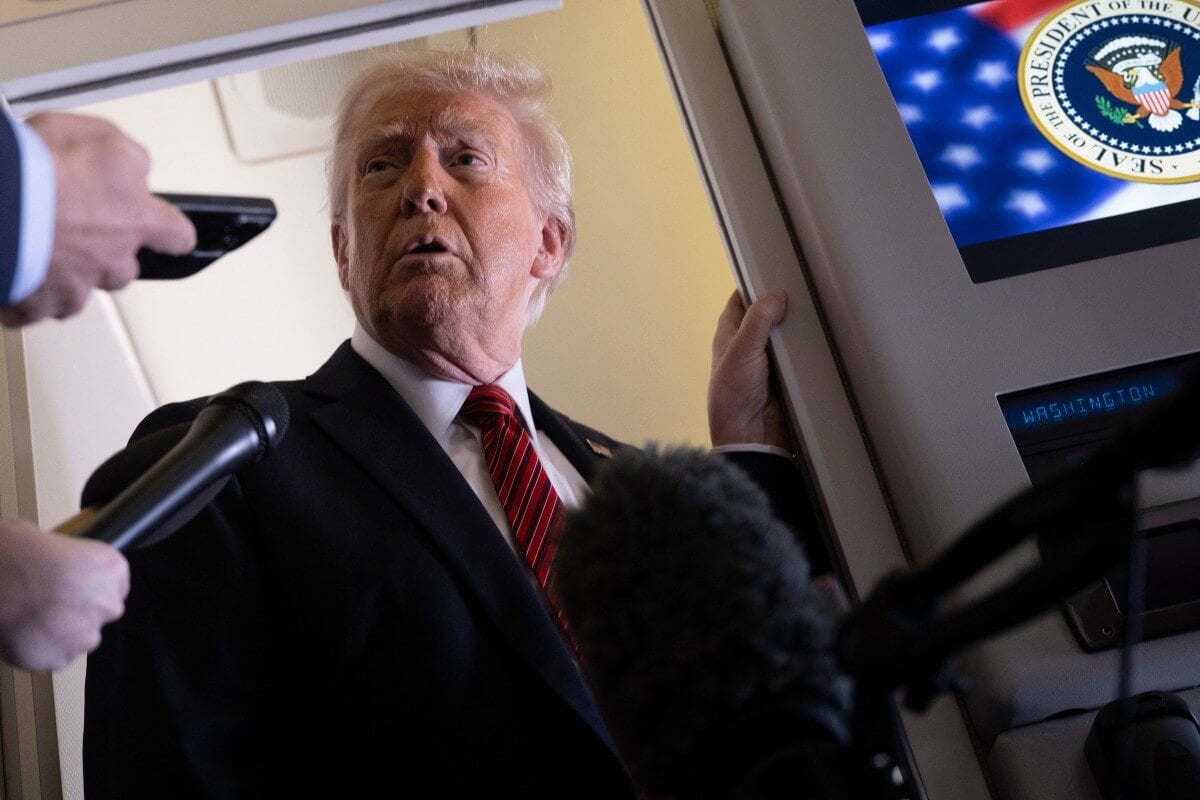
US President Donald Trump on Monday dismissed Israeli Prime Minister Benjamin Netanyahu’s opposition to a potential sale of F-35 fighter jets to Turkey, telling reporters aboard Air Force One, one day before the two leaders were due to meet at the White House, that no foreign leader would determine US arms export decisions.
Asked aboard Air Force One whether he would tell Netanyahu, who has publicly opposed supplying F-35s to Turkey, that he disagreed, Trump replied, “Nobody tells me what we should be selling and not.”
“Turkey has been a tremendous ally for me,” Trump said. “Turkey has been great. Very powerful country, by the way. Tremendous military. Very big military. Very powerful military. Has a lot of great equipment.”
Trump nevertheless acknowledged Ankara’s strained relations with Israel.
“Turkey’s not a big fan of Israel. You know that, right? And not a big fan of Bibi,” he said, referring to Netanyahu by his nickname.
Trump was scheduled to host Netanyahu at the White House for their eighth meeting since returning to office.
Before departing for Washington, Netanyahu said Iran would be the leading item on the agenda and that the talks would focus on strengthening Israel’s security and military position while expanding regional peace efforts.
Why the issue matters
Turkey was removed from the multinational F-35 Joint Strike Fighter program in 2019 after acquiring the Russian-made S-400 air defense system. Washington argued that operating the S-400 alongside the stealth aircraft could compromise sensitive NATO technology and later imposed sanctions on Turkey’s defense procurement agency under the Countering America’s Adversaries Through Sanctions Act (CAATSA).
Ankara has consistently rejected those concerns, arguing that it invested roughly $1.4 billion in the program before being removed and remains an important NATO ally. Turkish officials have repeatedly called for the country’s reinstatement in the project.
For Israel, the issue goes beyond US-Turkey relations. Successive Israeli governments have sought to preserve the country’s qualitative military edge in the Middle East and have traditionally opposed the transfer of America’s most advanced military systems to regional powers viewed as potential strategic competitors.
Disagreement over F-35s
Trump’s comments highlighted one of the few public disagreements that have emerged between the US and Israel since his return to office.
Earlier this month Netanyahu said he opposed supplying Turkey with F-35 fighter jets, arguing that such a move would undermine Israel’s qualitative military edge and alter the regional balance of power. He said he had conveyed those concerns directly to Trump.
Trump, however, has increasingly signaled an openness to restoring defense ties with Ankara following his meeting with Turkish President Recep Tayyip Erdoğan during this month’s NATO summit, where he said he would consider Turkey’s request to rejoin the F-35 program.
Turkey-Israel tensions
Relations between Turkey and Israel have sharply deteriorated since the Gaza war began in October 2023.
Erdoğan has repeatedly accused Israel of committing genocide against Palestinians in Gaza and has suspended most bilateral trade. Israeli officials, meanwhile, have accused Turkey of supporting Hamas and pursuing increasingly hostile regional policies.
Despite those tensions, Trump has continued to maintain warm personal ties with Erdoğan, repeatedly referring to him as “a friend” while emphasizing Turkey’s strategic importance to NATO.
Despite their apparent differences over Turkey, Trump and Netanyahu remain closely aligned on Iran.
The two leaders coordinated closely during this year’s US-Israeli military campaign against Iranian nuclear and military facilities and have repeatedly said preventing Iran from acquiring a nuclear weapon remains a shared security priority.