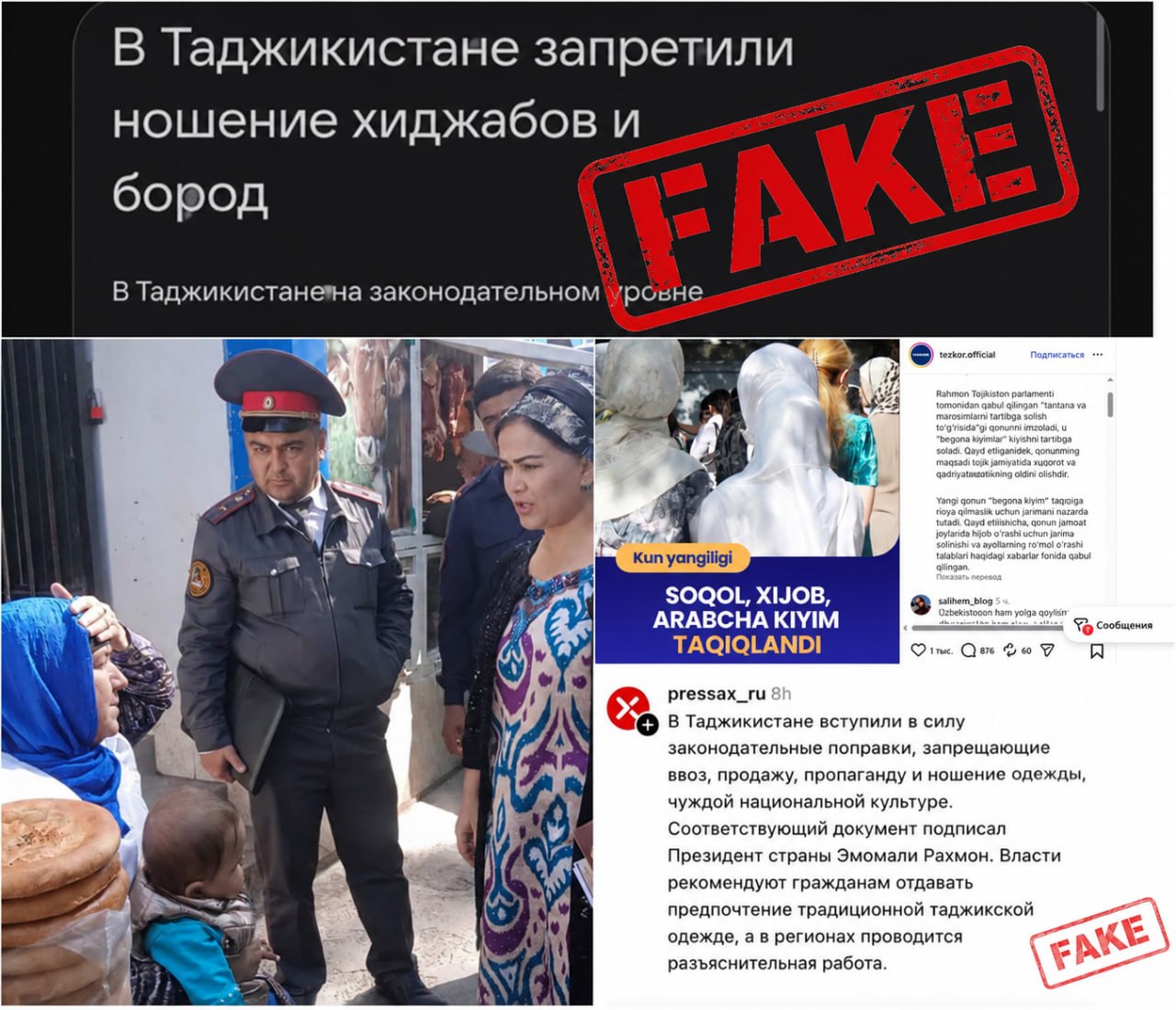
Tajikistan’s Committee on Religion, Regulation of Traditions, Celebrations and Ceremonies has denied reports that the country has adopted a new law banning men from wearing beards and women from wearing hijabs.
In recent days, several media outlets in Central Asia and Russia have published claims that Tajik authorities introduced heavy fines for wearing beards or hijabs. Some reports also alleged that certain citizens were required to send the authorities weekly photographs proving that they had shaved.
The reports prompted widespread discussion and concern on social media. Similar claims circulated online about two years ago.
Some of the latest publications cited Asia-Plus as a source. However, Asia-Plus has not published any recent reports containing such information.
The origin of the latest wave of claims remains unclear. A review of the publications suggests that some foreign media outlets republished older reports under new, sensational headlines.
What does the committee say?
An official source within the Committee on Religion told Asia-Plus that no legislative ban on beards or hijabs had been introduced.
He said the situation regarding freedom of conscience and religion in Tajikistan did not correspond to the picture presented by some foreign media outlets.
“The state of religious rights and freedoms of Tajik citizens is not what certain media outlets and various organizations portray it to be,” the source said.
“The country has established the necessary legislative and other conditions for the exercise of freedom of conscience and religion. Unfortunately, assessments of religious freedom in Tajikistan often do not reflect the actual situation, as they are frequently based on information from unreliable sources.”
Debate over “clothing alien to national culture”
The wearing of beards and religious clothing has been debated in Tajikistan for several years.
In 2024, amendments were introduced to the law “On the Regulation of Traditions, Celebrations and Ceremonies”
Article 18 prohibits the import, sale, promotion and wearing in public places of “clothing alien to national culture.”
However, the law does not clearly define which types of clothing fall into this category. The provision itself also does not specify the amount of any possible fines.
The lack of a precise definition prompted widespread speculation after the amendments were adopted and has once again attracted public attention.
Government officials subsequently offered various interpretations of the provision.
In July 2024, lawmaker Mujibakhon Javhari told Asia-Plus that the term “clothing alien to national culture” applied not only to hijabs and religious veils, but also to long black Arab-style dresses, including abayas, as well as ripped jeans and clothing considered excessively short or revealing.
At the end of July 2024, Tajikistan’s Council of Ulema issued a fatwa stating that traditional Tajik women’s clothing — consisting of a dress, headscarf and trousers — fully complied with Islam and the Hanafi school of jurisprudence.
The Ministry of Culture also said at the time that European-style clothing was “alien to our culture.” It announced plans to prepare a 16-section advisory guide on national clothing for men and women.
The guide was intended to explain which styles of clothing were considered appropriate in different public places.
What is the situation now?
Several years ago, the issue of beards and hijabs triggered heated public debate in Tajikistan.
Videos regularly appeared on social media showing unidentified individuals conducting what they described as “educational outreach” and persuading or pressuring women to remove their headscarves or tie them “in the Tajik style.”
There were also complaints that women wearing religious clothing and men with beards had been denied entry to hospitals and government institutions.
The number of such complaints has declined noticeably in recent years. However, residents still occasionally report isolated incidents, particularly in the regions.