with a thin margin and a controversial legacy
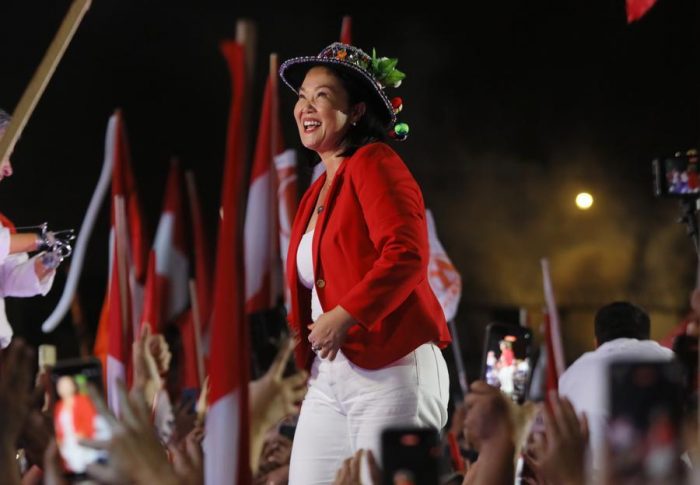
Peru’s new president Keiko Fujimori.
Keiko Fujimori is the first woman elected to Peru’s presidency. What will she do with her father’s controversial legacy to stabilize the country and overcome the risk of greater volatility?
By Alejandro Repenning López (El Mostrador)
HAVANA TIMES – On July 28, twenty-six years after her father, Alberto Fujimori, resigned by fax from Japan, Keiko Fujimori will become the first woman President of Peru. This culmination of her political career comes after four attempts, this time winning by a narrow margin over opponent Roberto Sanchez.
Fujimori will govern a country deeply divided both politically and geographically, where concerns about security of all kinds remain widespread. The new president comes to power promising a “firm hand” approach, similar to the one that characterized her father’s presidency in the fight against the terrorist group Shining Path.
However, the administration of Alberto Fujimori was also marked by serious human rights violations, excessive use of violence, and abuses against Indigenous communities, including mass forced sterilizations and massacres in rural areas. Faced with mounting allegations of corruption and crimes against humanity, he fled to Japan in 2000.
Unable to Distance Herself from Her Father’s Political Legacy
It is precisely Keiko Fujimori’s inability to acknowledge the darker aspects of her father’s legacy, apologize, and seek reconciliation with Peruvian society that continues to fuel Peru’s strong anti-Fujimori movement. Another segment of society, however, voted for Keiko Fujimori out of longing for the firmness and order that were the defining characteristics of Fujimori’s rule.
Her critics see Keiko Fujimori as a symbol of democratic backsliding and fear that her alliance with right-wing governments across Latin America—whose leaders are expected to attend her inauguration—could encourage more repressive policies in government.
Her tendency to use power to impose her will rather than build consensus could become, as it did in her father’s case, an obstacle to governing in a conciliatory manner and avoiding protests and police or military repression. Respect for the separation of powers was clearly not one of Alberto Fujimori’s strengths. During his presidency, he used illegal wiretapping and open corruption – including direct purchase of media outlets and extortion of political opponents – to control judges, autonomous institutions, police, and the military. Peru’s private sector must now assume the challenge of keeping its hands clean and avoiding political collusion that could revive memories of past Fujimori government abuses.
Lacking a Congressional Majority
Keiko’s victorious Fuerza Popular [“Popular Force”] Party is now the largest political force in the Peruvian Congress, with 22 of 60 seats in the Senate, and 41 of the 130 deputy seats. However, they will need to build alliances with other parties to secure legislative majorities. The fact that Popular Force and its allies won the presidency of the new Senate by a single vote illustrates just how narrow those majorities are.
Keiko Fujimori’s past management of a “parliamentary government” made her an effective opposition leader against numerous presidents, both elected and interim. She was active in bringing about an unusually high number of political resignations—not only among elected presidents but also among prime ministers and cabinet ministers—undermining Peru’s governability.
At the regional level, Popular Force failed to get a single governor elected from their ticket, highlighting the party’s limited strength in the outer territories, despite its firm presence in Congress.
Alberto Fujimori
Fujimoro’s legacy today: Will order return?
Politically and ideologically, certain aspects of Keiko Fujimori’s brand closely follow in her father’s footsteps. Her team includes longtime loyalists to her father who now serve as advisers, although their advanced age makes it unlikely they will be named to cabinet positions. Representatives from the business community close to the new president are also expected to play an important role. Fujimori supports a free-market economy, reducing bureaucratic obstacles, and promoting entrepreneurship, with the State assuming a subsidiary role.
Popular Force has proposed intervening in the Judiciary and the Public Prosecutor’s Office, accused those warning of potential state abuses of being accomplices of crime, and suggested withdrawing Peru from the Inter-American Court of Human Rights. These positions reflect trends seen in other right-wing governments across the region, seeking to free themselves from regulations perceived as limiting both national sovereignty and state authority.
In line with its campaign slogan, “Order Returns,” Fujimori’s government program includes theconstruction of four maximum-security mega-prisons, a measure that has become almost standard among governments adopting the so-called “Salvadoran model.” The armed forces, which have historically aligned themselves with the political current founded by Alberto Fujimori, could assume a more central role in addressing internal conflicts, opening the door to excessive use of force and potential human rights violations. It remains to be seen whether Keiko Fujimori, a seasoned politician, can control her temperament and begin her presidency with a degree of moderation, acknowledging both her narrow electoral victory and the strong mobilization of opposition forces.
Incoming Minister of Foreign Affairs, Carlos Espá (left); First Vice President Luis Galarreta (center-left), who will serve as Prime Minister; Peru’s president-elect Keiko Fujimori (center-right); and incoming Minister of Economy and Finance Elmer Cuba posing in Lima on July 27. After his appointment was announced, Galarreta thanked Fujimori for “the trust to lead” the new government’s Cabinet. He added that one of his main missions would be to “confront insecurity,” while also “restoring economic growth through investment and job creation.” Photo: EFE/ Fuerza Popular
The Challenge: Controlling Peru’s Political Volatility
The fact that eight presidents have occupied the Government Palace (Casa de Pizarro), located in Lima’s Plaza Mayor, in just ten years reflects the profound deterioration of Peru’s political and party system.
The problem of party-switching legislators and the weak cohesion of parliamentary blocs clearly reflect the continuing fragility of political stability and adequate conditions for effective governance. This has eroded citizens’ trust in politics and politicians, while also damaging Peru’s international image.
In this context, improving living conditions, especially in marginalized communities, will be a critical challenge for Fujimori’s government. If it fails to address this challenge, Peru could quickly see a return to political adventurism, with presidential removals, and declarations of “presidential vacancy” that add new episodes to the country’s past decade of instability.
Read more news at Havana Times.