- by croatiaweek
- July 28, 2026
-
in
News
(Photo: Pejo Gašparević)
ZAGREB, 28 July (Hina) – Recent archaeological discoveries of a church, cemetery and military complex in Split’s Hrvojeva Street, next to Diocletian’s Palace walls, are important for studying the palace’s transformation into a medieval city and the development of Split’s urban area.
The discovery of an early medieval church near the palace’s southeastern tower is particularly significant, archaeologist Andreja Markovac, who is leading the excavation, told Hina, describing it as a “sensational discovery” because it does not appear on any Venetian maps.
A sealed early medieval tomb was found next to the church, with a late antique sarcophagus fragment used as its cover. The inscription on the fragment mentions “Marcial palatin”, a court official.
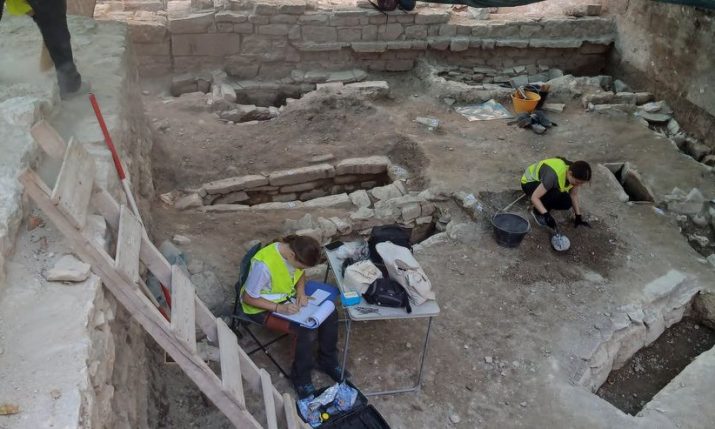
A total of 70 graves have been uncovered at the 800-square-metre site, containing human remains believed to belong to around 90 people. The remains will undergo analysis, while excavations, which have reached a depth of three metres, will continue down to four metres.
Markovac said the cemetery’s location next to Diocletian’s Palace walls was not unusual, as the area was used for burials in antiquity. Cemeteries were located along roads outside cities in Roman times, while in the Middle Ages they were usually situated near churches, with wealthier people buried closer to urban centres in more elaborate tombs.
(Photo: Pejo Gašparević)
Excavations, which began in April, have also uncovered a 17th-century Venetian military complex. The work is scheduled to continue until September, with a possible extension due to the unexpected discoveries.
Markovac said the works, involving around 20 people, would not threaten the stability of Diocletian’s Palace walls, whose foundations lie deeper than the excavation area.
Split City Museum director Vesna Bulić Baketić said the finds were highly valuable for understanding the transformation of Diocletian’s Palace into a medieval city and the continuity of urban development. The material will be conserved, analysed and scientifically evaluated, with selected finds later presented through exhibitions and educational programmes.
(Photo: Pejo Gašparević)
Split Tourist Board director Alijana Vukšić said the discoveries confirmed that Split, a city on UNESCO’s World Heritage List, was still revealing new chapters of its nearly 1,700-year history and would further strengthen its cultural tourism potential.