Your support helps us to tell the story
From reproductive rights to climate change to Big Tech, The Independent is on the ground when the story is developing. Whether it’s investigating the financials of Elon Musk’s pro-Trump PAC or producing our latest documentary, ‘The A Word’, which shines a light on the American women fighting for reproductive rights, we know how important it is to parse out the facts from the messaging.
At such a critical moment in US history, we need reporters on the ground. Your donation allows us to keep sending journalists to speak to both sides of the story.
The Independent is trusted by Americans across the entire political spectrum. And unlike many other quality news outlets, we choose not to lock Americans out of our reporting and analysis with paywalls. We believe quality journalism should be available to everyone, paid for by those who can afford it.
Your support makes all the difference.Read more
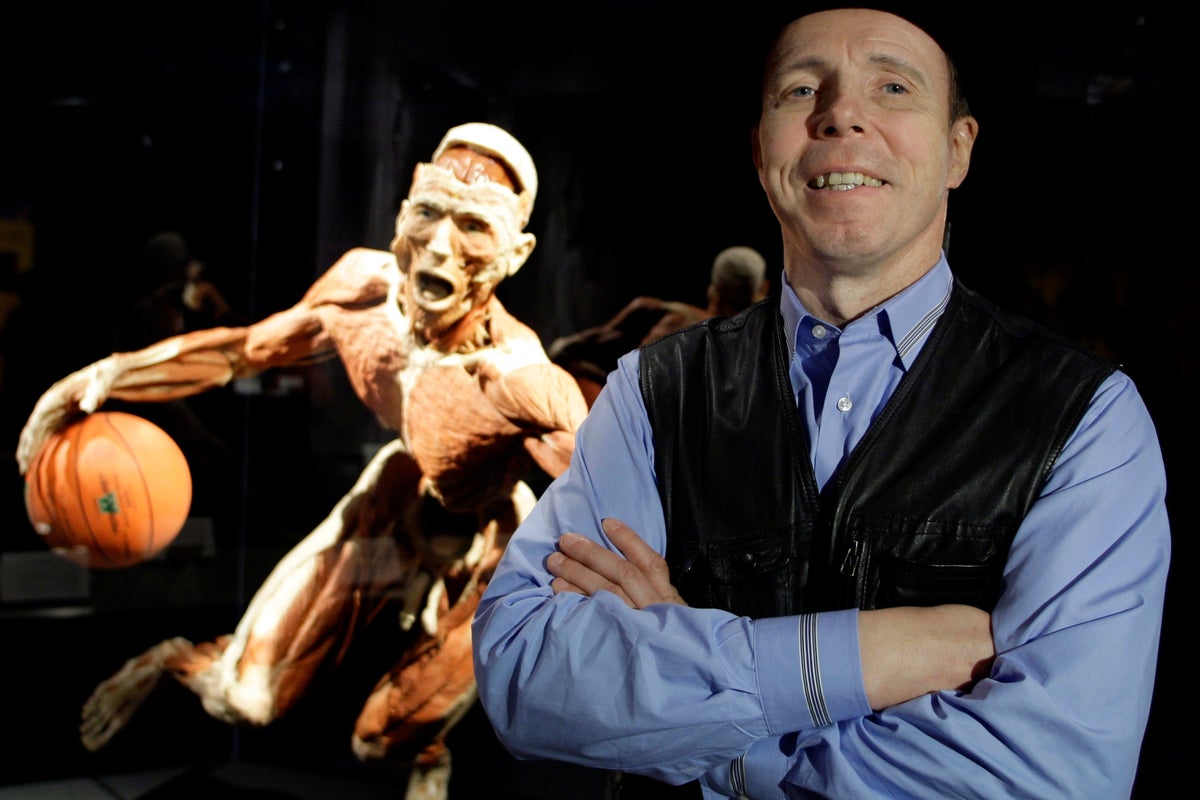
Gunther von Hagens, the German anatomist who generated both fascination and revulsion around the globe with his “Body Worlds” exhibits of preserved human corpses, has died. He was 81.
Von Hagens’ family and the Institute for Plastination, which he founded, said he died on Friday. A statement they issued on Monday gave no further details. Von Hagens had announced in 2010 that he was living with Parkinson’s disease.
Von Hagens trod a fine line between science, entertainment and commerce with his touring exhibits, as well as headline-grabbing actions such as a public autopsy.
At the heart of von Hagens’ work was the so-called plastination process — replacing body fluids with liquid plastic that then hardens. That technique, which he started developing in the 1970s, prevented decay, left tissues intact and allowed him to display preserved corpses and their inner organs.
The resulting exhibition, “Body Worlds,” first went on show in Japan in 1995.
Two years later, the collection of partly skinless corpses went on display in von Hagens’ homeland, overcoming an attempt by local church leaders to block its opening on the grounds that it was disrespectful. Von Hagens said he was helping viewers understand how their bodies work.
The anatomist “is forced in his daily work to reject the taboos and convictions that people have about death and the dead,” von Hagens said of his work.
“I touch here a taboo, which is our body, and nothing is so near as our body is to us,” he said.
The shows used the corpses of people who agreed to donate their bodies for plastination. Critics argued that von Hagens bordered on sensationalism with his works, which included a corpse riding a plastinated horse, and a pregnant woman with an eight-month-old fetus inside.
Von Hagens “plays with the corpses like a child plays with dolls,” the Rev. Ernst Pulsfort, spiritual rector of Berlin’s Catholic Academy, said when the show first opened in the German capital in 2001. He argued that it catered to a “public lust for sensation.”
During a “Body Worlds” show in London in 2002, the anatomist — wearing, as ever, his trademark black fedora — conducted Britain’s first public autopsy in 170 years before a sellout crowd of hundreds, defying government warnings that it might be illegal.
Von Hagens declared it a “huge success.” The British Medical Association’s head of ethics, Dr. Michael Wilkes, said it was “degrading and disrespectful.”
The “Body Worlds” exhibits were shown in several American cities after making their U.S. debut in Los Angeles in 2004.
Von Hagens’ “Plastinarium,” where bodies are prepared, opened in the eastern German town of Guben in 2006.
The anatomist was born Gunther Liebchen on Jan. 10, 1945, in what is now western Poland.
He went to medical school in Jena in East Germany, but increasingly questioned the communist system and made a failed attempt to flee to the West. He was detained before West Germany bought his freedom in 1970, a regular practice at the time.
He continued his medical studies at the University of Luebeck and, in the 1970s, began working at Heidelberg University’s pathology and anatomy institute. He married a former classmate, Cornelia von Hagens, and took her surname.
His second wife, Angelina Whalley, heads his Heidelberg-based Institute for Plastination and curates his exhibitions, and he had three children from his first marriage.
Monday’s statement said it was von Hagens’ wish that his body be made available for plastination and “his family will respect and carry out this wish.”