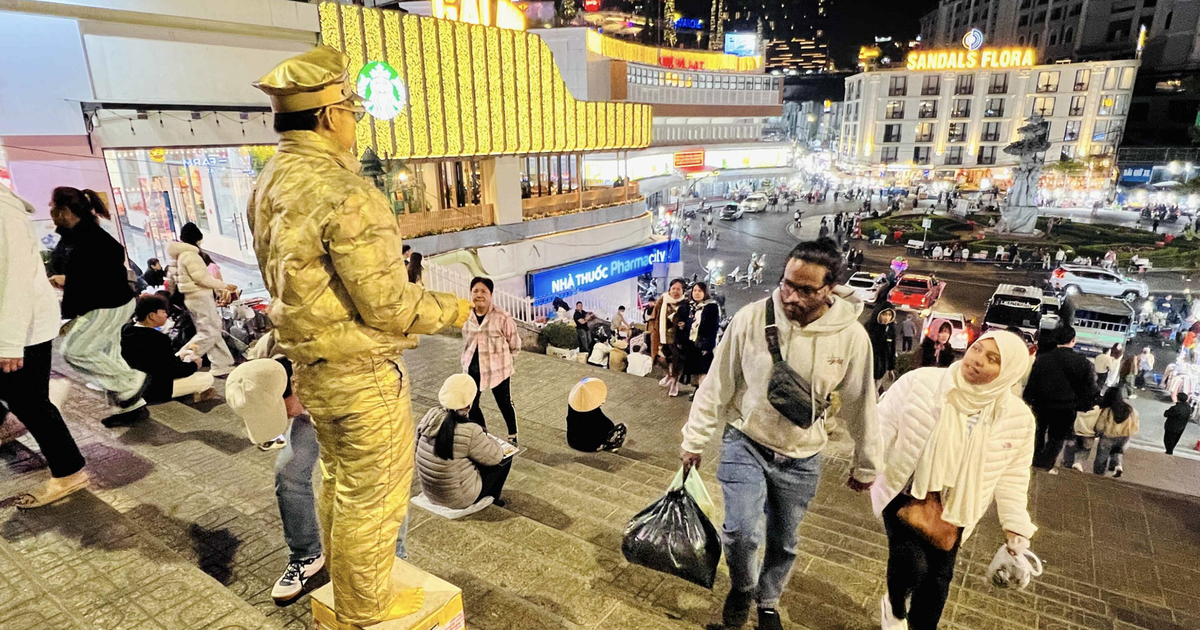
Some students in Da Lat, Lam Dong Province, located in Vietnam’s Central Highlands region, work as living statues to help cover their living expenses. Photo: Yen Trinh / Tuoi Tre
In the evenings, when temperatures hover around 19 degrees Celsius, several living statues can be found lining the stairways leading into Da Lat Night Market and the nearby roundabout.
Many visitors wave or call out ‘Hello.’
Families and couples often pause to take pictures, prompting the performers to respond with a subtle smile or carefully timed gesture before returning to complete stillness.
Among them is 18-year-old Doan Trung Kien, a second-year student at Da Lat University.
From his hat and uniform to his skin and hair, Kien is covered in shimmering silver paint as he portrays a Western-style police officer.
The contrast between the lively atmosphere of the market and the statues’ silence is striking.
Kien has worked as a living statue for more than a year.
Every afternoon, he arrives around 5:00 pm, having already eaten, hydrated and prepared himself for six hours of performance.
University student Doan Trung Kien has worked as a living statue at Da Lat Night Market in Lam Dong Province for more than a year. Photo: Yen Trinh / Tuoi Tre
“After putting on the thick costume and making sure every part of me is covered in metallic paint, I step onto a small box,” Kien said.
“The box also serves as a place for visitors to leave tips if they wish.
“I stay there until around 11:00 pm.”
The work was physically demanding at first.
Standing completely still for hours left his arms and legs numb, while Da Lat’s cold winds stung his eyes.
He also had to overcome the discomfort of being watched constantly.
Most visitors interact respectfully although some occasionally behave insensitively, he said.
The rewarding moments come when friendly tourists stop to chat or leave generous tips.
Standing outdoors for hours, living statue performers sometimes have their hands numb from the cold. Photo: Yen Trinh / Tuoi Tre
Flexible job for students
Living statue performances have become increasingly common in Vietnam over the past decade.
Performers frequently appear at promotional events, commercial exhibitions, and public spaces such as Nguyen Hue Pedestrian Street in Ho Chi Minh City.
The profession typically attracts young people with strong physical endurance and considerable patience.
With their entire bodies covered in paint, the living statue performers have to wash thoroughly after each night’s performance. Photo: Yen Trinh / Tuoi Tre
Dieu Kha, a law student living in Lam Dong Province, began working as a living statue in August 2024 after noticing performers while visiting the night market.
“The first few nights were freezing, but now I’ve gotten used to it,” he said.
Like Kien, Kha dresses as a police officer, although he uses gold-colored body paint instead of silver.
A thick winter jacket helps him withstand the cold, though his hands and bare feet still suffer from the low temperatures.
When fatigue sets in, he subtly shifts his posture.
Unlike many part-time jobs that pay monthly, Kha values receiving his earnings every week, which helps him manage the cost of student life.
He earns a fixed wage of around VND250,000 (US$9.5) per night.
The elaborate make-up requires extensive a clean-up at the end of each shift.
Thick cosmetic paint mixed with glitter must be carefully removed before he showers to wash away the remaining metallic coating.
“I felt embarrassed at first, but eventually it became normal,” Kha said.
“This is a form of art.”
A living statue chats with a tourist. Photo: Yen Trinh / Tuoi Tre
Sharing a rented room with a friend at a monthly cost of VND1.5 million ($57) each, Kha relies heavily on his evening performances to cover his living expenses.
He has even introduced another friend to the profession, turning it into a shared chapter of their university years.
Only heavy rain forces them to take a night off.
When major events are held at Lam Vien Square, Kha performs there because the pay is better.
Still, the night market remains his favorite venue.
“The tourists are friendly. We feel appreciated,” he said with a smile.
Living statue performances have become a regular feature of Da Lat Night Market over the past three years, according to both Kien and Kha.
The companies that hire them generally allow performers to manage their own schedules, choose poses, and decide when to shift positions.
Tran Ngoc Phat, a student at Yersin University, has also been working as a living statue for nearly a year.
“Kha introduced me to the job and picks me up every afternoon,” Phat said.
“It took me about two weeks to learn how to pose and express emotions. Sometimes the temperature drops to just a few degrees Celsius, but we still perform.”
After each shift, Phat returns to his boarding house to study, hoping to continue balancing the job with his university education.
Some living statue performers at Da Lat Night Market choose to cover themselves in silver paint rather than gold. Photo: Yen Trinh / Tuoi Tre
A tourist leaves tips for a living statue performer at Da Lat Night Market in Lam Dong Province. Photo: Yen Trinh / Tuoi Tre