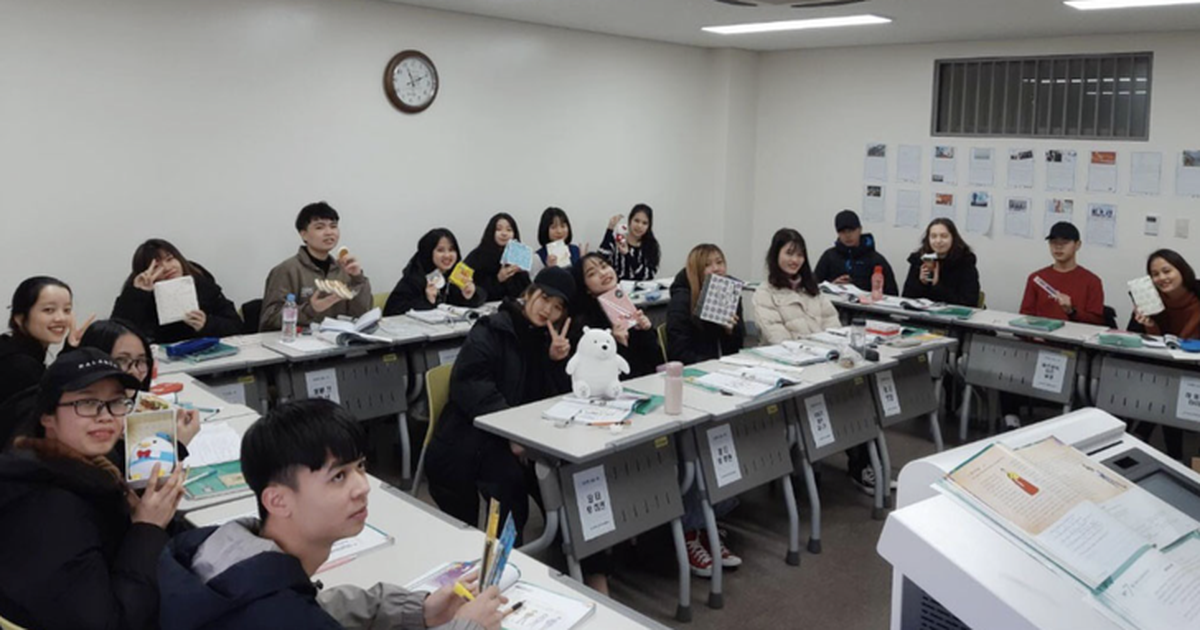
Vietnamese students studying in Daegu, South Korea. Photo: Duy Trinh
This shift marks a fundamental change in how families in Vietnam evaluate international education, moving away from traditional prestige toward a balance of practical career prospects and financial viability.
Winds of change
For decades, the United States, the United Kingdom, Australia, and Canada dominated the global education market. But their grip is loosening.
According to Universities UK International (2026), the ‘Big Four’ hosted nearly 40 percent of the world’s internationally mobile students in 2013, but by 2022 their share had fallen to around one-third.
As visa policies tighten, costs rise, and geopolitical tensions intensify, students are looking beyond prestige.
Qian Yaru, a Chinese graduate with a master’s from The London School of Economics and Political Science (LSE), chose Singapore Management University over staying in the UK or pursuing a PhD in the U.S..
She told the CNA newswire the decision reflected not just academics, but also life quality and stability. For many students, where they live now matters as much as where they study.
This shift is creating new winners. Asia is emerging as a new center of global education. The region now hosts more QS-ranked universities than Europe or the Americas, while remaining affordable and accessible.
According to IDP Education’s Emerging Futures surveys, students are placing greater emphasis on the return on investment of an overseas degree, weighing tuition fees, living expenses, and employment outcomes.
Meanwhile, another force reshaping the landscape is the rapid expansion of Transnational Education (TNE). Through branch campuses and joint degrees, students can now earn international qualifications without relocating, making global education more accessible than ever to students who may not be able to leave home for several years.
Where Vietnamese students are heading
According to the Vietnamese Study Abroad Market report, released in March, Vietnam remains one of Asia’s strongest student-sending countries. More than 137,000 Vietnamese students are studying overseas.
While the U.S., Australia, and Canada remain popular, attention is gradually shifting closer to home. Japan and South Korea have become leading destinations for Vietnamese students, thanks to lower costs, geographical proximity, and favorable post-study employment opportunities.
Students are pictured during an event at the University of Nottingham Malaysia Campus. Photo: Mohd Rasfan/AFP
However, international education no longer necessarily means leaving Vietnam. The growth of transnational education has enabled students to pursue international degrees through universities operating within the country, allowing families to balance educational quality, affordability, and peace of mind.
That balance was a decisive factor for Thu Ngoc, a 22-year-old recent graduate of RMIT Vietnam. Her family had originally planned for her to study in Australia, following her older brother’s path. But concerns about living alone overseas led them to consider an alternative closer to home.
“Because I’m a daughter, my parents were understandably more concerned about me living abroad on my own,” she told Tuoi Tre News. “RMIT Vietnam gave us confidence because the curriculum, teaching standards and degree are aligned with RMIT Australia.”
For Ngoc, studying in Vietnam did not mean compromising on international exposure. She said the Australian qualification, English-speaking environment, and exchange programs provided many benefits of studying abroad while allowing her to remain close to her family. “It also gives me a strong foundation if I decide to apply for a master’s degree overseas in the future,” she added.
A recent study, published in the British Educational Research Journal in November 2025, investigates the multifaceted factors influencing Vietnamese high school students’ intentions to pursue higher education abroad.
With survey data from 3,584 students across 12 high schools in Hanoi, the study found that parents play a central role in shaping study-abroad decisions through financial support, safety concerns, and long-term expectations.
Schools and peer networks also help students navigate an increasingly complex landscape by providing information and guidance on overseas opportunities, while teachers generally have a less direct influence.
The global map of higher education is no longer defined by a handful of English-speaking destinations. As new education hubs, transnational programs and more diverse study pathways emerge, students have greater flexibility than ever before.
For Vietnamese students, this means success is no longer about traveling the farthest; it is about finding the path that leads furthest.
Why Europe is also gaining traction
According to INEC (2026), some European countries like Italy combine internationally recognized universities with relatively affordable tuition, English-taught programs, scholarship opportunities, and a one-year post-study work permit.
For Vietnamese students, Europe is also becoming a more compelling alternative destination thanks to multilateral educational ties.
Just this week, during a visit to the University of Naples ‘L’Orientale’ on July 21, the Vietnamese Embassy in Italy discussed expanding academic exchanges and university partnerships, signalling broader opportunities for Vietnamese students, Nhan Dan (People) newspaper reported.