Half of the state-owned villas leased 11 years ago by Dipos – the company for renting state property – are now owned by a new business elite that emerged during the rule of the Serbian Progressive Party (SNS), consisting of well-known and controversial businessmen, private individuals, and their companies, an investigation by Radar reveals.
On the other hand, information regarding the new tenants of the remaining properties still owned by the state (and thus by the citizens of Serbia), as well as their rental prices, has been classified as a state secret.
One of the largest arms dealers in the region and an SNS donor, Slobodan Tešić, first extended his lease with Dipos for a villa in Dedinje until 2043, and then bought it as the sole bidder, encumbered by his own sub-lease. Nikola Petrović, the best man (kum) of Serbian President Aleksandar Vučić, also acquired a luxury property in Košutnjak, which he had previously rented from the state. Between 2012 and 2016, he served as the Director-General of the state enterprise Elektromreža Srbije, and is now the owner or co-owner of the EL&MI Group and a whole network of affiliated companies.
Unofficially, it is rumoured that the famous, recently renovated Parliamentary Club in Tolstojeva Street is now leased by Aleksandar Kajmaković, a controversial businessman arrested over ties to Veljko Belivuk’s clan, and speculation is rife that he will buy it out.
It is unlikely that 2015 will be repeated anytime soon-the year the Anti-Corruption Council published a report revealing that Dipos was leasing and selling luxury properties for a song to privileged individuals without public tenders, via direct negotiations. It was revealed then that the tenants in state properties included high-ranking officials, directors of public enterprises, individuals from criminal backgrounds, and celebrities. Moreover, Dipos had valued a villa in an elite part of Belgrade at €15,000, and two flats in the broader city centre at less than €2,500.
Dipos claims clients could sue if names are revealed
Discoveries like these are unlikely to be seen again, at least under the current administration, as the Government of Serbia has decided to label the list of tenants, rental prices, and contracts as “confidential”. This emerges from Dipos’s response to Radar. As stated, the confidentiality label was lifted solely for the purpose of conducting proceedings before state authorities, which were initiated precisely to collect unpaid bills (for rent and ancillary costs).
“The Company (Dipos) could not conduct proceedings or collect debts from negligent tenants in any other way than by submitting lease agreements to the presiding courts in legal proceedings, or to other state bodies… We emphasize that, in order to protect data (which were protected before the ‘confidential’ label was removed), the Company inserted a confidentiality clause into the lease agreements, regulating rights and obligations regarding personal data protection and the confidentiality of information exchanged as a result of business activities under the agreement,” reads Dipos’s response to the request submitted by Radar under the Law on Free Access to Information of Public Importance.
Dipos’s response also states that all tenants were informed of the confidentiality clause upon signing and agreed to it, meaning that “if the Company were to make public the data agreed as confidential, it would breach a contractual obligation it set itself.”
“Furthermore, if the Company were to make the requested data public, the other contracting party could initiate legal proceedings against the Company for breach of contract terms. We particularly emphasize that in the event of non-compliance with contractual obligations by the Company, there would be a high risk to future business cooperation with potential clients, thereby risking the Company’s business operations and expected profits,” Dipos stated.
The state-owned company completely ignores the fact that it leases properties owned by the citizens of Serbia and that it is entirely illogical to hide who lives in these properties and how much rent they pay. Perhaps this is precisely because there is something to hide, especially given the route through which Dipos’s-and effectively our-properties acquire new owners, starting via leases.
How a villa renting to Nikola Petrović was bought by his wife
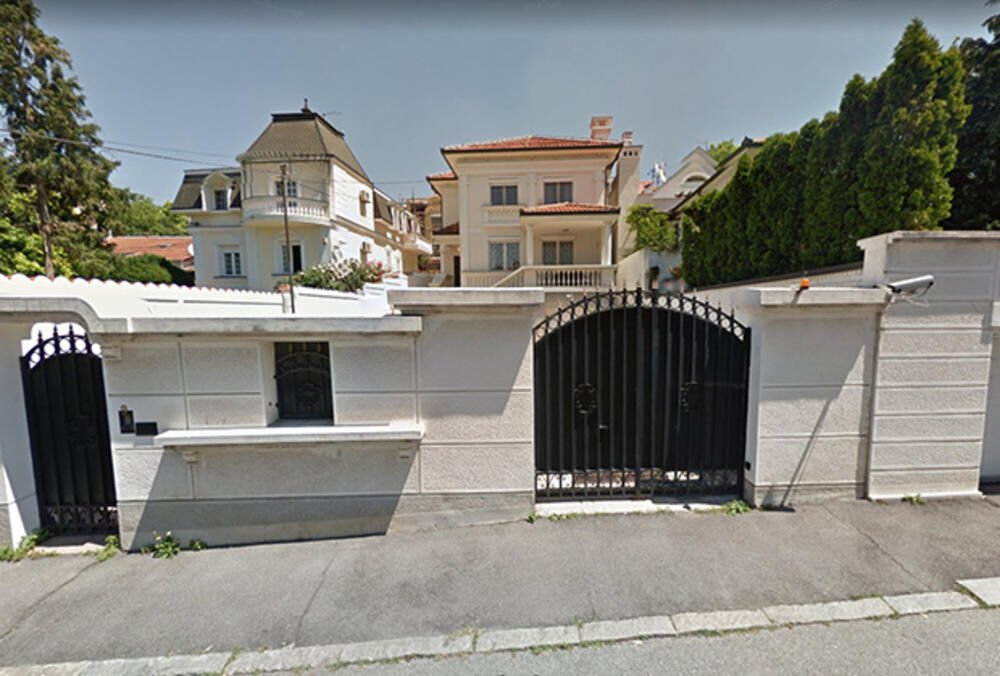
Villas in Dedinje were generally the most valuable assets in Dipos’s portfolio. There were about 40 on the list, and Radar’s investigation shows that half are now in private hands. Almost all those located in Beogradskog Bataljona Street were sold, mostly bought by private companies and individuals.
Among the buyers is Goran Đoković, uncle of the famous tennis player Novak Đoković, as well as Maja Petrović, wife of Nikola Petrović, the controversial businessman and Aleksandar Vučić’s kum. While serving as director of the state company Elektromreža Srbije, he rented the villa in Beogradskog Bataljona; when Dipos announced its sale, Petrović denied he would be the buyer.
Nikola Petrović and Aleksandar Vučić (Photo: RAS/Vesna Lalić)
Indeed, Nikola Petrović did not submit a bid for the villa, which was eventually sold to Mladen Vuković, owner of a marketing agency. Just a month later, however, came a twist: that was all the time needed for Petrović’s wife to buy the villa from Vuković. According to KRIK, Dipos offered the 182-square-metre villa in an elite part of Košutnjak for sale at a starting price of around €312,000.
Slobodan Tešić, the arms dealer sanctioned by the US Department of the Treasury, also bought a villa in Maglajska Street from the state, which he had previously leased. Just before the sale was advertised, Tešić extended his lease agreement until 2043, giving him an immediate advantage. Had anyone else bought the villa, they would have had Tešić as a tenant until 2043. It is unknown how much he paid for the property, but the advertisement published by Dipos stated a starting price of €4.47 million.
Tešić also purchased a state villa in Mihaila Mike Jankovića Street. That property was also encumbered by a lease until the end of 2033, though reportedly not held by Tešić. According to the 2015 Anti-Corruption Council report, that villa was leased by lawyer Zdenko Tomanović, who incidentally acted as Tešić’s lawyer in 2019, as reported by the Nova portal. The Republic Property Directorate stated that Tešić paid €2,510,000 for the property.
Majority owner of Belgrade Waterfront also bought villa from state
Among the buyers of state villas is ANH Holding Limited, owned, according to media reports, by Mohamed Alabbar, whose Eagle Hills is the majority owner of Belgrade Waterfront. The Arab billionaire also bought a luxury property at 38 Užička Street, in the elite district of Dedinje.
Alabbar is known to the Serbian public not only as an investor in Belgrade Waterfront, but also as a man President Aleksandar Vučić has repeatedly called his “friend” in public addresses. It is evident from Cadastre records that the Užička Street villa changed hands, but it remains unknown at what price and under what conditions Alabbar acquired the property.
Particularly unusual is the case of a flat in Braće Grim Street, in Belgrade’s Profesorska Kolonija neighbourhood, where the Dipos tenant was a certain Željko Šašić. Eight years older, but far less famous than his namesake, the local folk singer, he and his wife have since become the owners of the property. The couple bought the Belgrade flat from Dipos via the Commissariat for Refugees for just €32,600, payable in instalments.
That Šašić had rented a state flat was revealed by the Anti-Corruption Council when it published the list of Dipos tenants. That report listed neither the price nor the area of the flat, but his name appeared alongside the list of rented properties. According to Real Estate Cadastre data, a mortgage was registered on the Šašićs’ property in February 2024, listing the Commissariat for Refugees as the mortgagee and Željko Šašić as the mortgagor. They were also listed as the contracting parties.
The document further states that the mortgage was registered based on a property purchase agreement, with both parties agreeing the purchase price to be 3,814,983 dinars (around €32,600). The buyer is required to pay the purchase price over 25 years in 300 monthly instalments of 12,716 dinars (around €109).
The buyer must transfer the money to the seller by the 15th of each month for the preceding month. Should they fail to pay for three consecutive months, or four instalments within a year, the Commissariat reserves the right to terminate the contract. Additionally, the new owner committed to living in the property with their household members and not selling it for at least five years from the date of acquiring ownership rights. It remains unknown on what grounds the Commissariat acquired Dipos’s property and why it was sold at such a low price. Questions were emailed to the institution, but no response was received prior to publication.
State renovated Parliamentary Club for €6 million, then leased it out
It remains to be seen what plans the state has for the Parliamentary Club in Tolstojeva Street, Dedinje. After investing around €6 million in its renovation, the state handed it over to a private individual who opened the exclusive Tolstoj club there. Officially, the tenant’s identity is classified, but rumours suggest it is Aleksandar Kajmaković-better known by his nickname Aca Bosanac – who was arrested for links to Veljko Belivuk’s clan. He owns a range of well-known Belgrade taverns (kafanas), clubs, and restaurants.
Parliamentary Club in Tolstoy Street in Belgrade
The Tolstoj club is no longer accessible to the general public; its website states that access is strictly reserved for members. Media reports indicate that entering the luxury venue requires a membership fee far out of reach for average citizens, ranging from €1,200 to as much as €10,000.
Leasing out the Parliamentary Club could be the first step towards its privatisation and state divestment, judging by past practice. And it is not as though many state-owned villas remain in Dedinje.
Some are not leased at all, as they are occupied or used by top state officials such as Ana Brnabić, Tomislav Nikolić, or Aleksandar Vučić. It will be a stroke of luck if these luxury properties remain in state ownership. After all, much has changed over the years, but they have never agreed to move out of Dedinje.
(Radar, 24.07.2026)
https://radar.nova.rs/ekonomija/drzavne-vile-sns-komesarijat/