Indrek Laul, the concert pianist and entrepreneur who revived Estonia’s national piano maker and turned it into an international export brand, has entered the contest to become the country’s next president.
The Juilliard-trained pianist and entrepreneur, backed by 30 prominent Estonians, says he wants to become a consensus candidate capable of uniting political parties, communities and worldviews.
Laul, 58, accepted the nomination after 30 prominent Estonians – drawn from business, academia and the arts – published a letter urging parliament to consider him for the presidency.
The signatories include the conductors Paavo and Kristjan Järvi, the poet Doris Kareva, the composer Erkki-Sven Tüür, the film director Tiina Lokk and several leading figures from Estonian business and technology.
Their intervention adds a distinctly different candidate to a field that has so far featured Ülle Madise, the chancellor of justice, and Riho Ühtegi, a retired major general and former commander of the Estonian Defence League.
Laul confirmed in an interview with the Estonian public broadcaster, ERR, that he had agreed to stand. He said his experience in international business, culture, education and philanthropy had persuaded him that “the time has come to give something back”.
He has begun meeting politicians but has declined to identify those with whom he has held private discussions. His first formal meeting with a parliamentary party was with Isamaa, the conservative opposition party, on Thursday.
Laul insisted that he was not seeking to represent Isamaa, or any other single political force.
“I will seek to be that consensus candidate, uniting different parties and different worldviews,” he said.
A candidate from outside the state
Laul’s candidacy rests on a résumé unlike those of most recent Estonian presidential contenders. He has never been a minister, diplomat, senior civil servant or member of parliament. Instead, his career has moved between music, manufacturing and international business.
Born in Tallinn in 1968, he studied at the Tallinn Conservatoire and the University of Arts in Belgrade before moving to New York. He completed a master’s degree at the Juilliard School in 1993 and a doctor of musical arts degree there in 1999, studying under the American pianist Peter Serkin and receiving the Vladimir Horowitz scholarship.
While living in New York, Laul learnt that the Estonia Piano Factory – whose instruments he had played as a child – was struggling after the collapse of the Soviet market. In 1994, annual production had fallen to about 50 pianos, compared with a Soviet-era peak of almost 500.
Laul began marketing the instruments in the United States, then invested in the factory and gradually became its owner. Working with international specialists and Estonian researchers, the company redesigned its instruments, upgraded their components and established a network of dealers in North America.
The turnaround made the Estonia piano one of the country’s more recognisable high-value exports and gave Laul an unusual form of international experience: part businessman, part cultural envoy.
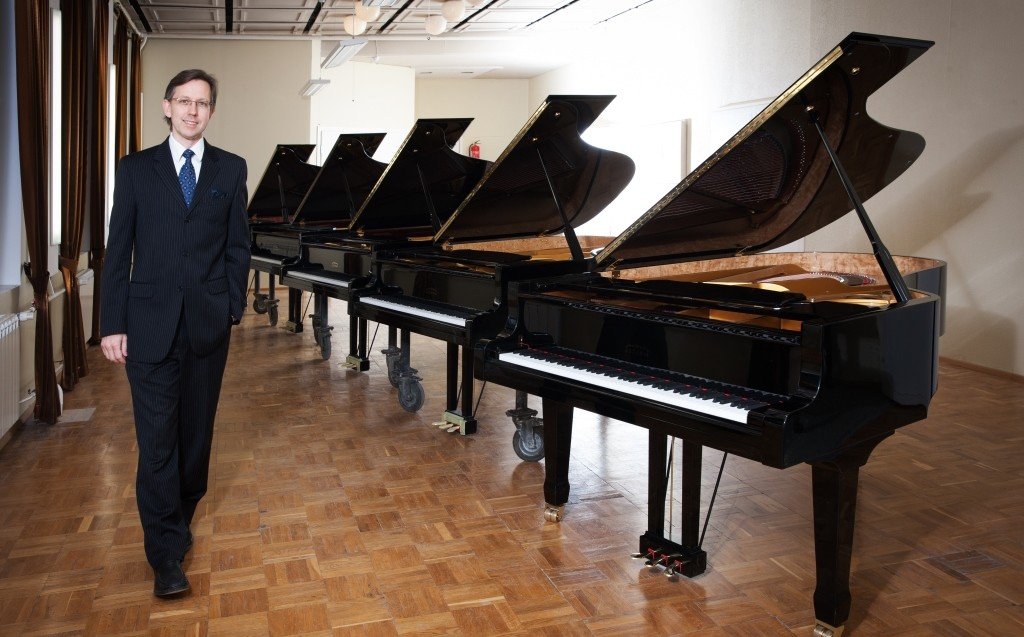
Indrek Laul plays a grand piano at the Estonia Piano Factory in Tallinn. Photo by Meeli Küttim.
He lived outside Estonia for 24 years before returning with his family. He has continued to divide his time between Estonia and the United States and is serving his ninth year as president of the American Chamber of Commerce in Estonia.
Laul has also held positions at the Estonian Academy of Music and Theatre and the Arvo Pärt Centre. He is Bulgaria’s honorary consul in Estonia and received the Order of the White Star, fourth class, in 2015.
His supporters argue that this combination of culture, enterprise and international experience would allow him to represent Estonia persuasively abroad while remaining independent of party politics.
In their letter, they described Laul as a figure capable of defending Estonia’s security, strengthening social cohesion and rebuilding trust in democratic institutions. They said his candidacy deserved “a substantive, dignified and open-minded discussion” in public and in parliament.
Prosperity, security and national continuity
Laul has organised his political message around the Latin expression salus populi – the welfare of the people – which he divides into three themes: prosperity, security and the nation’s long-term continuity.
On the economy, he argues that Estonia must remain outward-looking and produce more high-value goods and services. He sees a role for the president in opening doors abroad for Estonian exporters, scientists, cultural institutions and technology companies.
“Exports are what make nations wealthier,” he told ERR, pointing to his experience of taking Estonia pianos into the upper reaches of the international market.
On security, Laul said Estonia must continue strengthening its defence capabilities, maintaining close relations with NATO allies – particularly the United States – and supporting Ukraine.
The Estonian parliament convening to elect a new president in 2021. Under Estonia’s indirect electoral system, a candidate needs the support of two-thirds of MPs to be elected in parliament. Photo by Silver Tambur.
His third theme is demographic and cultural continuity. He said Estonia should be a country in which young people want to remain, raise families and fulfil their ambitions. The president’s task, he argued, was to find common aims rather than deepen the divisions between political, linguistic and social groups.
Laul said the president must also uphold the constitution and defend the values contained in its preamble, including liberty, justice, peace and the preservation of the Estonian nation, language and culture.
His critics are likely to ask whether experience in commerce and cultural diplomacy can substitute for direct knowledge of the state.
Raimond Kaljulaid, a Social Democratic MP, said Laul’s record in international business was a strength but that his lack of experience within public institutions could prove a weakness.
A president unfamiliar with the machinery of the state might remain distant from its other institutions, Kaljulaid argued. Yet he did not dismiss Laul’s prospects, noting that Estonia’s fragmented political landscape and secret presidential ballots could make the result unusually difficult to predict.
“Whoever starts campaigning first and does it best may ultimately emerge as the winner,” Kaljulaid said.
Isamaa keeps its options open
Urmas Reinsalu, the leader of Isamaa, said his party was open to Laul’s candidacy but would meet other prospective candidates before deciding whom to support.
Reinsalu welcomed the fact that citizens were putting names before parliament rather than waiting for political parties to produce a candidate through closed negotiations.
He rejected the suggestion that Laul was merely Isamaa’s second choice after President Alar Karis declined to seek another term. Estonia’s “Plan A”, he said, should be the strongest candidate among those willing to accept the office.
Then foreign minister Urmas Reinsalu (left) presents Indrek Laul (right) with the Estonian foreign ministry’s Cross of Merit in 2020. Photo by Marko Mumm.
Isamaa has also met Ühtegi, whose military background and conservative views have made him an obvious candidate for parties on the right. The Conservative People’s Party of Estonia, EKRE, is continuing to support its former leader, Mart Helme.
Madise, meanwhile, remains the candidate thought most likely to attract support across the centre of parliament. The Social Democrats have promoted her as a constitutional authority and potential consensus figure, although she has not given her formal consent to stand.
Ülle Madise, Estonia’s chancellor of justice, has emerged as a leading potential consensus candidate in the country’s 2026 presidential election.
Other names raised in public include Jonatan Vseviov, the secretary general of the foreign ministry; Hannes Hanso, Estonia’s recently appointed ambassador to the United States; and Maive Rute, a senior European Commission official.
The search for 68 votes
Estonia’s president is chosen indirectly. A candidate must first secure the backing of at least 21 members of the 101-seat parliament to be formally nominated.
To be elected in parliament, however, a candidate needs a two-thirds majority – 68 votes. That threshold means no party can elect a president alone and makes some degree of cross-party agreement unavoidable.
Retired major general Riho Ühtegi, a former commander of the Estonian Defence League, is another prospective candidate in Estonia’s 2026 presidential election. Photo by the Estonian Defence Forces.
Formal nominations will take place from 21 to 24 August. The first parliamentary ballot is scheduled for 2 September, with a second and, if necessary, third round expected the following day.
If parliament fails to elect a president, the contest passes to an Electoral College comprising MPs and representatives of Estonia’s local councils.
Laul’s name has surfaced in presidential discussions before, in both 2016 and 2021, but he was never formally nominated. This time, he says, the effort is more deliberate and his acceptance unequivocal.
Whether his life outside the political establishment proves an asset or a liability will depend on the same quality he says he wishes to bring to the presidency: an ability to persuade very different groups to listen to one another.