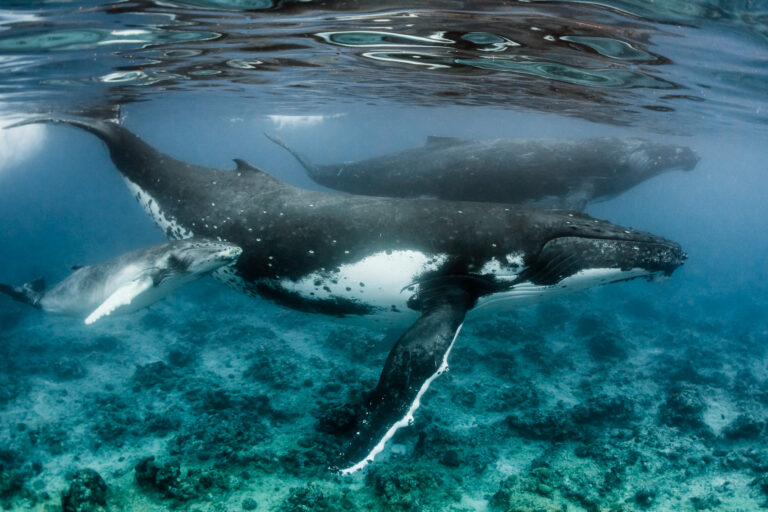
It was spring, 20 years ago now, but he remembers it clearly. On the deck of the Geco Resolution, wind tearing spray from the waves, Robert McCauley stood gazing out onto an ocean blackened by night. The ship had been firing seismic airguns all day, thunderous blasts punching through the water and into the seabed. Over time, the rhythmic boom reverberating through the hull had almost faded into the background. But then night fell, and the sound revealed itself. “Every time the airgun went off, the sea would light up,” McCauley told Mongabay. Each blast was triggering a burst of bioluminescence — dinoflagellates and other microscopic life igniting in unison. “A sheet of light would shoot out, like a wave traveling at the speed of sound. It went out for about a kilometer at least,” he said. As Australia’s leading expert in marine bioacoustics, McCauley, a research scientist at the Centre for Marine Science and Technology at Curtin University, was there to study how whales responded to the noise. But watching the bioluminescent glow pulse outward and fade, then pulse again, he found himself wondering less about whales and more about the tiny organisms that sustain them. “It made me think, what’s happening to all those little animals? How are they being stimulated? And what happens if they’re being stimulated every five or 10 seconds, repeatedly?” McCauley wondered. For decades, marine seismic surveys have echoed through the world’s oceans, largely in search of oil and gas. Research has shown the…This article was originally published on Mongabay