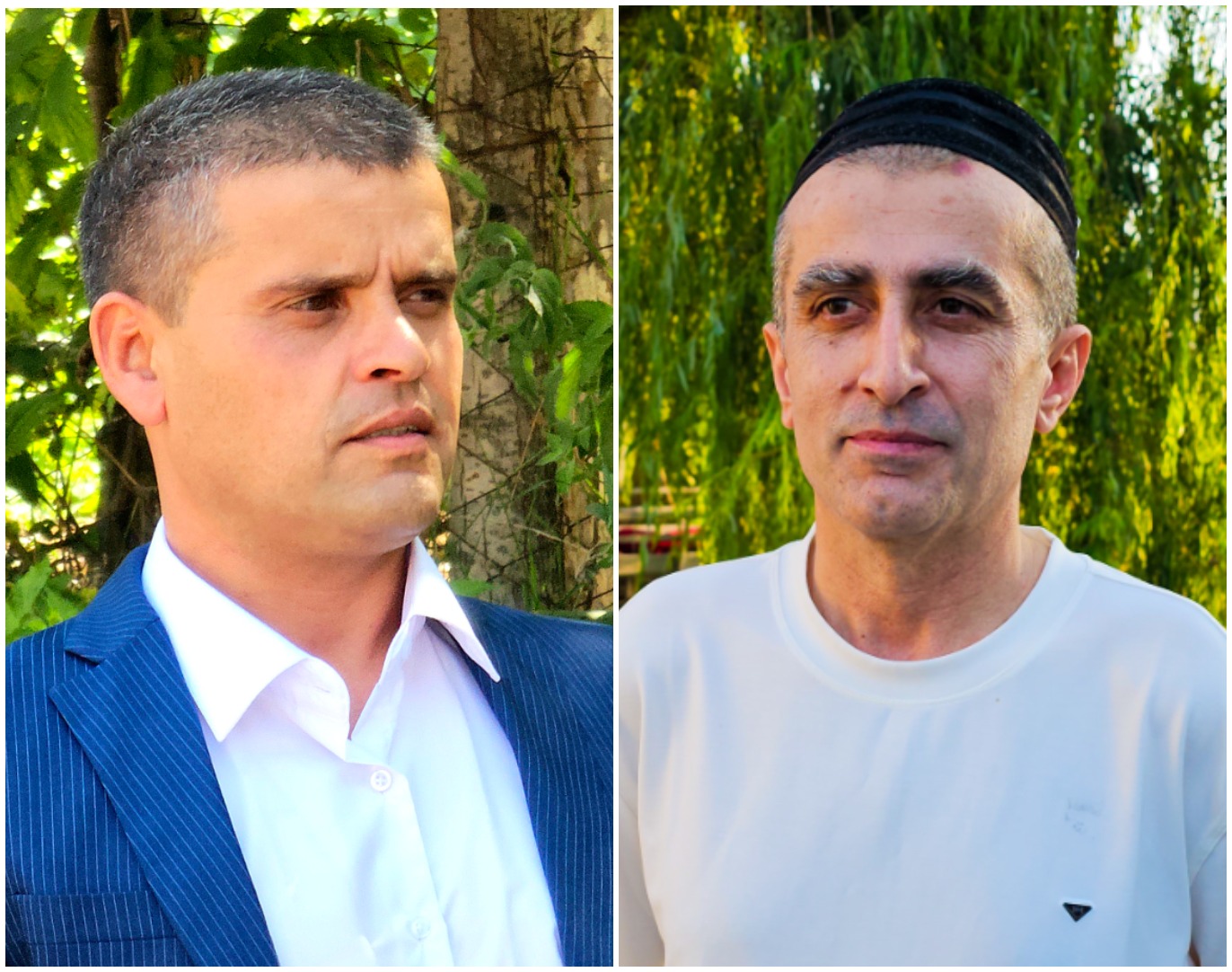
Tajik journalists Abdusattor Pirmuhammadzoda and Zavqibek Saidamini, who spent more than four years in custody, were released from prison on the morning of July 18 under an amnesty law.
In brief interviews with Asia-Plus, they spoke about their first days of freedom, life behind bars, their health and plans for the future.
Both men were sentenced in 2022 to seven years in prison on charges related to cooperation with banned organizations. They denied the accusations at the time and said after their release that they still did not consider themselves guilty.
“Perhaps I will write a memoir”
Abdusattor Pirmuhammadzoda, 48, told Asia-Plus on the day of his release that he had been freed from Pre-Trial Detention Facility No. 1 in Dushanbe.
“I spent about a year and two months in the prison in Dushanbe. Thank God, this morning, July 18, we were released under the amnesty law. We are free now and have already met friends and loved ones,” he said.
Before being transferred to Dushanbe, Pirmuhammadzoda spent almost three years in a penal colony in Khujand, the capital of Sughd province. He said he had been moved “after one incident” but did not provide further details.
Asked about prison conditions and his treatment in custody, the journalist said he might tell the full story later.
“Perhaps in the future I will write a memoir. Maybe years from now people will be able to read it and learn what was really happening,” he said.
“All the hardships seem to have faded a little after I heard about the amnesty and was released. I feel much better now.”
There had previously been reports about the journalist’s health problems while in custody. According to him, “surgery is still necessary,” and after a brief rest he intends to seek treatment.
Speaking about his separation from his family and children, he admitted: “It was very hard. When you see that your children have grown up and you took no part in raising them.”
Pirmuhammadzoda did not elaborate on the possibility of returning to journalism.
“
“A person wants many things, but it all depends on what the circumstances and the situation require. It is no longer just our desire,” he said.
Abdusattor Pirmuhammadzoda was detained on July 9, 2022, and on December 26 of the same year was sentenced to seven years in prison. He was charged under Article 307¹ (“Public calls for extremist activity and public justification of extremism”) of the Criminal Code of the Republic of Tajikistan. The journalist rejected the charges and maintained his innocence.
Pirmuhammadzoda is the father of four children. For many years he worked at state radio. He gained widespread recognition after recording a video on President’s Day in which he complained about the everyday hardships of his life.
There had previously been reports that Pirmuhammadzoda was experiencing health problems in prison. He said he still needed surgery and planned to seek medical treatment after a short period of rest.
Speaking about his years away from his family, he said the separation had been particularly painful.
“It was very difficult. You see that your children have grown up and that you took no part in raising them,” he said.
Pirmuhammadzoda did not say whether he planned to return to journalism.
“A person may want many things, but everything depends on the circumstances and the situation. It is no longer determined only by our wishes,” he said.
Pirmuhammadzoda was detained on July 9, 2022, and sentenced on December 26 of the same year to seven years in prison.
He was convicted under Article 307¹ of Tajikistan’s Criminal Code, which covers public calls for extremist activity and the public justification of extremism. He rejected the charge and maintained his innocence.
The journalist is a father of four. He worked for many years at state radio and became widely known after posting a video on President’s Day in which he spoke about his financial and everyday difficulties.
“The hardest thing was the loss of freedom”
Zavqibek Saidamini, 43, was released from the Dushanbe correctional facility commonly known as Perviy Sovetskiy. Asia-Plus spoke to him after he returned to his hometown of Roghun.
“I will spend a few days at home and then seek treatment for my spine and leg. At the moment, even cold air from an air conditioner causes severe pain in my back,” he said.
Saidamini said he had been taken to Istiqlol hospital for an examination in 2024.
After completing his treatment, he hopes to return to work and may also start a business.
“If state television channels are willing to hire me, I could work at least as a freelancer. I may then start some kind of business,” he said.
“While I still have the energy to work in television, I would like to use my professional abilities. At the same time, I would pursue entrepreneurship to improve my family’s living conditions.”
Saidamini said journalism remained an important part of his life.
“Journalism is my profession. A person cannot simply abandon journalism, remain silent and stop speaking altogether,” he said.
“In the past, we tried to speak about shortcomings. Our only aim was to help resolve problems in one state institution or another. We were not trying to take anyone’s position. We simply wanted the existing problems to be addressed.”
He did not complain about prison conditions or the conduct of correctional staff, saying that the most difficult part was the deprivation of freedom itself.
According to Saidamini, the constant concern for his family and children was particularly painful.
“What saddens a person most, makes them age quickly and turns their hair grey is constant worry about their family,” he said.
“In moments of solitude, I most often thought about my mother or wrote poetry.”
Saidamini said he had worked at the prison’s cultural club with several other imprisoned Tajik journalists, including Daler Imomali and Ahmad Ibrohim.
According to penitentiary officials, the journalists took part in activities aimed at supporting the rehabilitation of inmates.
Saidamini said other imprisoned journalists, including Abduqodir Rustam, Abdullo Ghurbati, Daler Imomali and Ahmad Ibrohim, continued to read and engage in creative work.
“They asked me to convey their gratitude to everyone who remembers them and remains interested in their fate,” he said.
After completing his medical treatment, Saidamini hopes to travel around Tajikistan.
“I want to see the beautiful parts of Tajikistan and the places that were built while I was in custody,” he said.
Speaking about his conviction, he said: “We always told our families that we disagreed with the charges and did not accept them.”
Saidamini was detained on July 8, 2022, and sentenced on November 3 of that year to seven years in prison under Part 2 of Article 307 of the Criminal Code, concerning the establishment of an extremist organization.
He and his relatives consistently denied that he had any links to political parties or movements banned in Tajikistan.
Saidamini appealed against the verdict, but the Dushanbe City Court upheld the sentence.
He is a father of five and previously worked for both state and private media. He was also active in public life and repeatedly spoke out against extremist groups.
Tajik journalists Abdullo Ghurbati, Khurshed Fozilov, Rukhshona Hakimova and Ahmad Ibrohim, as well as blogger Daler Imomali, remain in custody.