Southeast Asia, especially Cambodia and Myanmar, has emerged as a regional hub for crime syndicates running fake romance and cryptocurrency investment schemes in which scammers — some willing, others trafficked — often working in fortified compounds defraud internet users around the world.
Online scams, mostly from investment fraud, across the specified regions cost victims an estimated $88.3 billion to $114.1 billion last year, according to the new report from the UN Office on Drugs and Crime (UNODC).
The combined losses far exceed the $18 billion-$37 billion estimated to have been lost in 2023, and reflect “the dramatic scaling of this criminal economy”, it said.
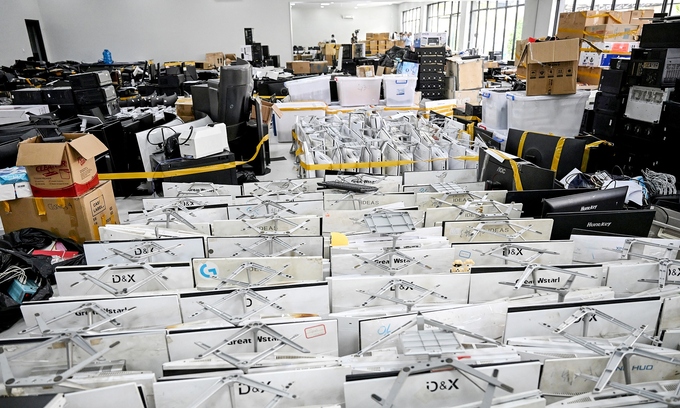
Equipment seized from a scam center is gathered at the Phnom Penh Municipal Police headquarters on March 11, 2026. Photo by AFP
Global spread
The cyberscam industry has ballooned in Southeast Asia in recent years, with organized criminal groups initially mostly targeting Chinese speakers before widening their reach and targeting victims globally.
They also recruit and traffick scammers from around the world, with individuals from at least 80 countries and territories found in scam compounds across the Mekong region, the report said.
AI-powered translation tools have made it easier to reach new audiences but recruits still post advertisements for staff speaking German, Polish, Dutch, Spanish, Italian, French, Swedish and Norwegian, as well as English, it said.
And when the scam centers are raided by authorities, some of the foreigners who work there take their newfound skills back home.
Under pressure from several countries, including the United States, Britain and China, authorities in the region say they are cracking down on the illicit industry.
Several alleged scam network bosses were extradited from Cambodia to China in the past year, after Washington and London sanctioned firms and individuals accused of operating far-reaching cyberscams fuelled by human trafficking.
The report authors said many operations continue despite the arrest of the kingpins, and that some of those released from raided centers take their skills elsewhere.
“It’s always a bit of a thin distinction between victims and whoever has been using their presence in the group to acquire criminal expertise that they’re going to be able to sell,” UNODC regional representative Delphine Schantz said.
“They’re going back to their country of origin and they’re tapping into some existing criminal networks,” she told a news conference, noting that this was happening in Africa as well as Europe, particularly in the Balkans.
Criminal ecosystem
The scam centers are only one part of a wider criminal ecosystem in Southeast Asia that has been transformed over the past decade, the UNODC said.
It encompasses the illegal drug trade — mostly methamphetamine — as well as child sexual exploitation and real estate investment, working through existing trade routes and hiding behind cryptocurrencies, the report said.
Organized criminals are “moving away from a fragmented system of locally rooted criminal syndicates toward an increasingly integrated, transnational, and technologically sophisticated criminal economy”, it said.
The shift has challenged conventional law enforcement and threatened regional governance, as well as economic and social stability.
“Their operating model looks like corporate franchising: imagine specialized departments for laundering money, trafficking people, smuggling migrants, and harvesting data, all plugged into the same, service-based interconnected network,” Schantz said in a statement.