Researchers from the University of Oxford assessed heat risk across 205 cities with populations exceeding one million.
Their framework goes beyond simple temperature exposure by combining three critical factors: heat hazard, population vulnerability, and coping capacity, with the findings recently published in the journal Sustainable Cities and Society.
The study ranks cities based on a composite risk score, an overall rating that merges safety, health, climate, and infrastructure data into a single measure. The higher the score, the greater the combined risk.
Among the 50 cities with the highest composite heat risk, Ho Chi Minh City ranks 16th while Hanoi is placed at 34th.
Within Southeast Asia, HCMC is second only to Quezon City in the Philippines, which ranks fifth worldwide.
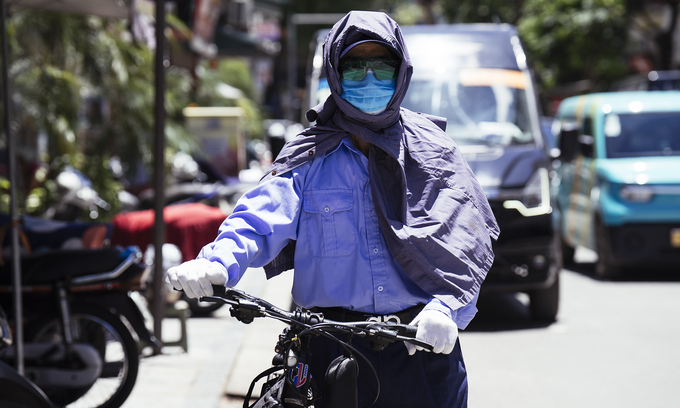
A man shields himself from the scorching sun of Hanoi, May 26, 2026. Photo by VnExpress/Tung Dinh
Vietnam’s southern metropolis recorded the maximum normalized hazard score of 1.00, indicating extremely high heat exposure, while Hanoi received a hazard score of 0.75.
Both cities also scored moderately high on vulnerability and showed limited coping capacity, placing them firmly among the world’s most at-risk urban areas.
Globally, more than 95% of cities in the highest-risk category are in South and Southeast Asia, as well as Sub-Saharan Africa. Topping the global ranking is Iraq’s Al Basrah with a score of 0.83, followed by India’s Ahmadabad (0.79) and Mali’s Bamako (0.78).
Beyond just temperature
Unlike traditional rankings that focus solely on temperature, the researchers assessed heat risk using a broader framework that combines three factors: heat exposure, population vulnerability and a city’s ability to cope with extreme heat.
Heat exposure was measured using the Universal Thermal Climate Index (UTCI), which estimates how hot conditions feel to the human body by accounting for air temperature, humidity, wind and solar radiation. Rather than looking only at the hottest days, the study also considered cumulative heat stress over time, capturing how long and how often people are exposed to dangerous conditions.
The 10 cities exposed to the highest extreme heat risks globally. Graphics by AI
The vulnerability component evaluates how susceptible residents are to heat-related impacts, taking into account demographic and socioeconomic characteristics such as age and income that can influence people’s ability to withstand extreme heat.
The third factor, coping capacity, reflects how well a city can protect its population through measures such as healthcare, infrastructure, access to cooling, green spaces and broader economic resources.
A city’s overall ranking is determined by the combined effect of these three factors, meaning a city with moderate temperatures but high social vulnerability and limited coping capacity may face greater heat risk than a hotter city with stronger infrastructure and more resources to protect residents.
Expert warnings and solutions
Lead author Nethmi Jayaratne Kariyawasam, a researcher at the Oxford Smith School of Enterprise and the Environment, emphasized the need for multi-faceted assessments.
“It isn’t just exposure to hot temperatures that matters for risk,” Kariyawasam stated in the report. “In many major cities, particularly across Asia and Africa, extreme heat coincides with high vulnerability and limited coping capacity. This combination can substantially increase heat risk and, in some cases, have life-threatening consequences.”
The study concludes that reducing heat risk requires more than just lowering exposure. Policymakers need to strengthen urban resilience by expanding green spaces, improving cooling infrastructure, and reducing socioeconomic vulnerabilities.
Dr. Radhika Khosla, who co-supervised the research, also warned against over-relying on air conditioning to solve the problem.
“Air conditioning demand is increasing worldwide, but many cannot afford it. And if we over-rely on this energy-intensive form of cooling, we risk further global warming in a vicious cycle,” Khosla said in the report.
To keep people safe sustainably, she suggests a nuanced approach that prioritizes passive cooling and low-energy technologies, such as fans and evaporative coolers, as a first step.