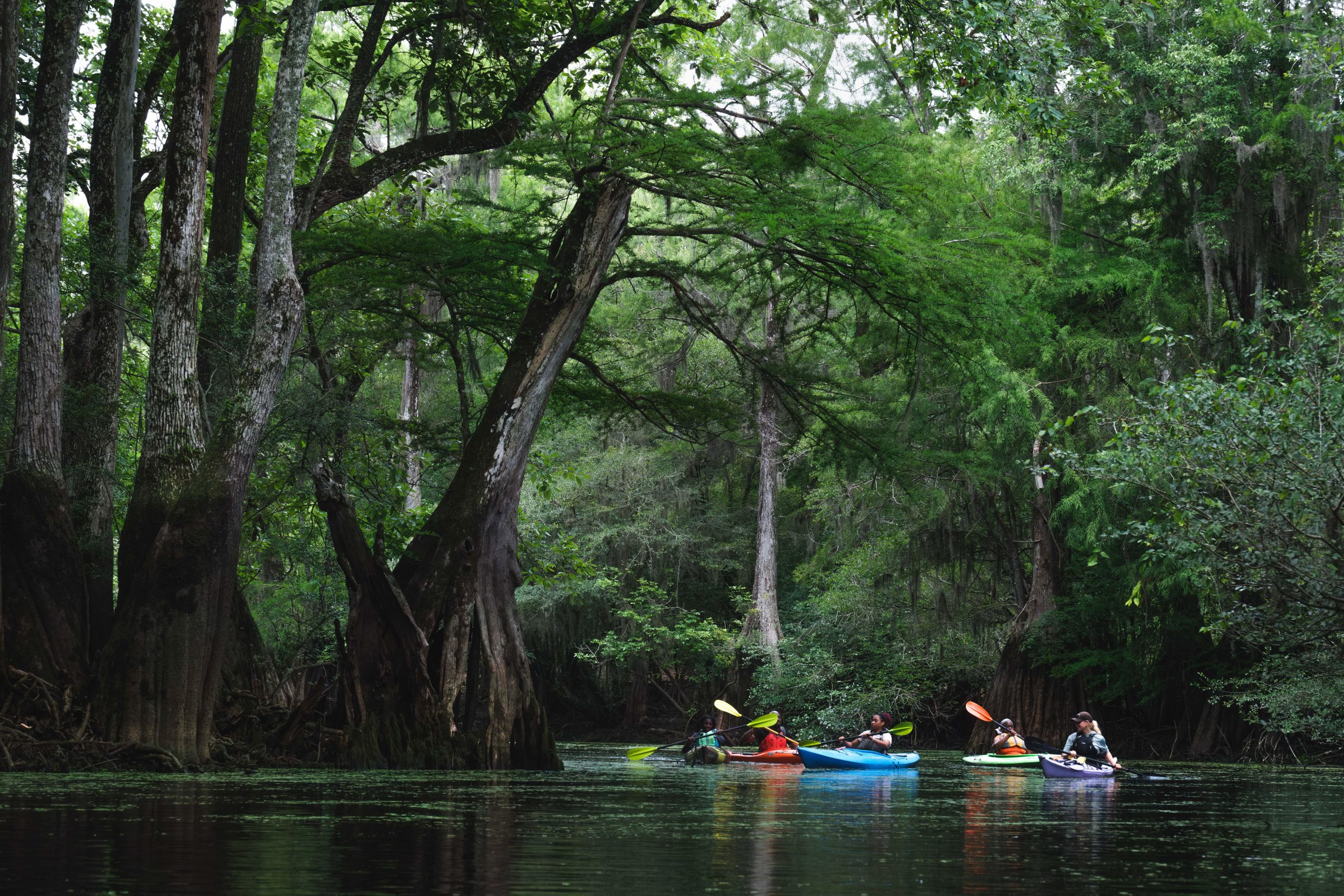
Paddling the slow, black water of Ebenezer Creek feels like traveling through time.
For roughly 13 miles in Effingham County, the creek winds through one of Georgia’s oldest forests, home to some of the last remaining old-growth bald cypress and tupelo trees in the world.
During Juneteenth weekend, Color My Outdoors, a nonprofit dedicated to reconnecting people of color with the outdoors, hosted a kayaking trip through the ancient swamp that holds both extraordinary natural beauty and the memory of one of the Civil War’s least-known tragedies.
“One of the important parts of our work is to tell the stories that have been lost and to rewrite the outdoor narrative,” says CMO founder Simone Adams.
The event drew experienced paddlers and beginners from across the Southeast.
Cypress trees tower overhead at the Tommy Long boat ramp on Ebenezer Creek in Effingham County on June 20, 2026. Credit: Justin Taylor/The Current GA/CatchLight/Report for America
Ananda Williams prepares to exit her kayak during a break in the kayaking trip on Ebenezer Creek in Effingham County on June 20, 2026. The group visited the site of the Ebenezer Massacre to pay their respects to those who died. (Justin Taylor/The Current GA/CatchLight/Report for America)
On a hot Saturday morning, 14 kayaks launched from the Tommy Long boat ramp for a slow four-mile round trip, led by two guides from Savannah Canoe and Kayak.
Along the way, yellow-bellied sliders basked on fallen logs, and alligators slipped beneath the water’s surface as kayakers paddled by. Herons flew along the creek, and songbirds called from deep within the trees. Every autumn, leaves fall from ancient trees, releasing tannins into the water, staining it a dark-tea color and creating the blackwater that defines the creek.
Lesford Duncan with Color My Outdoors points out a rare bird species as he kayaks down Ebenezer Creek in Effingham County on June 20, 2026. Credit: Justin Taylor/The Current GA/CatchLight/Report for America
A black-crowned night heron perches on a branch along Ebenezer Creek in Effingham County on June 20, 2026. Credit: Justin Taylor/The Current GA/CatchLight/Report for America
Naturalist Christian Cave holds up a brown water snake he found in the hollow trunk of a bald cypress tree in Ebenezer Creek in Effingham County on June 20, 2026. Credit: Justin Taylor/The Current GA/CatchLight/Report for America
A yellow-bellied slider suns itself on a mossy stump along Ebenezer Creek in Effingham County on June 20, 2026. Credit: Justin Taylor/The Current GA/CatchLight/Report for America
A prothonotary warbler hangs from the decaying pylon of a bridge that once spanned Ebenezer Creek in Effingham County on June 20, 2026. Credit: Justin Taylor/The Current GA/CatchLight/Report for America
Kayakers with Color My Outdoors paddle down Ebenezer Creek in Effingham County on June 20, 2026.
An alligator slips below the water in Ebenezer Creek in Effingham County on June 20, 2026. (Justin Taylor/The Current GA/CatchLight/Report for America)
Ebenezer Creek’s oldest trees sprouted more than 1,000 years ago, when indigenous people of the Mississippian culture hunted, fished, and traveled along its waters. Centuries later, members of the Yuchi (or Euchee) tribe encountered German-speaking Protestant refugees known as the Salzburgers, who established the nearby settlement of New Ebenezer in 1736.
Kayaker Devin Cowins paddles past the buttress root of a bald cypress in Ebenezer Creek in Effingham County on June 20, 2026. Credit: Justin Taylor/The Current GA/CatchLight/Report for America
By the time of the American Revolution, Ebenezer Creek had become an important route through Georgia’s coastal wilderness, used by soldiers, traders and settlers. Nearby New Ebenezer served as a base for British and Loyalist forces.
In the decades that followed the nation’s fight for its freedom, enslaved people cleared the surrounding forests for plantations as the rice and timber industries transformed the region. Ebenezer Creek and the Savannah River were used to carry lumber, rice and other goods to the port of Savannah.
A kayaker with Color My Outdoors paddles down Ebenezer Creek in Effingham County on June 20, 2026. Credit: Justin Taylor/The Current GA/CatchLight/Report for America
Near the Civil War’s end on Dec. 9, 1864, Union troops, after marching roughly 300 miles from Atlanta to Savannah, arrived at the rain-swollen banks of Ebenezer Creek. Behind them followed hundreds of enslaved people who had escaped plantations, trusting that the Union army would bring them to freedom.
Army engineers built a temporary pontoon bridge, enabling Union troops to cross. As the Confederate cavalry under Maj. Gen. Joseph Wheeler closed in, Union Gen. Jefferson C. Davis ordered the bridge removed before the refugees could cross.
An estimated 600 to 800 Black men, women, and children were trapped between the flooded creek and advancing Confederate troops.
Many rushed into the icy water, hoping to swim across. Others were swept under in the panic. Some survivors were captured and forced back into slavery. No one knows exactly how many people died.
“I sat upon my horse then and witnessed a scene the likes of which I pray my eyes may never see again,” wrote Col. Charles D. Kerr of the 126th Illinois Cavalry, a Union officer who witnessed the event. “Cries of anguish and despair, men, women, and children rushed by the hundreds into the turbid stream, and many were drowned before our eyes. From what we learned afterward of those who remained on land, their fate at the hands of Wheeler’s troops was scarcely to be preferred.”
News of the tragedy at Ebenezer Creek reached Washington, D.C., within weeks. Secretary of War Edwin Stanton traveled to Savannah to question Union Gen. William T. Sherman about what happened. Stanton and Sherman later met with Black ministers and community leaders to discuss the future of newly freed people. Four days later, President Abraham Lincoln approved Sherman’s Special Field Order No. 15, setting aside roughly 400,000 acres of coastal land for formerly enslaved families, giving rise to the promise of “40 acres and a mule.”
Historian and cultural storyteller Alma Busby-Williams speaks to a group of kayakers near the site of the Ebenezer Massacre during a Juneteenth weekend kayaking trip on Ebenezer Creek in Effingham County on June 20, 2026. Near this stretch of the creek, Union Gen. Jefferson C. Davis ordered a pontoon bridge removed in December 1864, trapping hundreds of formerly enslaved refugees between the flooded creek and advancing Confederate troops.
Kayakers paddle among the remains of a wooden bridge that once stretched across Ebenezer Creek in Effingham County on June 20, 2026. The weathered pylons mark the site where hundreds of Black refugees drowned or were recaptured in December 1864 after Union troops removed a pontoon bridge.
Lyn Benoit, Simone Adams and Christian Cave sit in kayaks among the remains of a bridge along Ebenezer Creek in Effingham County on June 20, 2026. The pair paddled to the site of the Ebenezer Massacre during a Juneteenth weekend kayaking trip. Credit: Justin Taylor/The Current GA/CatchLight/Report for America
Today, the skeleton of an old bridge is all that remains at the site of the tragedy.
For Leandra Taylor, board president of CMO, the Juneteenth trip was about ensuring that history is remembered while allowing people to experience the creek in a way that celebrates resilience.
“We really want to bring some visibility to this story and pay our respects in a way of joy and commemoration,” Taylor said.
For Adams, reconnecting people with places like Ebenezer Creek is about more than spending time outdoors. It is about restoring a relationship with the natural world where generations of people of color hunted, fished, farmed, worked, and lived, before many came to believe those places were not meant for them.
“People of color are the original stewards of the land,” Adams said. “We all have ancestral ties to the land. Many of us have been disconnected from that. We want to showcase that yes, we belong in these spaces, we thrive in these spaces, we’ve been leaders in these spaces and stewards of the land for a long time.”
Kayakers with Color My Outdoors paddle down Ebenezer Creek in Effingham County on June 20, 2026. Credit: Justin Taylor/The Current GA/CatchLight/Report for America
Support Our Work
Nonprofit, independent journalism needs YOUR support to survive and thrive. Help us achieve our mission of creating a more informed world by making a one-time or recurring donation today.