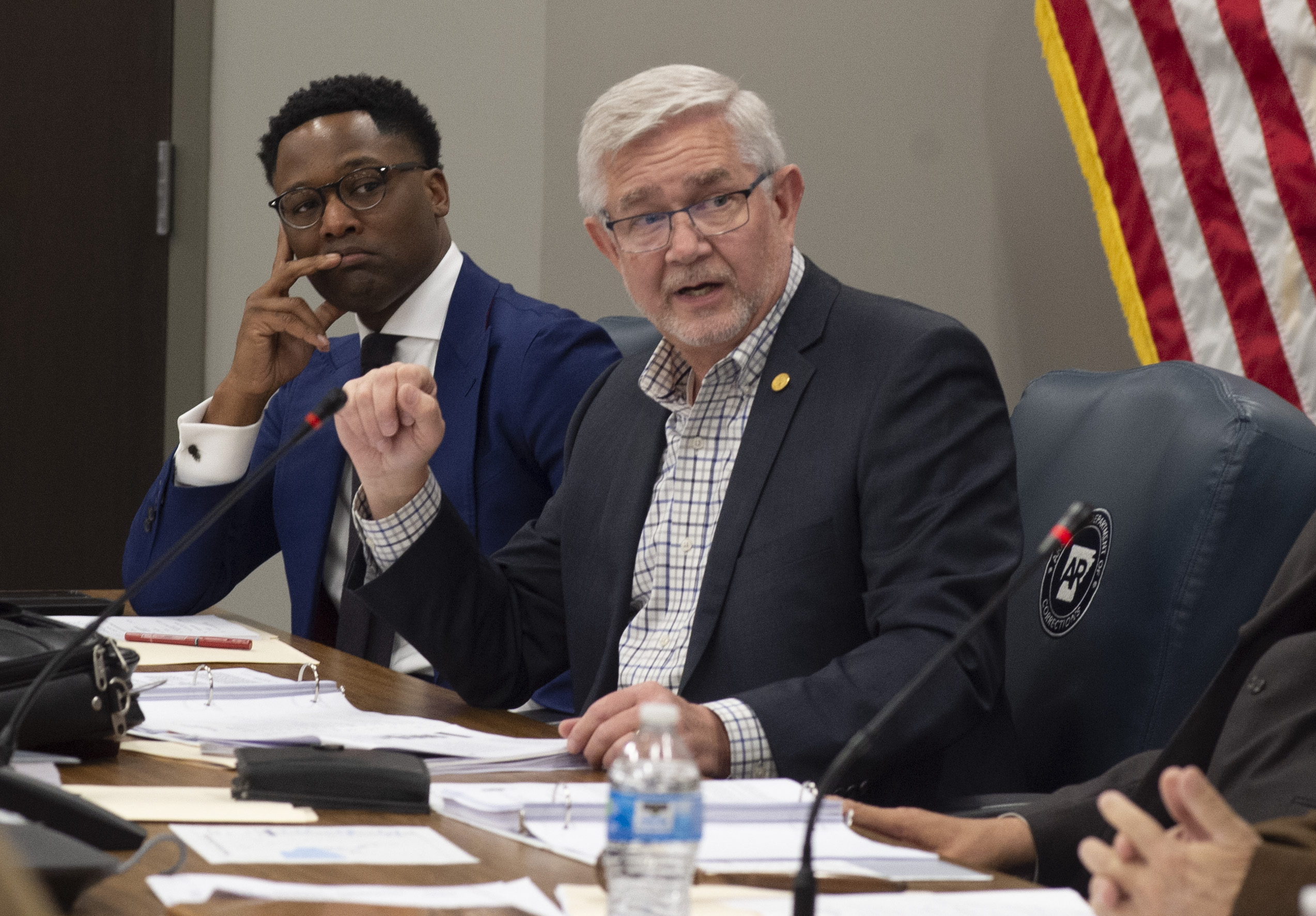
Lee Watson and Benny Magness, having never gotten an opportunity to defend themselves, have been found to have violated the state Freedom of Information Act.
Such was a 5-2 decision from the state Supreme Court on Thursday that sided with the state Attorney General’s office, which had offered two settlements to the state Board of Corrections in March.
One of the settlements, now approved by the Supreme Court, required the board to agree that Watson and Magness broke the FOIA in 2023 when they discussed hiring an attorney to sue Gov. Sarah Sanders over two state laws that transferred much of the board’s authority to the governor.
Watson, a current board member, and Magness, now retired from the board, have denied the allegation and said it was not right that the board had basically entered a guilty plea on their behalf and that they had not been able to defend themselves.
The two had asked to intervene in the matter in hopes of making their defense, but that effort was also precluded by the Supreme Court’s decision. Watson and Magness had also claimed that the board could not agree to any settlement because the board did not have legal representation. The board has a staff attorney, Thomas Burns, but he has said he doesn’t have the resources to take on the case.
Watson said Friday he and Magness are reviewing their options.
“We are considering a new legal action to void the settlement agreement’s false statement about us,” Watson said. “Unfortunately, that will require us to file suit against the current board and the attorney general in order to clear the false label stuck on us.”
The second settlement involves a lawsuit between the governor’s office and the board over the two state laws – Acts 185 and 659 – that took much of the board’s authority away and gave it to the governor. The board sued over the matter, and Pulaski County Circuit Judge Patricia James ruled in its favor that the two acts were unconstitutional because they violated Amendment 33 of the state Constitution. But now the board, by agreeing to the settlement, did an about face, saying the acts were not unconstitutional. The case is now headed back to James.
Last summer, Attorney General Tim Griffin, who has worked to expand Sanders’ authority, said he had no interest in settling the cases. But he changed his tune and offered settlements once the makeup of the board changed, with four of the seven members appointed by Sanders. Not surprisingly, those four voted to accept the settlements, trumping the three “no” votes from the members who were appointed by previous governors.