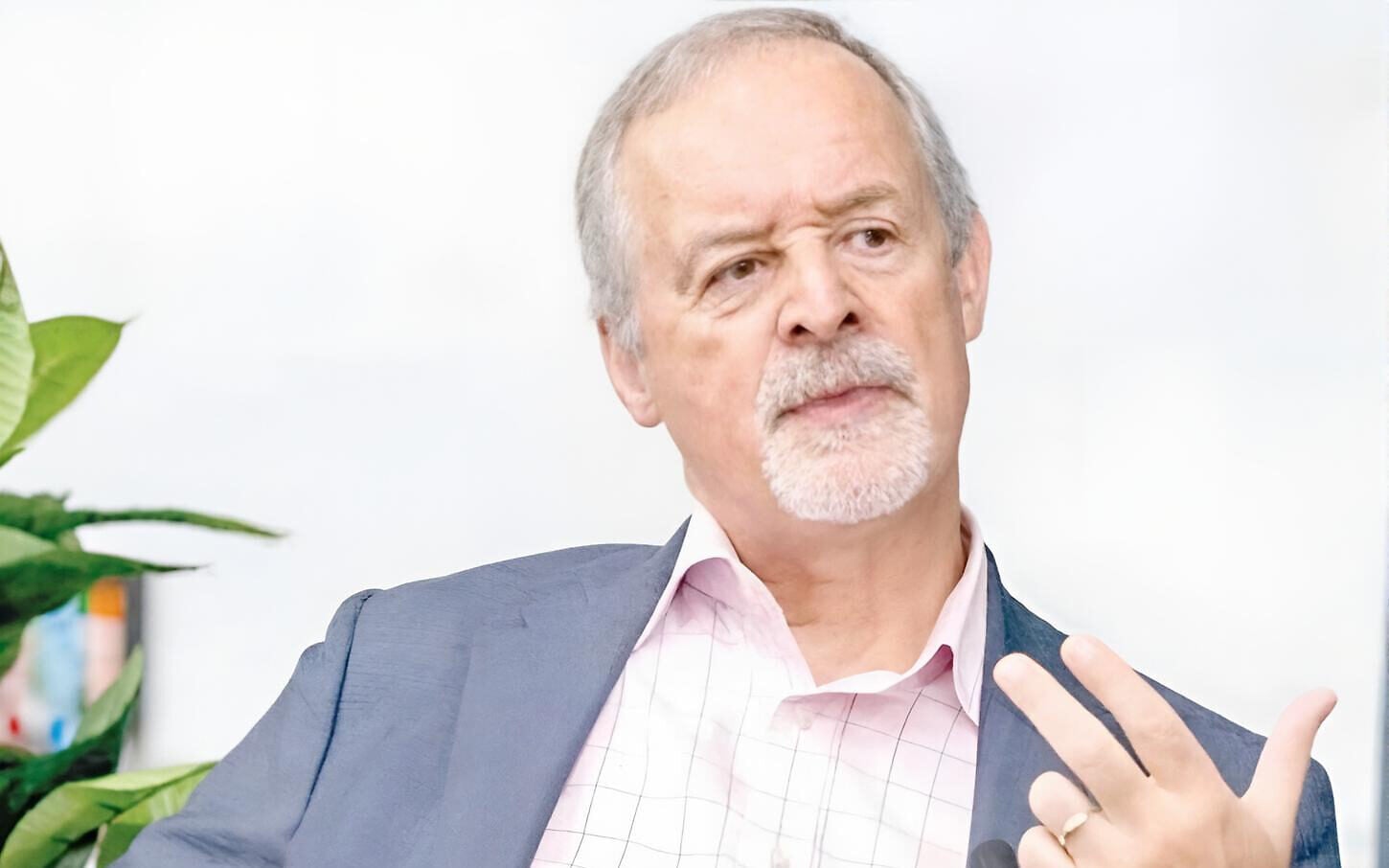
LONDON — For much of his 30-year career in diplomacy, Edmund Fitton-Brown represented his country in some of the Middle East’s most volatile areas. Now, the former UK ambassador to Yemen believes there is a “loss of clarity” in his country’s Foreign Office about who Britain’s friends and enemies are. He points his finger at Islamist entryism into the country’s civil service and wider society.
Fitton-Brown also says outgoing Prime Minister Keir Starmer’s record on Israel, the Middle East, and tackling extremism and antisemitism at home has been “disappointing,” but he is “guardedly optimistic” that his likely successor, Andy Burnham — who has already said he would consider additional sanctions on Israel — will perform better.
Over his decades-long career, Fitton-Brown has held postings in Egypt, Kuwait, Saudi Arabia and the United Arab Emirates. After leaving Yemen in 2017, he joined the United Nations, serving as coordinator of the Security Council team responsible for sanctions and threat assessment on ISIS, al-Qaeda and the Taliban.
In March, Fitton-Brown said in the Daily Telegraph newspaper that parts of Britain’s civil service have “a systematic bias when it comes to the Middle East,” and that Israel is treated with a “forensic level of scrutiny” that few other states receive, while the behavior of its adversaries is frequently “contextualized, rationalized, excused or ignored.”
He says the Foreign Office’s “lack of clarity” about who Britain’s enemies are was symbolized by the fact that, just weeks after the Iranian regime reportedly killed thousands in mass protests in January, staff from the department attended a reception at the Iranian Embassy in London celebrating the anniversary of the 1979 Islamic Revolution.
Retired from public service and currently a senior fellow at the US-based Foundation for Defense of Democracies think tank, Fitton-Brown is a rare voice in the UK diplomatic establishment who has been willing to lift the lid on, and openly criticize, what he terms “a really pronounced drift towards an unconditional pro-Palestinian perspective” in the Foreign Office, itself a reflection of a shift in the wider civil service and public bodies, including law enforcement, academia and schools, and the National Health Service.
Starmer and statehood
Last July, more than 30 former UK ambassadors and 20 former senior British diplomats at the United Nations wrote an open letter to Starmer calling on the government to immediately recognize a Palestinian state.
Fitton-Brown, by contrast, publicly condemned such a step as “misguided,” arguing: “In the aftermath of the October 7 massacre, statehood recognition would be at best an empty gesture, at worst a reward for terrorism.”
Despite Labour’s manifesto seeming to rule out Palestinian recognition outside a formal peace process, the UK joined France, Portugal, Canada and Australia in making the move late last summer.
The former ambassador believes the Foreign Office was sympathetic to recognition of a Palestinian state but that Starmer was, in part, motivated by political considerations, given pressure from the parliamentary party and the perceived need to stem Labour’s loss of support among Muslim voters.
Britain’s Prime Minister Keir Starmer (R) shakes hands with Palestinian Authority President Mahmoud Abbas at the beginning of their meeting at 10 Downing Street in London on September 8, 2025. (Photo by Jonathan Brady / POOL / AFP)
“I suspect Starmer had reservations about this but, in the end, so many people came to him and said it’s the right thing to do,” Fitton-Brown says, suggesting that the prime minister lacked the “confidence in his own judgment” to resist.
Addressing Starmer’s overall record, he says: “I don’t think he’s been terrible. I think he’s been disappointing. I think his own instincts are not bad. I certainly don’t think he is guilty of any personal prejudice or animus against Israel or indeed particular sympathy or softness [toward] bad actors in the Middle East. The problem is that he’s a poor leader. He hasn’t led with any real decisiveness or confidence and, of course, he’s leading a party that has got so many people in it who are very bad on this issue.”
A Tehran turnaround needed
Fitton-Brown says Starmer has demonstrated “indecisiveness” when it came to Tehran, noting that it has taken nearly two years to bring forward legislation to proscribe Iran’s Islamic Revolutionary Guard Corps, while London remains “a center of sanctions evasion” with little action to address “the huge amounts of regime money” in the UK. It is, the former ambassador notes, “incredible” that the Iranian ambassador to Britain remains in the UK after his embassy had reportedly urged British-based Iranians to sign up for a controversial “martyrdom” program. Instead, the ambassador received “nothing more than a ticking off” from the Foreign Office.
Fitton-Brown also faults Starmer for failing to act when Iran shut the Strait of Hormuz at the outset of the conflict with Israel and the US. The prime minister, he believes, should have said: “This is an act of war, an intolerable infringement of the law of the sea and the right of commercial shipping to transit the high seas, and we’re going to go all in to force Iran to back down on this.”
Nonetheless, he believes the prime minister was right to keep Britain out of the conflict.
“Trump made it impossible,” says Fitton-Brown. “He did it without consultation [and] without any regard for what the legal requirements or restrictions might be for his allies.”
Fitton-Brown believes that while Burnham’s “instincts” on foreign policy are probably similar to those of the outgoing prime minister, his “readiness to face down bad advice and his leadership and communication skills” are superior to Starmer’s. “Unlike Starmer, he might have the ability to lead from the front and bring the [Labour] party with him,” he says.
Labour Party’s Andy Burnham gestures as he delivers a speech at the People’s History Museum in Manchester, England, Monday, June 29, 2026.(AP Photo/Alastair Grant)
He urges Burnham to “stick close to the European Union when the EU is getting it right,” noting that Brussels proscribed the IRGC before Britain and continues to take a hard line regarding Iranian sanctions, suggesting that Tehran’s behavior doesn’t warrant the relief Trump is preparing to give it. He adds that Burnham should join Britain’s European allies in opposing any suggestion that Iran be allowed to charge tolls or fees for shipping through the Strait of Hormuz, which he calls “a protection racket.”
Beating back runaway antisemitism
Fitton-Brown is also hopeful that Burnham will “grapple with the issue of antisemitism,” which he believes is going to be “one of the defining issues of the remainder of this parliament.”
“Since October 7, 2023, a curtain was ripped open on what had been incubating in Britain over the previous couple of decades,” Fitton-Brown says, adding that the scenes that have unfolded, including “borderline violent, definitely intimidatory” mass demonstrations, have been a “shock to a lot of middle-of-the-road Brits.”
Anti-Israel protesters, one wearing a shirt reading ‘Death, death to the IDF,’ gather outside the High Court in London on July 4, 2025. (BENJAMIN CREMEL / AFP)
He notes that, as mayor of Greater Manchester, Burnham has been “good on antisemitism and good on counter-terrorism,” as has been the region’s police force. He contrasts Greater Manchester’s police with that of the West Midlands, which “disgraced itself” with a controversial decision to ban Maccabi Tel Aviv fans from attending an away match in Birmingham last November.
“I don’t think that would have happened in Manchester,” Fitton-Brown says. “I don’t think Burnham would have let it happen. I don’t think the Greater Manchester Police would have let it happen.”
Radical infiltration
Fitton-Brown says he remains deeply concerned about the UK’s longstanding failure to tackle Islamist extremism. When he was in the diplomatic service, concerns raised by moderate Arabs in Egypt, and later in the UAE, about Muslim Brotherhood extremists operating in Britain largely fell on deaf ears back in London.
Islamist extremism, Fitton-Brown says, frequently falls into the civil service’s “too difficult to handle” box. It is also, he believes, the result of Islamist entryism into the Foreign Office, civil service and other public bodies. DEI policies and the establishment of officially sanctioned networks for minority groups within the civil service have helped enable this process.
Minority caucuses, he notes, have gone beyond discussing issues such as combating discrimination in recruitment to, for instance, expressing opposition to the government’s approach to the conflict in Gaza.
“The Muslim Brotherhood understood what it was doing,” he says. “It understood that… it wanted as strong a caucus as possible… within the civil service, the wider public service, the police, teaching, the NHS, academia.”
In March 2024, then-deputy prime minister Oliver Dowden suspended the Civil Service Muslim Network after reports that, in a series of meetings, hundreds of civil servants discussed how to force the government to change its policy on the Israel-Gaza war. The meetings featured “numerous antisemitic tropes,” The Times newspaper reported. More recently, concerns have been raised about the National Association of Muslim Police, following revelations that the body, which represents Muslim members of the police force, published a policy paper that called the IDF a “Zionist terrorist group.” It further claimed Zionists “misuse the Holocaust” and argued that “Zionism represents one of the manifestations of anti-Muslim hatred, stripping Muslims of their humanity.”
The former diplomat accepts that allegations of anti-Israel bias in the Foreign Office aren’t new, but believes it has “gotten worse” over the past decade — and attributes this, in part, to the UN and a loss of British self-confidence post-Brexit.
“If the Foreign Office is very much influenced by one external organization, it’s probably the United Nations — and the United Nations, of course, is deeply suspect on all issues related to Israel and actually probably on most issues relating to the West,” says Fitton-Brown.
Illustrative: Supporters of Jordan’s Muslim Brotherhood take part in a protest in the village of Sweimeh on May 21, 2021, to express their solidarity with Palestinians. (Photo by Khalil MAZRAAWI / AFP)
“All of this bleeds back into the Foreign Office because Britain… lacks the self-confidence to say, ‘We know best and we know when the UN is right, and we back it up… and we also know when it’s wrong,’” he says.
During the course of the Gaza conflict, more than 300 Foreign Office staff reportedly wrote a series of letters to government ministers and their departmental bosses accusing Israel of violating international humanitarian law and warning of Britain’s potential “complicity” and contribution to “the erosion of global norms.”
But, the former ambassador concludes, this shouldn’t disguise the continuing presence of a “pretty strong body of opinion within the Foreign Office that is very much as it’s always been — staunchly Atlanticist, staunchly pro-NATO, very much pro-Ukraine, very much anti-Iran, anti-Hezbollah and anti-Houthi.”