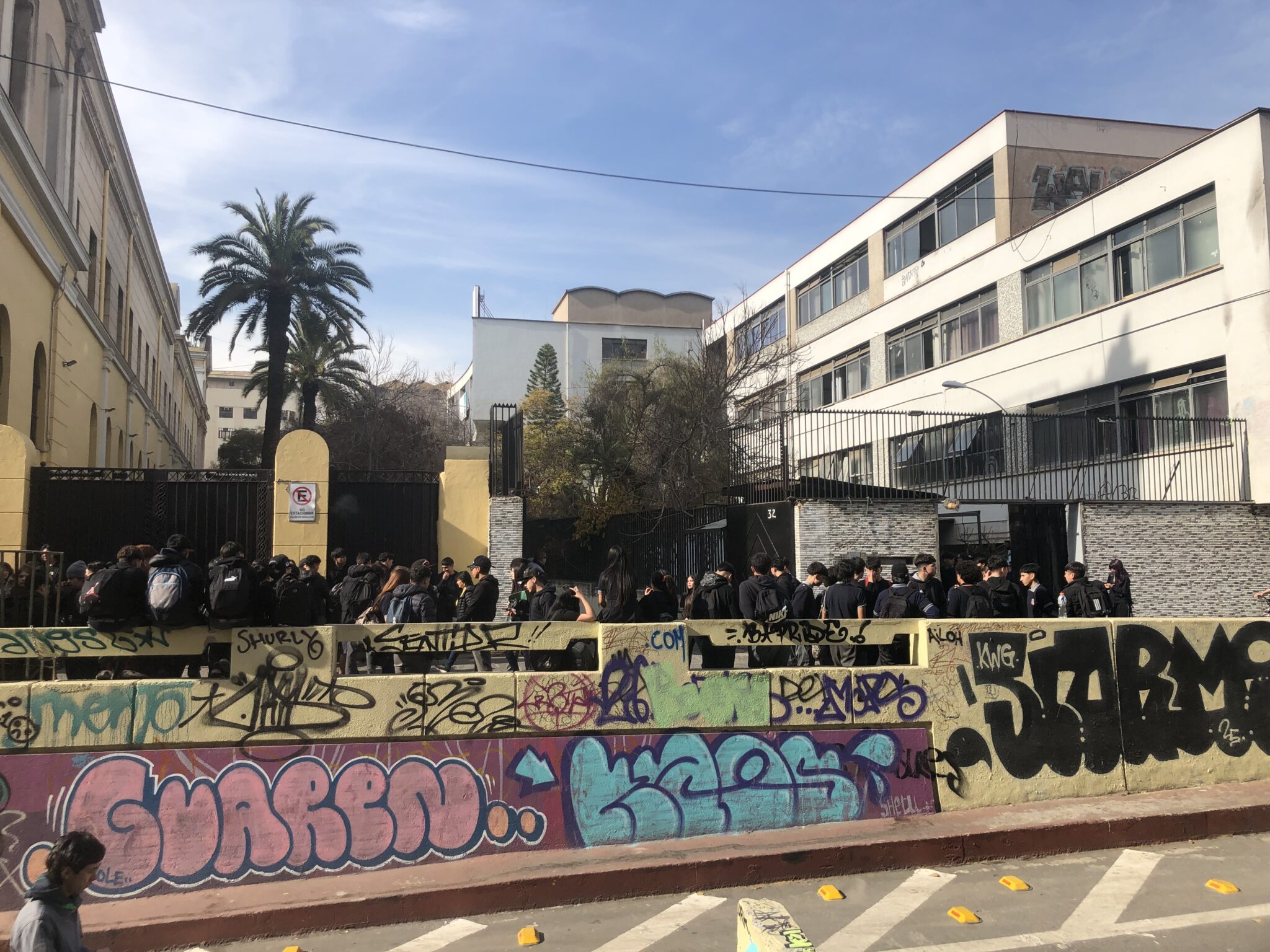
Students at the entrance to the National Institute on Santiago’s Alameda Avenue, near the presidential palace, La Moneda. The National Institute is a free public school that has educated dozens of prominent Chilean figures. Image: Orlando Milesi / IPS
By Orlando Milesi (IPS)
HAVANA TIMES – Chile’s government, led by far-right President Jose Antonio Kast since March, is pushing measures that roll back the rights of children and adolescents in an effort to curb juvenile crime, while abandoning preventive policies aimed at addressing the root causes of rising youth violence.
On June 2, the right-wing majority controlling Chile’s National Congress passed the Protected Schools Law, which among other measures will allow metal detectors to be installed at the entrances of elementary schools and high schools.
The stated goal is to reduce violence in educational institutions, but critics argue the law primarily targets students from working-class neighborhoods. They point out that these students are the ones who would suffer from losing social and educational benefits, whereas students from middle- and upper-class families would be largely unaffected by such penalties.
However, the Constitutional Court, an autonomous and independent high court, struck down several provisions of the law, declaring unconstitutional police searches of students’ backpacks without a warrant, restrictions on free university tuition for accused students, and bans on certain types of clothing.
The installation of metal detectors in schools will not take effect immediately, as regulations implementing the law must first be drafted and published. The measure is expected to be in place by the next school year, beginning in March 2027.
Lawmakers from the governing right are also seeking to lower the age of criminal responsibility from 14 to 13, while the government has announced plans to create a registry of vandals for people who commit acts of incivility. The registry would include penalties such as the loss of social benefits.
“The only policies proposed in recent months have been aimed at criminalizing the student movement, segregating students, increasing punishment, lowering the age of criminal responsibility, and restricting freedom of expression and organization,” said Laura Mlynarz.
Catalina Droppelmann, a professor at the School of Government at the private Catholic University, told IPS that all of these initiatives take a punitive approach toward young people.
“They are young people who already have very few opportunities, suffer from mental health disorders, suicidal thoughts, and have extremely limited expectations for the future,” she said. “Now they are being subjected to punitive policies that, instead of integrating them, punish them and push them further away from education and social inclusion.”
Regarding the proposed registry of vandals, Droppelmann said it would further stigmatize young people for conduct that is already punishable under existing laws.
“The loss of social benefits only deepens existing processes of exclusion and symbolizes the state’s failure to recognize these young people as citizens deserving of social protection,” added Droppelmann, who directs the Catholic University’s Justice and Society Center.
Laura Mlynarz, president of the Student Federation at the public University of Chile, believes the government’s policies portray young people and students as being responsible for the country’s security crisis rather than organized crime, drug trafficking, or corruption networks.
“The only policies proposed in recent months have been aimed at criminalizing the student movement, segregating students, increasing punishment, lowering the age of criminal responsibility, and restricting freedom of expression and organization,” she told IPS.
She added that the new law conflates two different issues: violence and coexistence problems within schools, and the broader public security crisis.
“We recognize that there is significant violence in schools and believe it is urgent to legislate and discuss that issue, but the priority should be listening to educational communities—and the government is not doing that,” she said.
For Ximena Gauche, a law professor at the private University of Concepción, young people are more often victims than perpetrators of extremely serious crimes.
Speaking to IPS from the southern city of Concepcion, she said violence in high schools is a highly complex reality that requires examining its underlying causes, beginning with the difficult conditions faced by thousands of children across Chile.
She argued that “serious incidents of poor coexistence and even school violence stem from violent family environments, the absence of love and emotional support, the lack—or complete absence—of essential goods and services needed for healthy development and daily well-being, as well as the shortage of resources affecting many schools.”
The busy Plaza Egaña Metro station in the southern outskirts of Santiago. Throughout the station and on trains, printed notices and loudspeaker announcements urge passengers to report any harassment or criminal activity they witness. Image: Orlando Milesi / IPS
Young People Face Abuse and Excesses
The violent environment in which many young people live was documented in the 2026 report by Chile’s Children’s Ombuds Office, an autonomous institution that analyzed the situation of children and adolescents in this South American country of 18.4 million people.
Between 2019 and 2025, the number of children and adolescents subjected to sexual abuse rose by 46.4 percent, reaching 28,969 cases. Last year alone, authorities recorded 1,099 cases of sexual harassment and 5,058 rapes.
In 2024, 15.1 percent of adolescents experienced cyberbullying, while between 2022 and 2024 the rate of children and adolescents who were victims of sexual exploitation increased by 73 percent, partly because the previous leftist administration of President Gabriel Boric expanded monitoring and reporting.
In 2025, Chile’s Education Superintendency received 17,076 complaints involving violence in schools.
Children’s Ombudsman Anuar Quesille said the report “forces us to ask whether current public policies are responding to the reality experienced by children and adolescents today.”
“Chile needs to update its institutional responses and recognize that protecting children requires political, budgetary, and territorial priority,” he stressed.
Criminalizing Children
Children’s participation in robberies—often orchestrated by adults—is featured daily on privately owned television networks, fueling calls to lower the age of criminal responsibility.
The Chamber of Deputies has approved resolutions urging the executive branch to reduce the age of criminal responsibility from the current 14 to 13. Leaders of the far-right Independent Democratic Union (UDI), a governing ally, have even proposed lowering it to 12.
Lawmakers are also debating tougher prison sentences and placing 16- and 17-year-olds under the adult criminal justice system.
Student leader Mlynarz emphasized that violence has not been addressed through community-based or preventive measures but almost exclusively through punitive policies.
“With this approach, we will never address the underlying reasons why a 12 or 14-year-old becomes violent. There must be opportunities for rehabilitation, and education plays an essential role. It is the key factor in reintegration and inclusion, allowing community-based public policies to prevent violence,” she argued.
She believes that “lowering the age of criminal responsibility or taking away free education because of actions committed during one’s school years runs completely contrary to what should be done.”
“What these policies do is segregate, divide, deny opportunities for rehabilitation, and fail to recognize that education is a tool for preventing violence and promoting social integration,” Mlynarz criticized.
Professor Gauché argued that criminal responsibility at such an early age remains the subject of ongoing criticism because there is little evidence that it is effective.
“Civil society organizations and international bodies continue to remind us that modern human rights standards reflect broad consensus that must be taken into account,” she said.
Graffiti in the pedestrian tunnel beneath Alameda Avenue on Bandera Street in downtown Santiago. Such graffiti has been classified as an act of incivility that could lead to inclusion in the proposed registry of vandals, with penalties including the loss of access to social benefits. Image: Orlando Milesi / IPS
Registry of Vandals: Classist and Ineffective
Rodrigo Bustos, executive director of Amnesty International Chile, described the proposed registry of vandals as deeply classist because it includes penalties such as withdrawing benefits, including free education.
Such penalties are meaningless for those who do not rely on the state, in other words, the wealthiest sectors of society.
“What would be the equivalent sanction for them? The question has no answer, and that is no minor detail, it represents inequality before the law,” he said.
He added that because the measure disproportionately affects poor students, Chile risks violating its international obligations.
“We must not forget that education is an inalienable human right and an indispensable means for exercising other human rights,” he said.
According to Bustos, depriving someone of social benefits does not make them a better citizen; it pushes them further to the margins. Rather than reducing acts of incivility, the registry of vandals creates conditions for them to continue.
The National Barros Arana Boarding School, a public school in Santiago’s working-class district of Quinta Normal. Founded in 1902, it was created to house students from other regions who came to Chile’s capital to study. Image: Orlando Milesi / IPS
Violence Against Young Workers
Makarena Albornoz, Youth Affairs Secretary of Chile’s United Workers’ Confederation (CUT), told IPS from the southern city of Valdivia that labor precarity is the defining form of violence affecting young people.
“Work in Chile is under strain because of labor precariousness and new employment practices. Flexible work arrangements, the lack of stable contracts, temporary, informal, and hourly jobs are becoming more common. Young people struggle to get their first job or to find work that matches their qualifications,” she said.
According to Albornoz, violence also manifests itself through “harassment, abuse, and intimidation, all of which have serious consequences for young workers. It affects their mental health, causes stress and depression, reduces motivation and productivity, and many end up leaving their jobs in search of other alternatives.”
She added that this climate of violence creates fear and insecurity, particularly when it comes to reporting abuse.
“Young people often prefer to remain silent. It hinders workers’ development and career growth, increases turnover, leads people to abandon their jobs, and pushes them to seek other forms of employment,” she explained.
The union leader advocates for workplace protocols that allow workers to report harassment and violence in order to prevent such behavior from escalating and to help create workplaces free of violence.
First published by IPS and translated and posted in English by Havana Times.
Read more from Chile here on Havana Times.