By Wilson Musa
YAOUNDÉ, Cameroon-Recent criminal complaints filed abroad against Cameroonian President Paul Biya by opposition figure Issa Tchiroma Bakary have renewed public debate over universal jurisdiction; a legal doctrine that, under certain circumstances, allows national courts to investigate and prosecute genocide, war crimes, crimes against humanity and torture committed outside their own territory. The complaints are allegations, and no foreign court has ruled on their merits or determined criminal responsibility.
The renewed attention has prompted many Cameroonians to ask whether foreign courts can genuinely prosecute crimes allegedly committed in another country and whether such legal action has succeeded before.
The short answer is yes; but only under specific legal conditions, and there are numerous precedents involving African political figures, military officials and rebel commanders.
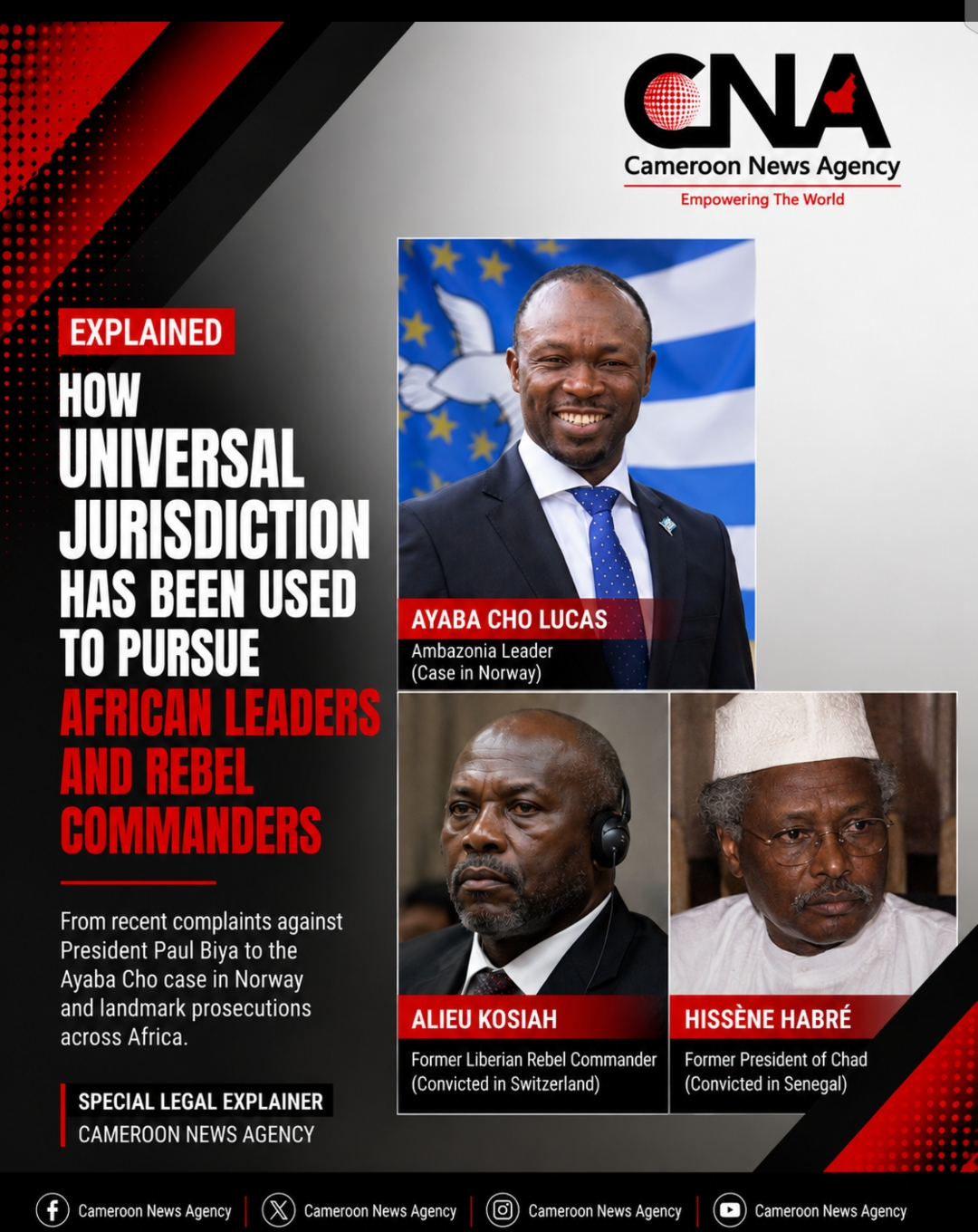
One of the most recent examples is unfolding in Norway, where Cameroonian separatist leader Ayaba Cho Lucas is facing criminal proceedings over alleged crimes committed during the conflict in Cameroon’s North West and South West regions.
Ayaba, founder of the Ambazonia Defence Forces (ADF), was arrested by Norwegian authorities in September 2024 following an investigation by Norway’s National Authority for Investigation and Prosecution of Economic and Environmental Crime (Økokrim). Prosecutors allege he encouraged or contributed to serious violations of international humanitarian law, including war crimes and crimes against humanity. Ayaba has denied the allegations, and the proceedings remain before Norwegian courts, meaning no verdict has yet been delivered.
The case illustrates one of the defining characteristics of universal jurisdiction: a country may investigate and prosecute an individual found on its territory for certain international crimes even when the alleged offences occurred abroad and involved foreign victims and foreign nationals, provided its domestic laws permit such action, a legal expert told CNA but begged not to be named for the sensitivity of the report.
Norway is far from alone in applying this doctrine.
In 2021, Switzerland’s Federal Criminal Court convicted former Liberian rebel commander Alieu Kosiah of multiple war crimes committed during Liberia’s first civil war. Kodiak, who had lived in Switzerland before his arrest, was found guilty of crimes including murder, cruel treatment, acts of terrorism, pillage, rape and the recruitment of child soldiers. The court sentenced him to 20 years’ imprisonment, making it one of Europe’s landmark universal jurisdiction convictions involving crimes committed in Africa.
Another significant Swiss case involved Ousman Sonko, the former interior minister under Gambian President Yahya Jammeh. After seeking asylum in Switzerland, Sonko was arrested following complaints by human rights organisations. In 2024, Switzerland’s Federal Criminal Court convicted him of crimes against humanity for offences linked to his period in government, reinforcing Switzerland’s growing role in prosecuting international crimes under universal jurisdiction.
Which leader has been persecuted before?
While the proceedings in Norway and Switzerland have drawn renewed attention to universal jurisdiction, they are part of a broader international effort spanning decades to prosecute individuals accused of the world’s gravest crimes when domestic courts are unable or unwilling to do so.
One of the most significant African accountability cases is that of Hissène Habré. Unlike the Swiss and Norwegian cases, Habré was not prosecuted under the traditional framework of a European court exercising universal jurisdiction. Instead, he was tried before the Extraordinary African Chambers, a special tribunal established within Senegal’s court system with the backing of the African Union.
After years of legal battles, Habré was convicted in 2016 of crimes against humanity, war crimes and torture committed during his rule over Chad between 1982 and 1990. He was sentenced to life imprisonment, marking the first time a former African head of state was tried and convicted in another African country for international crimes. The judgment was widely hailed by human rights organisations as a milestone in the fight against impunity and demonstrated that senior political leaders could be held accountable for alleged atrocities committed while in office.
Belgium was among the first European countries to adopt expansive universal jurisdiction legislation in the 1990s. The law initially allowed Belgian courts to investigate international crimes regardless of where they occurred or the nationality of those involved.
The legislation led to several high-profile complaints involving African conflicts, including cases linked to Rwanda and the Democratic Republic of Congo. Although Belgium later narrowed the scope of its law following diplomatic pressure and legal reforms, it remains an important reference point in the development of universal jurisdiction.
Germany has also emerged as one of Europe’s leading jurisdictions for prosecuting international crimes through its Code of Crimes against International Law. German prosecutors have used the legislation primarily in cases involving Syria and Iraq, but the country’s legal framework illustrates how universal jurisdiction has become an increasingly accepted mechanism for addressing genocide, war crimes and crimes against humanity where national justice systems fail to act.
Legal experts caution, however, that universal jurisdiction is neither automatic nor unlimited.
See related article: https://cameroonnewsagency.com/explainer-can-switzerland-investigate-alleged-crimes-committed-in-cameroon/
Most countries impose strict legal conditions before opening investigations. In Switzerland, for example, authorities generally require that a suspect be present on Swiss territory before prosecutors can proceed. Other jurisdictions apply similar requirements or assess whether another country or international tribunal is better placed to investigate the allegations.
Questions of immunity also remain important. Under international law, serving heads of state and certain senior state officials may enjoy immunity from the criminal jurisdiction of foreign national courts while they remain in office. Once they leave office, that protection may become more limited depending on the nature of the alleged crimes, the forum hearing the case and the applicable domestic and international legal rules.
For that reason, legal scholars stress that every universal jurisdiction case turns on its own facts, the evidence available and the legislation of the country hearing the matter. The existence of a criminal complaint does not automatically lead to an arrest, prosecution or conviction.
The recent complaints targeting President Paul Biya, the proceedings against Ayaba Cho Lucas in Norway and earlier prosecutions in Switzerland have nevertheless placed universal jurisdiction at the centre of legal and political discussions involving Cameroon.
Whether any individual is ultimately convicted depends not on political debate but on judicial proceedings, admissible evidence and the application of international and domestic law.
As international cooperation on accountability continues to expand, universal jurisdiction is likely to remain one of the most significant legal tools available to prosecute alleged perpetrators of genocide, war crimes, crimes against humanity and torture when justice cannot be achieved where the crimes were allegedly committed.
For African countries grappling with conflict, political violence and historical abuses, the growing use of the doctrine signals that allegations of the most serious international crimes are increasingly capable of crossing borders, even when the crimes themselves did not.